Expresando Preferencias con Gustar, Encantar y Odiar
Clase 2 de 17 • Curso de Inglés Básico A2: Preguntas y Respuestas Comunes
Contenido del curso
Clase 2 de 17 • Curso de Inglés Básico A2: Preguntas y Respuestas Comunes
Contenido del curso

Claudia D.

Gina Pedraza

Sarah Daniela Zafrani Lamoth

Angie Figueroa Berbesi
Miguel Andres Rendon Reyes

Violeth Valmont Azahar

Diego Ademir Duarte Santana
Yoselin Nieto

Francisco Javier Rodriguez Gomez

Roxana Janet Nuñez Tito
Sarah Daniela Zafrani Lamoth
Sarah Daniela Zafrani Lamoth

Alan Díaz Díaz

Valeria Schembri
Sarah Daniela Zafrani Lamoth

Mi Chu
Gina Pedraza

Alberto José León Castelli

Martin Salomon

Andres Felipe Cogollo Hincapie

Paola Alapizco

Carlos Emmanuel Córdoba
Gina Pedraza
Sarah Daniela Zafrani Lamoth
Katheryn Alejandra Gomez Girón

Edwin Pérez

José Eduardo Juárez Cárdenas
Monica Marcela Mieles Montenegro

Jose Orozco

Leidy Vaneza Vicente Ccorimanya
Gina Pedraza
Leidy Vaneza Vicente Ccorimanya

Maria Alejandra Rojas Eslava

Jacky Martinez
Rosario Elizabeth Castillo Santos

Silvia Yojana Ajpacajá
Gina Pedraza
Elizabeth Romero

Diego Herrera

Johsting Mazurek
Lisgleydi Perez

Nicol Mejia
Gina Pedraza

Cinthya Aracely
Gina Pedraza
I like studying English in this course and this teacher. I love eating pasta too. I hate forgeting the pronunciation words in English :/
Pasta!! 🤤🍝
HE/SHE/IT LIKES
I like reading books about romance I love listening music in English I hate feeling hot 🔥
I hate feeling hot all guys relate xd.
you could also say: I don't like the hot weather.
I hate listen regueton music.
Hola Diego, tengo entendido que debes agregar ING al verbo - listening.
I hate listening to reggaeton music 👍🏻.
kk
xoxo
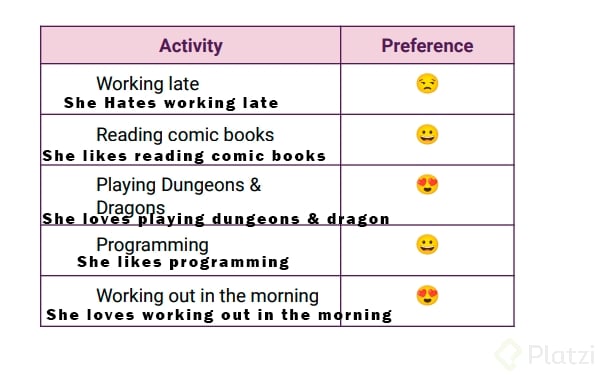
Practice Worksheet Instructions: Write 5 complete sentences about Naomi’s preferences using the information in the table:
Naomi hates working late.
Naomi likes reading comic books.
Naomi loves playin dungeons and dragons.
Naomi likes programing.
Naomi loves workig out in the morning.
Hi! I´m Valeria and I like watching movies, I love going to the swimming pool and I hate cooking
I like l love I hate
I also hate going to the dentist 😅😅😅
🫣🦷
Why? It's very funny.
what is the difference between: i like reading and i like read??
I think that the reason is to be grammatically correct, when you use the first ver in present you should use the second ver with (-ing )
Hi Martin. . Both examples mean the same, but the first sentence "I like reading" you mustn't use "to" after "like/love/hate" because the verb ends with -ing . . The second example "I like to read", needs the word "to" after "like/love/hate" because the verb is in its infinitive form. . I hope this comment will help to you.
I like learning. I love running. I love listening music. I like cooking, but I hate washing dishes.
*I like listening to music 🤓🎶
I like music and dancing I love my pets and I hate hot weather summer to hot ; uwu
I like to study📚 I like to listen to music 🎶. I don't like to read 📖 I don't like to cook.
Hello Kateyn. Look at the structure noun+like+verb(ing) -> for your examples it could be: 1. I like studiying. 2. I like listening to music. 3. I don't like reading 4. I don't like cooking.
And for this class… I don’t like to read books — I hate reading books I don’t like to cook — I hate cooking
Tengo una inquietud. ¿Es lo mismo decir "I like solving jigsaw puzzles" que "I like to solve jigsaw puzzles"?
la misma duda tengo yo, en una clase ella especifica que para hobbies usemos "like to"
I love this class. 🏛
I love waking up early.
She loves to play the guitar. 🎸🎸
I love reading. 📚📖
He likes to listen to music.
She likes to cook. 👩🏻🍳🍳
She hates cleaning her kitchen in the mornings. 🧹🧽
He hates riding the bus. 🚌🚌
Great examples Leidy! ✅ ✅ ✅
I like doing exercise I love eating lasagna I hate studying with noise
Third Person
Hana likes reading novel books Hana loves playing with her pets Hana hate cooking on the weekends
ooohhh I hate eating berejena
i like sleeping
i love watching kdramas
i hate cooking every day
Naomi hates working late. Naomi likes reading comics books. Naomi loves playing dangeons and dragons. Naomi likes programming. Naomi loves working in the morning.
Great job Silvia!! 🤩
He Hastes eating Sushi. HE loves cokking onions and meat
So, is this the only way to express likes and dislikes? With the ing verbs?
Like saying "I like to eat apple" or "I love drink coffee" are both wrong?
thanks again.
If you don't want to use the gerund "ing", you can use the auxiliary "to" before the verb, like: I love cooking pasta.
Hi! I'm Lis. I love reading and I hate eating Spanish food. I like travelling. :)
I like reading a book
she/he/it likes cold weather
I love watching series
she/he/it loves running at the park
I hate cooking
she/he/it hates going outside
Good examples Nicol!! 🤓✅
I like reading I love swimming I hate eating meat
Well done Cinthya! 👏🏼🤓


