Grupos de Alimentos y Tipos de Dietas Nutricionales
Contenido del curso

Dietas saludables en inglés
- 2

Macronutrientes y Micronutrientes en la Alimentación Saludable
05:49 min - 3

Qué son las empty calories en inglés
07:31 min - 4

Grupos de Alimentos y Tipos de Dietas Nutricionales
Viendo ahora - 5

Cómo leer etiquetas nutricionales en inglés
05:30 min - 6

Refeições, calorias e perguntas indiretas
06:36 min - 7

Práctica de conversación en inglés (contexto cotidiano sobre salud y fitness)
00:00 min
Estilo de vida activa en inglés


Conexión de cuerpo y mente en inglés


Cerramos el gimnasio por hoy

Grupos de Alimentos y Tipos de Dietas Nutricionales
Resumen
Understanding how food is classified and why people choose specific eating plans is essential for building strong nutritional vocabulary in English. This workshop breaks down the five major food groups, explains what it really means to go on a diet, and introduces popular diets like the Paleo and vegetarian approaches — all while reinforcing useful words, prefixes, and word-formation patterns.
What are the five food groups and why do they matter?
Before talking about any specific eating plan, it helps to know how foods are organized. A diet simply refers to the kind of food a person typically eats [0:18]. When someone says they are going to go on a diet, they mean they will restrict themselves to a special course of food [0:28]. This phrase is an idiomatic expression: you cannot change the words or their order — only the tense ("He went on a diet," "I'm going to go on a diet") [0:40].
People go on diets for many reasons beyond losing weight [1:05]:
- Gaining or maintaining weight.
- Controlling medical conditions such as celiac disease or diabetes.
- Personal beliefs and preferences.
All diets share one principle: they focus on consuming or limiting certain foods [1:26]. Foods can be classified by macronutrients, but another common method is grouping them into five food groups [1:34].
What foods belong to each group?
- Grains [1:42]: divided into cereals (wheat, rye, oats) and legumes (lentils, chickpeas, beans). Starchy foods like potatoes are sometimes included here.
- Vegetables [2:04]: spinach, carrots, and broccoli, all packed with essential micronutrients. Many people list vegetables as a dislike, but it is beneficial to maximize your intake.
- Fruit [2:26]: apples, bananas, and citrus fruit such as oranges, grapefruit, lemons, and limes. Under-consumption of fruit can prevent your body from getting the vitamins and minerals it needs.
- Dairy [2:44]: milk and its derivatives — butter, yogurt, and cheese. The pronunciation tip shared is: dare-re, dairy.
- Protein / meat [2:58]: beef, chicken, pork, fish, eggs, and even legumes, because they are high in protein. Over-consumption of red meat is linked to higher health risks, so it is better to minimize beef intake.
How does the Paleo diet work?
An important reminder: any time we change our diet, we must ensure we still get the right mix of nutrients; otherwise, we risk malnutrition [3:34].
The Paleo diet [3:46] focuses on foods available before the Agricultural Revolution. People choose it to develop leaner muscles — a useful word to practise: muscles — to balance blood glucose levels, or to lose and maintain weight.
On this plan you increase your consumption of [4:18]:
- Whole, unprocessed foods.
- Fruit and vegetables.
- Nuts and seeds.
- Proteins like meat, eggs, fish, and seafood.
- Healthy fats such as olive oil and avocado.
At the same time, you minimize grains, dairy, and legumes, and reduce processed food like sausage, hot dogs, and ham [4:50].
What makes vegetarian diets different from each other?
Vegetarian diets form a class of diets [5:08]. The general approach is to increase legumes, fruit, vegetables, nuts, and seeds while decreasing meat — including beef, pork, fish, and poultry [5:30]. Poultry refers specifically to birds like chicken and turkey; practise the pronunciation: pul-try.
Classical vegetarian vs. vegan
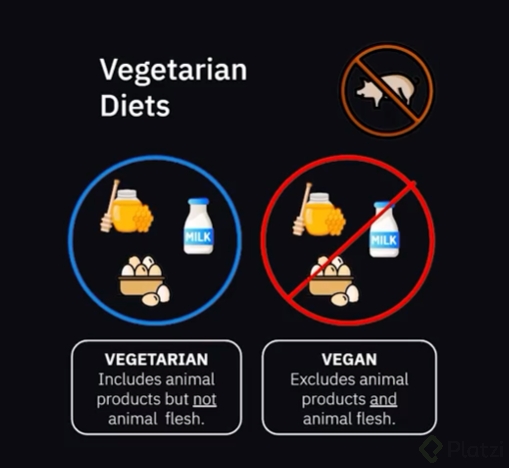
- Classical vegetarian [5:50]: includes animal products (honey, milk, eggs) but excludes animal flesh.
- Vegan [6:00]: excludes everything that comes from an animal — both flesh and its products.
How do prefixes and word formation strengthen your vocabulary?
Several words in this topic use a prefix at the beginning to change meaning [6:18]:
- Macro- + nutrients → macronutrients.
- Sub- + groups → subgroups.
- Over- + consumption → overconsumption.
- Under- + consumption → under-consumption.
Verbs can also be formed from nouns and adjectives [6:34]:
- Maximum → maximize.
- Strength → strengthen.
- Minimum → minimize.
Recognising these patterns helps you decode new vocabulary quickly and use it with confidence. As a practice exercise, try writing 150 words about a diet of your choice, covering its benefits and drawbacks — share your ideas in the comments!