Uso de Adjetivos Cortos en Forma Comparativa
Clase 13 de 16 • Curso de Inglés Básico A2: Infinitivos y Presente Continuo
Contenido del curso
Clase 13 de 16 • Curso de Inglés Básico A2: Infinitivos y Presente Continuo
Contenido del curso

Arturo Solares

Jennifer Yashira Mercedes

Juan Camilo Maldonado Perez

Ronald Victor Blanco Balboa

Kevin Guzman

Denilson Martinez
Emilia María Flores Baquero
Manuel Avila
Manuel Avila
Diego Alejandro Quintero Buitrago

Leidy Diana Rodriguez Acosta

Lizette Rosalía Dazza Hernández

Sofia Ortiz Trujillo

Luis Miguel Aponte Rayo

Leonardo Aldana

CESAR IVAN URQUIZA RAMIREZ

Juan Sebastian Valencia Morales
ZULMA IVANIA OSORIO ALVARADO
ZULMA IVANIA OSORIO ALVARADO
ROXANA GUADALUPE INGLES GUILLEN
Here is the worksheet :D
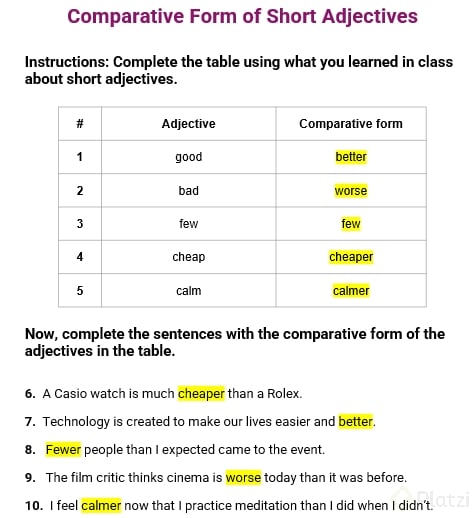
Good/Better Bad/Worse Few/Fewer Cheap/Cheaper Calm/ Calmer A Casio watch is much cheaper than a Rolex. Technology is created to make our lives easier and better. Fewer people than I expected came to the event. The film critic thinks cinema is worse today than it was before. I feel calmer now that I practice meditation than I did when I didn’t.
Now, complete the sentences with the comparative form of the adjectives in the table.
Is it acceptable?
Comparative adjectives We use comparative adjectives to express the difference between two people or things. Example: My sister is older than my brother.
Rule for short adjectives If an adjective has one syllable we add -er Example: bright -> brighter Example: dark -> darker Example: old -> older Example: young -> younger Example: small -> smaller Example: short -> shorter Example: tall -> taller
Keep in mind If an adjective has one syllable but ends in a vowel and consonant we need to double the consonant: Example: big -> bigger Example: sad -> sadder Example: wet -> wetter Example: thin -> thinner
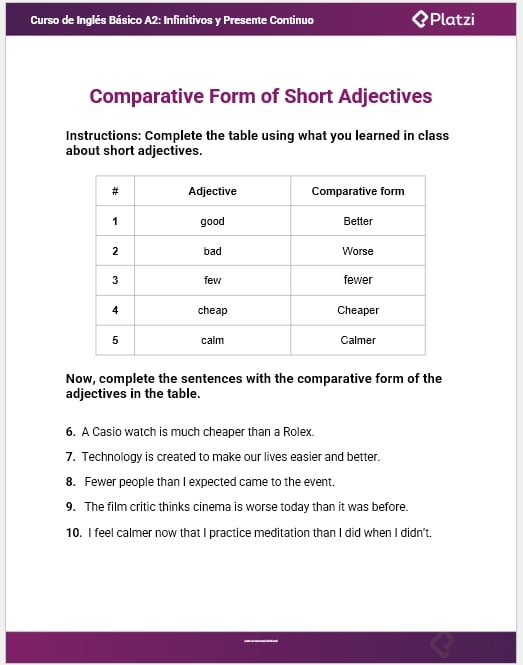
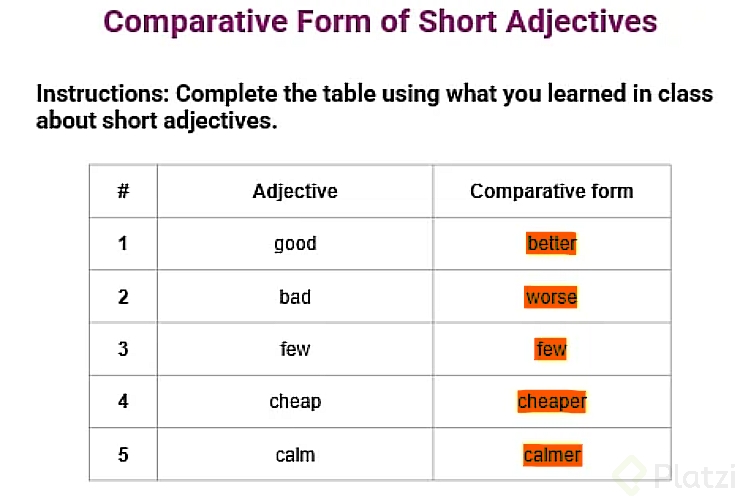
Adjective Comparative Form
1: Good Better 2: Bad Worse 3: Few Fewer 4: Cheap Cheaper 5: Calm Calmer
SMALL - SMALLER
SHORT - SHORTER
TALL - TALLER
Estos adjetivos son ejemplos donde se duplica la consonante final antes de añadir "-er" para formar el comparativo.
Estos adjetivos no requieren doble consonante en su forma comparativa.
smaller shorter taller
Good-better
Bad-Worse
Few-Fewer
Cheap-Cheaper
Calm-calmer
wet thin belly
Hola:
And
1.smaller
bigger
taller
largger
1.smaller
bigger
taller
largger
taller
bigger
largger


