Describing pictures is one of the most practical skills you can develop when learning English. Not only does it help you expand your vocabulary, but it also prepares you for standardized English tests that frequently include picture description tasks. The earlier you start practicing, the more confident you'll feel when facing these challenges.
What structure should you follow to describe a picture?
The recommended approach moves from general to specific, building your description in three clear layers [0:52]:
- General description: identify the main elements using there is (singular) and there are (plural).
- Location of elements: explain where things are positioned in the image.
- Detailed information: add specific characteristics like colors, materials, or actions.
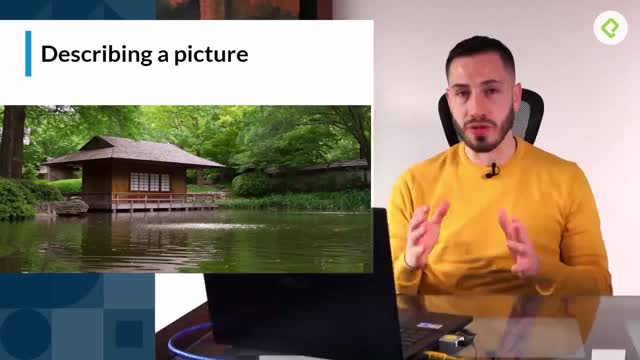
Using "there is" and "there are" correctly is essential. You say there is when referring to one element and there are when mentioning multiple elements. For example: "There is a house by a lake and there are several trees around the house" [1:08].
How do you describe where things are in a picture?
Position expressions help your listener or reader visualize the scene. The most useful ones include [1:32]:
- On the right.
- On the left.
- In the middle.
- At the bottom.
- At the top.
A practical example would be: "There is a house in the middle of the picture. The lake is at the bottom and there are trees at the top" [1:42].
How do you add detailed information?
Once you've covered general and location elements, you enrich your description with adjectives and specific observations [1:56]. For instance, describing a house as "a wooden house" tells the listener the material it's made of. Saying "the lake is green" and "the trees are bushy" adds vivid detail that makes the description come alive.
Putting it all together sounds like this: "There is a wooden house in the middle of the picture. There is also a green lake at the bottom and there are several bushy trees around the house" [2:16].
What do real picture descriptions look like?
Practicing with different images helps you internalize the structure. Here are three examples covered step by step.
The first practice image shows a dining scene [2:38]. The general description identifies a dining table, four chairs, and some flowers. Location details place the table in the middle and a window at the back. Detailed information notes it's a wooden table with pink roses that match the walls and chairs. The complete description: "There is a wooden table in the middle of the picture with four chairs around it. There are some pink roses on the table which match the colors of the walls" [3:30].
The second image features a city scene [3:46]. General elements include a man with an umbrella, a rainy city, and traffic lights. The man stands in the middle, buildings appear on the right, and cars with traffic lights sit on the left. Key details: the man is walking on the sidewalk, the floor is wet, and it looks like a big city. Notice the expression "it must be raining" — this shows probability based on evidence you observe [4:27].
The third example presents a street market [5:14]. A woman is looking for fruits and vegetables. She wears a red dress and stands on the left. Fruits and vegetables are to the right, and a big tree appears at the back. The detailed layer mentions a variety of tomatoes and peppers and suggests it's a warm place based on the clothing people are wearing.
How can you practice this skill on your own?
The best way to improve is by selecting any picture — whether one you've taken yourself or found online — and applying the three-step structure [6:10]:
- Start with there is and there are for general elements.
- Use position expressions like on the right, in the middle, or at the back.
- Add adjectives and observations for texture, color, material, and actions.
Words like wooden, bushy, wet, and pink transform a basic description into a detailed and engaging one. Paying attention to what people are doing — walking, selling, buying, holding — adds a dynamic layer to your description.
Share your own picture description in the comments. Choose an image, follow the steps, and practice turning what you see into clear, structured English. The feedback you receive will help you grow faster than practicing alone.