Simulación de Entrevistas de Trabajo con Google Interview Warm-up
Clase 11 de 12 • Curso de Inglés para el Uso de Inteligencia Artificial
Contenido del curso
Clase 11 de 12 • Curso de Inglés para el Uso de Inteligencia Artificial
Contenido del curso

Moni Guerra

Fernando Sánchez Mejía

Javier Ramos

Diego Alejandro Lesmes

Gloria Parra

Luis Alejandro Rojas Bustos
Renzo Manuel Cuadra Lazarte

Federico Maciel

Rel Guzman
Renzo Manuel Cuadra Lazarte

José Daniel Calle Briceño

Felipe Bernardo González Barranco

DANIEL Martinez Cruz
Renzo Manuel Cuadra Lazarte

Katherine Peña

Diego Armando Toro Cárdenas

Obdaly Garay

Senaida Rodriguez
Juan Felipe Angarita Lopez

Alejandra Galeano
Renzo Manuel Cuadra Lazarte

Alexis Manuel Villegas Contreras
Renzo Manuel Cuadra Lazarte

Michel Santiago Andreu Olarte Moyano

MARIA TERESA PANIAGUA RIVERA

Daniel Morelo

Juliana Castillo Araujo
Juan Felipe Angarita Lopez

Erick De la cruz

Humberto Guardado
Amazing
Good CV and good answer
Great tool! let's practice!
hola
Thank you so much for the data. I did not even have any idea about such great tool.
You're welcome, Luis! Let me know how it goes.
Great Tool!!
It must be fun to have chatgpt interviewed by this tool and see how well it does
You could try that! Google Interview Warmup gives you the option to give a written answer instead of a spoken one.
Such a great tool! What I''ve learned:
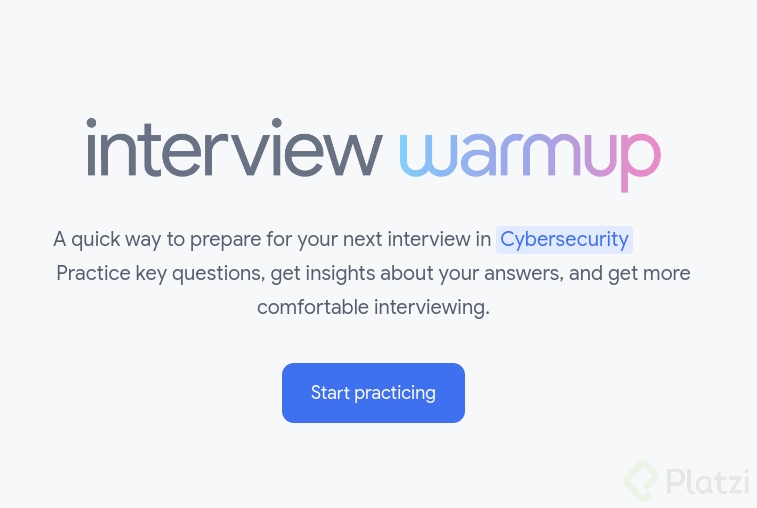
What a great website!
El quiz tiene preguntas en español y además hay preguntas que solo tienen una respuesta ;)
Hi Daniel, thank you for noting this. This is due to an error we're currently fixing.
Interview Warnup is not longer available. :(
Yo he desarrollado una herramienta similar para poder practica mi speaking.
AiTeTalk:
Ensayala y dime qué tal te parece.
Esta cool, faltaría mas naturalidad para entender mejor el acento nativo y no un robot, me parece un sistema innovador y muy útil, si la desarrollas bien perfectamente la podrías vender o lanzar
it does not work
Tell me why you are interested in a role in data analytics. What is it that particularly interests you?Tell me why you are interested in a role in data analytics. What is it that particularly interests you?
Hi Renzo, I have one question.
Right after class #11, the quiz had 19 questions but some of them, around 7-8 did only have one option (which was the right one). After completing the quiz, I felt like I only did 40% or less, tbh.
Idk if this is how it was planned or maybe there was an error loading all the choices.

Hi Alejandra! Thank you for noting this. There was indeed a mistake loading the questions. We're currently working on fixing it.
ayuda, no me carga la pagina de interview warmup
Hi Alexis! I just tested the link and it is working correctly. Maybe there was a connection issue when you tried it. Have you tried again?
What a tool, i need this and for sure i´ll be practicing with this.
Gracias
Nice course. Very Helpfull
Great course! I love it, thank you so much Renzo 👩💻
Certainly! Here's an example of a technical interview scenario:
Interviewer: Good morning, thank you for coming in today. We're excited to learn more about your technical skills. Let's start with a coding question.
Candidate: Good morning, thank you for having me. I'm ready.
Interviewer: Great. Here's the question: Write a function in Python that takes a list of integers as input and returns the sum of all the even numbers in the list. You have 10 minutes to complete the task. Please explain your thought process as you work through the problem.
Candidate: Okay, I'll start by defining the function. I'll name it 'sum_even_numbers' and it will take a list called 'numbers' as input.
[The candidate starts writing the function]
Candidate: Next, I'll initialize a variable called 'sum_even' to keep track of the sum of even numbers. Then, I'll loop through each number in the list using a for loop. Within the loop, I'll check if the number is even by using the modulo operator (%). If the remainder is 0, then the number is even and I'll add it to the 'sum_even' variable.
[The candidate continues writing the function]
Candidate: Finally, I'll return the 'sum_even' variable which will contain the sum of all even numbers in the list.
[The candidate finishes writing the function]
Interviewer: Thank you for your solution. Can you explain the time complexity of your function?
Candidate: Sure. The time complexity of my function is O(n), where n is the number of elements in the input list. This is because I'm iterating through each element in the list once to check if it's even and add it to the sum.
Interviewer: Excellent explanation. Now, let's move on to a system design question...
This scenario demonstrates how a technical interview might unfold, including the presentation of a coding question, the candidate's thought process and problem-solving approach, and follow-up questions to assess the candidate's understanding of technical concepts.
Renzo, this was an excellent class. An awersome tool to use to prctice an interview. Great material and a way of teaching! Hope to get more courses with you. Awesome job.
My dialog with CHATgpt today:
The list here:
Certainly! Here's how these terms might apply to the industry of language interpretation:


