Logros personales y profesionales: cambios y adaptación
Clase 17 de 17 • Audio Historia en Inglés: Una Aventura en la Ciudad
Contenido del curso
Clase 17 de 17 • Audio Historia en Inglés: Una Aventura en la Ciudad
Contenido del curso

Daniel Libardo Diaz Gonzalez
Felipe Bernardo González Barranco
Freddy Peñate Goberna

Rubén Vega
Felipe Bernardo González Barranco

Luisa Fernanda Morales

Danna Valentina Hernández Pinilla

Lindy Johanna Mendoza González

José Elías Aguilar Díaz

Mery Johanna Gutiérrez Ortiz
Abigail Perez
José Iván Triviño Fúnez

Marco Julian
Felipe Bernardo González Barranco

Mario Roberto Aragón

Ariel Humberto Reyes Hernández

FABRIZIO VITORINO MONJARAS
José Elías Aguilar Díaz
Mario Roberto Aragón
Mario Roberto Aragón
Mario Roberto Aragón
Jesús Miguel Rivera Carballo

Elizabeth Betbirai Hernández García
Carlos Alberto Martínez Ramírez

Nicolas Alpargatero

Michael Aguillón

Ana Lucía Perez Sebaquijay

Santiago Tellez Hernandez

Ali Hilario
Really good course! Definitely, Juan had to face many challenges, but finally, he was able to overcome all of them.
Some day I’ll visit Chicago, not because of study purposes, but to attend a game of the Chicago Bulls.
That's a good reason too!
Heey Chicago Bulls hu, really nice Bsketball team!
Juan absolutely won't win lotery hahaha!
Nobody knows, maybe in the next season crazy things could happen to Juan
hahhaha
This was an amazing course! Juan was able to overcome all the challenges that he had to face, but along the way he was able to teach us a lot of things, new vocabulary and help us improve our English. Thank you!
I agree
yes
I Love this audio and all the messages it has in the back
Is this a real story?
Mmmmm, I think that not S:
possibly it is real, it is similar to many cases that I have been told
Good luck in chicago! now you have to get better day by day!
I feel very proud to Juan! I want to be his new friend
Things that happen, that are part of life Juan. Good course.
i
Solo me hizo falta una pregunta, pero no se puede realizar para terminar la evaluación ni de este módulo
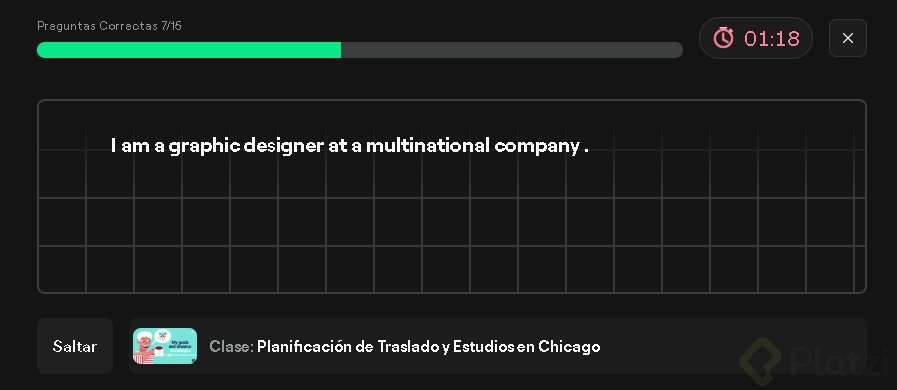
No se puede terminar la evaluación
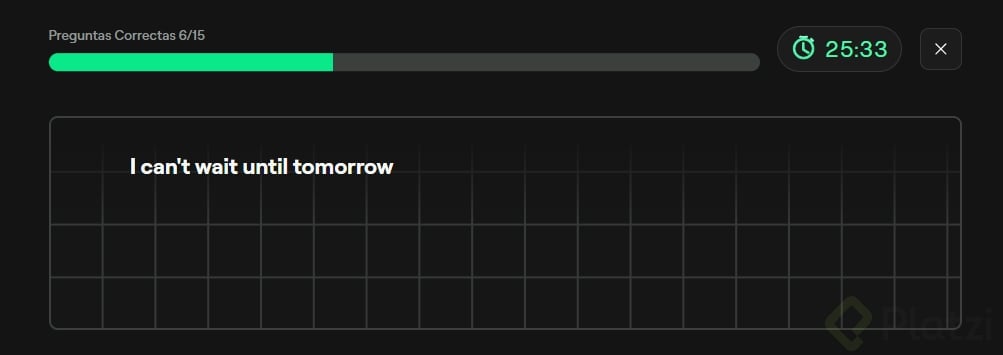
igual, no puedo terminar el test
NO PUEDOO TERMINAR EL EXAMEN, POR EL ERROR DEL SISTEMA
No se puede contestar el examen. No da opciones para seleccionar.
Thank you Juan
For my list:
eɪm - aiming - con el objetivo, intensionbət nʌn əv ðiz pero ninguno de estosGreat course, good pronunciation and my aim to improve my English skills have gone noticing
Definitely I'm cheerful and grateful
Thank you for sharing your story Juan!
New vocabulary: Overcome Risking Borrow Aim
It was an excellent story, all the specials effects sounds very realistic, I really enjoy this story. I learned a lot of new phrases and words. I really appreciated that Platzi make that kind of courses! Great job! :)


