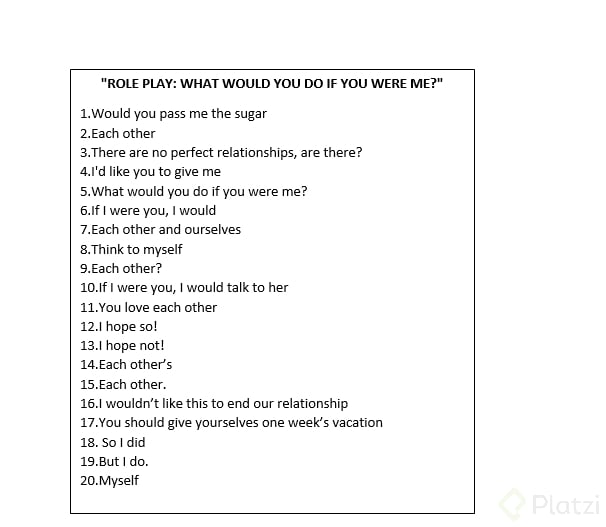
Emily and Thomas continue their conversation touching on family updates, relationship advice, and making important life decisions. This second part of the role play offers rich vocabulary and grammar structures that are essential for intermediate English learners, including how to make polite requests, use conditional sentences, and incorporate everyday phrasal verbs naturally.
How do Emily and Thomas talk about family and life updates?
The conversation picks up with Thomas asking about Emily's family. She shares that her parents have just retired and are planning on traveling the world. Her sister is finishing high school and her brother is going to get married next year. This section introduces useful expressions for talking about life milestones [01:30].
The phrase "planning on" followed by a gerund (-ing form) is a natural way to talk about future intentions. For example: "They're planning on traveling the world." Similarly, "going to get married" uses the going to future to express a planned event.
What grammar and vocabulary appear in the relationship advice?
Thomas reveals that he and Josie have been discussing marriage, but they disagree on whether to move in together first [03:05]. The phrasal verb move in means to start living in the same place with someone. Emily gives advice using the second conditional structure:
- "What would you do if you were me?"
- "If I were you, I would ask her why she doesn't want to move in first."
- "If I were you, I would talk to her and come up with the things I would like or wouldn't like her to do."
This grammar pattern is critical for giving advice and talking about hypothetical situations. Notice the use of were instead of was after if, which is standard in conditional advice-giving.
Thomas also expresses his concerns using "what if" questions [03:40]:
- "What if things change and we don't understand each other?"
- "What if we got married and then hated living together?"
These structures help express worry about possible future outcomes.
How are polite requests used in everyday conversation?
A small but important moment happens when Thomas asks Emily: "Hey, would you pass me the sugar, please?" [02:30]. She responds with "Here you are," a common phrase when handing something to someone. Using would you plus a verb is one of the most natural ways to make a polite request in English.
What phrasal verbs and useful phrases stand out?
Several phrasal verbs and expressions appear throughout the conversation:
- Ups and downs: the good and bad moments in a relationship [02:50].
- Come up with: to think of or produce an idea or plan [04:10].
- Move in: to begin living together in the same home.
- Take care of: to look after something, in this case health [05:10].
- Time off: a period away from work to rest [05:20].
- Head home: to go home [05:40].
- Meet up: to get together with someone [05:50].
- Keep in touch: to stay in contact with someone [06:00].
Emily's advice also includes the expression "either way," which means regardless of which option is chosen [04:40]. She reassures Thomas by saying they will make the right choice, showing confidence in their relationship.
Why is honest communication important in relationships?
Emily recommends that Thomas and Josie give themselves one week's vacation to discuss things calmly [05:00]. The phrase "you should give yourselves" uses a reflexive pronoun and a modal verb for suggestion. Thomas mentions that his manager told him he needed to request some time off, which he did. The distinction between need to (necessity) and should (recommendation) is a useful grammar point for everyday English.
The conversation closes warmly with both friends agreeing to meet up next week and have lunch together. The farewell phrase "Have a good one" [06:05] is a casual and friendly way to say goodbye, very common in spoken American English.
What part of this conversation did you find most useful? Try using some of these phrasal verbs and conditional structures in your own conversations and share your sentences in the comments.