Uso del Apóstrofo para Indicar Posesión en Inglés
Clase 6 de 17 • Curso de Inglés Básico A2: Preguntas y Respuestas Comunes
Contenido del curso
Clase 6 de 17 • Curso de Inglés Básico A2: Preguntas y Respuestas Comunes
Contenido del curso

Homer López

Sarah Daniela Zafrani Lamoth

Harold Leonardo Vallejo Tangarife

Aster Darian
Esteffany Dayana Montenegro Narváez

Luis Fernando Bustos Ramírez

Jesus Guillermo Belman Leal

Arnie Farid Espinoza Pachas
Isis del Cid

Leidy Esther Cardenas Manso

Javier Ramos

Juan Manuel Correa Muñoz

Alberto José León Castelli
Sarah Daniela Zafrani Lamoth

Andrés Cuéllar

Juan Pablo Delgado Robles
Sarah Daniela Zafrani Lamoth

Julio César Burgos Paz

ANDRES VELEZ
Sarah Daniela Zafrani Lamoth

Joshua Altair Rodríguez Liceaga

Walter Jacobo

Valeria Bringas González

Juan Diego Largo Campo

Cristopher Eduardo Briones Daccarett

Adrian Rondon

Ernesto Javier Ramos Renteria
Sarah Daniela Zafrani Lamoth

Edna Patricia
Sarah Daniela Zafrani Lamoth
Javier Ramos

Esperanza Lourdes Azucena
Sarah Daniela Zafrani Lamoth

Sheilly Amarilis González Márquez
Sarah Daniela Zafrani Lamoth

Maryoli Mosqueda
Sarah Daniela Zafrani Lamoth
Jefferson Stiven Zaldívar Godinez
Cristian Eduardo Alas De La Quadra

Gloria Yamileth Flores Cruz

José Octavio Trejo Salazar
cool
Thanks, that's great!
Practice Worksheet:
sorry. Why is s° in the number four and five
Hi @e.daya, we are using siblings' and colleagues' because they are regular plural nouns
epic
paz descanse
Es interesante la explicacion del apostofe en las oraciones.
In English please
In the last example. Can i say "This is my friends´ house"?
Yes. You can say it. There's no problem.
thx
Hi, on the 2:30 to the video the teacher @Gina said " Arnold's school is across the store" but I see across from the store. My questions is both are corrects ?
Yes, she said it both ways
mmm
BROTHER'S GRANDMOTHER'S SALLY AND EMILIO'S
xd
Cuando algo pertenece conjuntamente a dos o más personas, el apóstrofo con la 's' ('s) se añade solo al nombre de la última persona mencionada. Por ejemplo, si una casa pertenece a Sally y Emilio, diríamos "Sally and Emilio's house". Esto evita repetir la posesión en cada nombre.
In the sentence with two apostrofhes, it is not better write "those are my friend's childrens' toys. Because childrens it is a plural?
¿por qué no responden? Tengo la misma duda
But "children" is an irregular plural noun and is not formed by adding s' to the end. The correct form is to add the possessive 's in this case would be:
"Those are my friend's children's toys."
In this structure, we first add the 's to the friend to indicate that the children belong to the friend, and then we add another 's to the end of "children" to indicate that the toys belong to the children.
Hi, I have a question: if I'm talking to a person who doesn't know my friends and I mention something that belongs to several friends, how would that person know if it belongs to a friend or several friends? For example, if I talk about my friends' house, how would that person know if it belongs to a friend or several friends?
Minute 1:10, I hope that this resolve your question https://platzi.com/clases/2395-fechas-horas-expresiones-simples/40079-s-to-express-possession/
my sister's sweater is beautiful My cousin's car is new
good
Practice Worksheet:
Those are Leila’s presents. She’s the team’s new manager. My sister’s schedule is empty. My siblings’ favorite activity is camping. My colleages’ project is going well.
kk
Excellent, 5 points for that
mmmmmm
my brother´s clothes are very elegant my grandmother´s hat is pretty this is sally and emilio' s house practice worksheep
Those are Leila___ presents. a. ‘s She’s the team___ new manager! a. ‘s My sister__ schedule is empty. a. ‘s My sibling__ favorite activity is camping. b. s'
My colleague___ project is going well. b. s'
cool
amazing
Cuando algo pertenece conjuntamente a dos o más personas, el apóstrofo con la 's' ('s) se añade solo al nombre de la última persona mencionada. Por ejemplo, si una casa pertenece a Sally y Emilio, diríamos "Sally and Emilio's house". Esto evita repetir la posesión en cada nombre.
That's Emilio's house
That's Mike's jacket
She is my cousin's wife
¿Cuándo usar 's' después de la 's'?
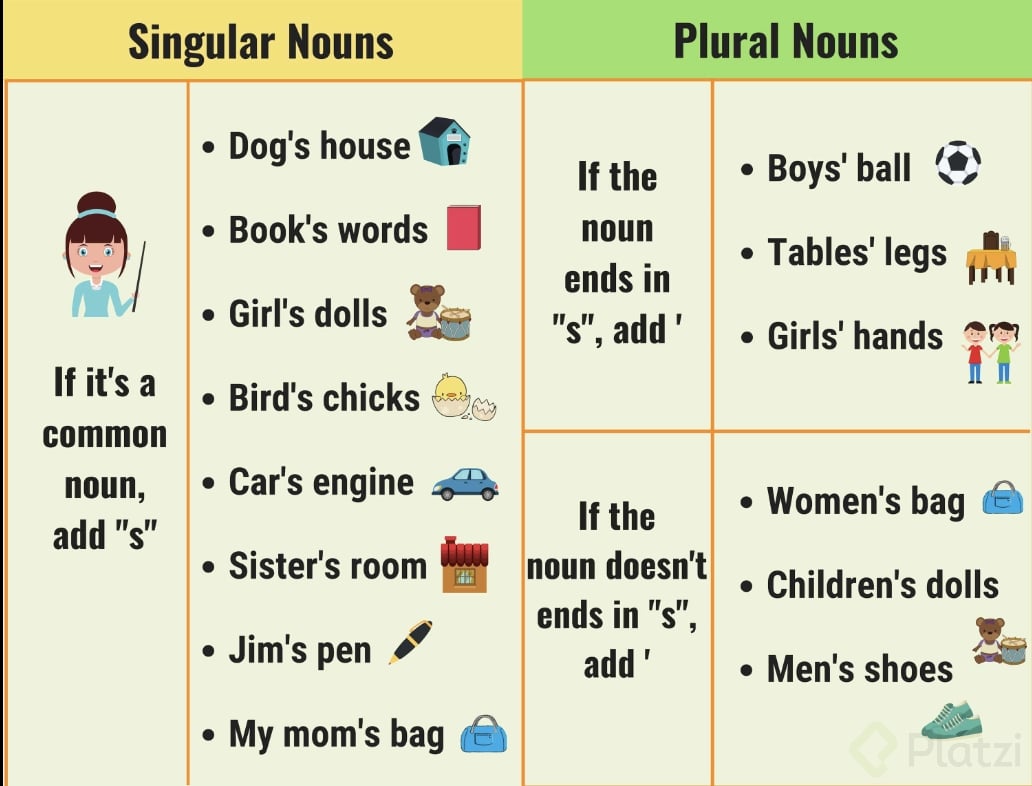
Utilizamos solo el apóstrofo después de la 's' (s') cuando el sustantivo plural ya termina en 's'. Esto indica que algo pertenece a un grupo, como en "my brothers' toys" (los juguetes de mis hermanos). Si el plural no termina en 's', como en "children", aún usaríamos "children's".
Reglas del apóstrofe (‘) de posesión
1️⃣ Sustantivo singular
2️⃣ Sustantivo plural que termina en “s”
3️⃣ Sustantivo plural que NO termina en “s”
4️⃣ Dos o más dueños
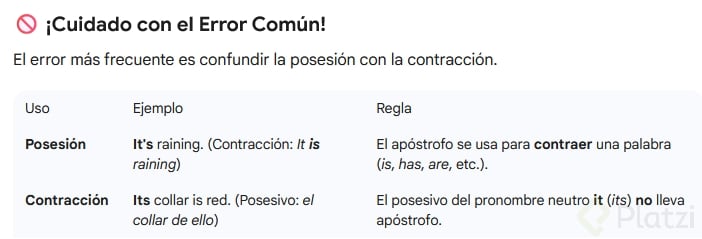
5️⃣ Nota importante: no confundir con contracciones
💡 Tip para recordar:


