Assimilation
Contenido del curso

Fluency


Stress


Intonation



Conversation


English around the world


Congratulations!

Recursos
Resumen
Cuando hablas inglés con fluidez, los sonidos no se pronuncian de forma aislada. Se transforman, se fusionan y se simplifican de maneras que la mayoría de hablantes nativos ni siquiera notan. Comprender la asimilación es fundamental para sonar más natural y, sobre todo, para entender el inglés hablado a velocidad real.
¿Qué es la asimilación y por qué ocurre en connected speech?
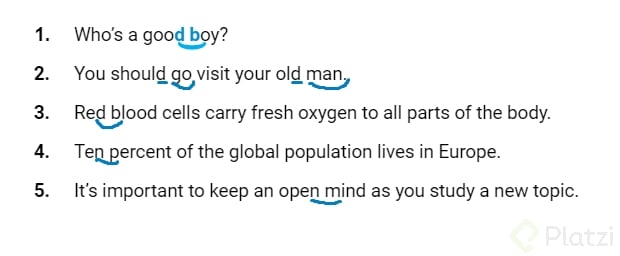
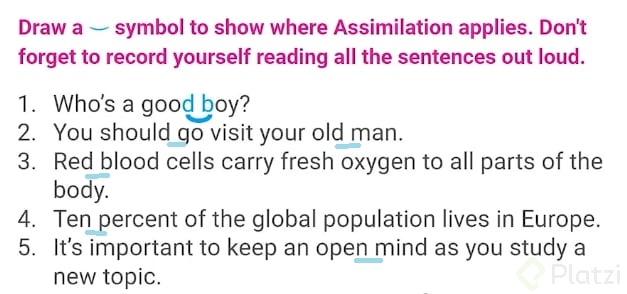
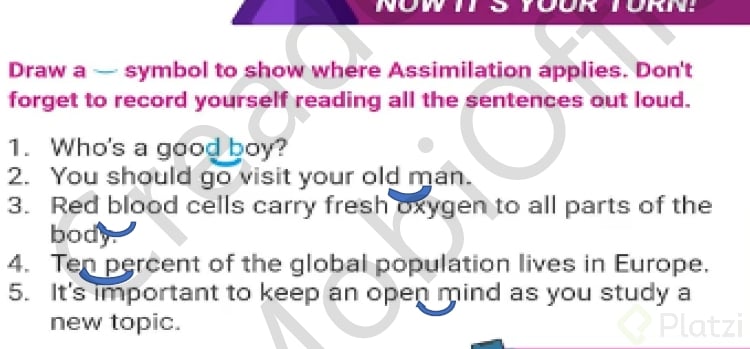
La asimilación es el proceso mediante el cual un sonido se vuelve similar o idéntico a un sonido cercano [0:28]. Esto sucede porque el aparato vocal busca la ruta más eficiente: en lugar de mover la lengua o los labios a posiciones muy distintas entre dos consonantes consecutivas, el hablante adapta el primer sonido para que coincida con el punto de articulación del segundo.
Este fenómeno forma parte del connected speech, un conjunto de modificaciones que los hablantes aplican para simplificar secuencias complicadas durante la articulación [0:15]. La clase se centra en el enlace consonante a consonante (consonant-to-consonant), uno de los tres tipos de enlace junto con consonante a vocal y vocal a vocal [0:42].
¿Cuándo T se convierte en P, y cuándo D se convierte en B?
T se convierte en P
Cuando una T (sonido alveolar sordo) va seguida de P, B o M, se transforma en P (sonido bilabial sordo) [0:55]. Esto ocurre porque los labios ya se están preparando para el siguiente sonido.
- White paper: en careful speech se pronuncia la T claramente, pero en fast speech suena como "whipe paper" [1:13].
- Sweet potato: la T final de "sweet" adopta el sonido P [1:42].
- Peanut butter: la T de "peanut" pasa a P porque le sigue una B, ambos sonidos oclusivos (stop sounds) [1:58].
Un dato importante: cuando quieres enfatizar una palabra, vuelves al careful speech. Por ejemplo, "Can you pass me that white paper?" mantiene la T clara [1:26].
D se convierte en B
Cuando una D (alveolar sonora) precede a P, B o M, se convierte en B (bilabial sonora) [2:18].
- Red panda: en habla rápida suena como "reb panda" [2:28].
- Bald man: la D se transforma en B al estar seguida de M [2:46].
- Old boat: la D de "old" se convierte en B antes de "boat" [3:03].
¿Cómo funcionan los cambios con N, T y D hacia sonidos velares?
N se convierte en M
Cuando N (alveolar sonora) va seguida de P, B o M, se transforma en M (bilabial sonora) [3:20]. La razón es simple: mover los labios hacia una posición bilabial es más rápido que mantener la lengua en la posición alveolar.
- One more: suena como "wum more" en habla rápida [3:34].
- Open book: la N final pasa a M [3:50].
- Ten percent: se pronuncia algo como "tem percent", ya que M y P comparten el mismo punto bilabial [3:58].
T se convierte en K
Cuando T (alveolar sorda) precede a un sonido velar como K o G, se transforma en K [4:16].
- Fruitcake: en fast speech la T adopta el sonido K [4:30].
- Not good: suena como "nok good" al hablar con naturalidad [4:42].
D se convierte en G
Cuando D (alveolar sonora) va seguida de K o G, se convierte en G (velar sonora) [4:56].
- Board game: la D suena como G en habla rápida [5:04].
- Red Cross: se percibe como "reg cross" [5:18].
N se convierte en NG
Cuando N precede a K o G, se transforma en el sonido NG, ese mismo sonido nasal velar que usamos en terminaciones -ing [5:34].
- Lion King: la N de "lion" se fusiona en un sonido NG con la K de "King" [5:50].
- Mean Girls: la N final se desplaza hacia atrás en la boca, produciendo un sonido velar [5:58].
El patrón es consistente: el primer sonido se desplaza al punto de articulación del segundo. De alveolar a bilabial, o de alveolar a velar. Practica grabándote y comparando tu careful speech con tu fast speech. ¿Notas la diferencia? Comparte tu grabación y sigue perfeccionando tu pronunciación.