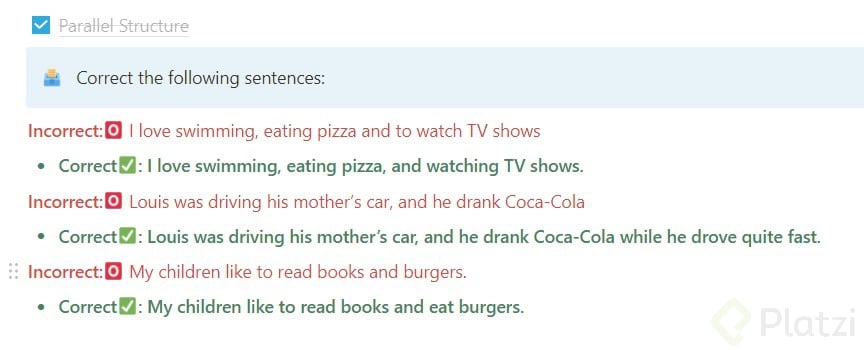
Writing clear and balanced sentences is one of the most important skills you can develop in English. When you list actions, nouns, or ideas in a series, every element needs to follow the same grammatical pattern. This principle is called parallel structure, and mastering it will make your writing more professional and easier to read.
What is parallel structure and why does it matter?
The parallel structure is a grammatical rule used when writing elements in a series [0:22]. The goal is to balance all the elements so they share the same form. Without this balance, sentences feel awkward and inconsistent. With it, your ideas flow naturally and your reader stays focused on the message.
Consider this incorrect sentence: "I like eating pizza, listening to music, and to play soccer." The first two verbs use the -ing form, but the third switches to the infinitive. That break in pattern is exactly what parallel structure fixes.
How do you fix verbs in a series?
When listing verbs, choose one tense or form and stick with it [0:54]. You have two correct options:
- "I like eating pizza, listening to music, and playing soccer." (all gerunds).
- "I like to eat pizza, to listen to music, and to play soccer." (all infinitives).
Both versions are grammatically correct. The key is consistency across every item in the list.
What happens when nouns require specific verbs?
Some nouns naturally pair with particular verbs, and ignoring that pairing creates confusing sentences [1:22]. For example: "They read books and music" is problematic because you don't read music in the same way you read books. The corrected version separates each noun with its proper verb: "They read books and listen to music."
How does noun number affect parallel structure?
When listing nouns, keep the singular or plural form consistent throughout the series [1:42]. Look at this example:
- Incorrect: "They sell pineapples, oranges, and an apple in the supermarket."
- Correct: "They sell pineapples, oranges, and apples in the supermarket."
Mixing plural nouns with a singular one breaks the pattern and confuses the reader about whether you mean one item or many.
How can parallel structure add context and improve punctuation?
Adding context to related actions
Parallel structure also helps you connect ideas that belong together [2:10]. The sentence "I finished my project, and I ate cake" is grammatically fine, but the two actions seem unrelated. Adding context creates a stronger connection: "I finished my project and I ate cake to celebrate." Now the reader understands why both actions matter.
Using semicolons to separate complex elements
When your series contains items that already include commas, semicolons become essential to avoid confusion [2:32]. Compare these versions:
- Confusing: "My cousin traveled to Bogotá, Colombia, New York, USA, and Barcelona, Spain."
- Clear: "My cousin traveled to Bogotá, Colombia; New York, USA; and Barcelona, Spain."
The semicolons separate each city-country block, making the sentence instantly readable.
Here is a quick checklist to apply parallel structure in your writing:
- Use the same verb form across all items in a list.
- Pair each noun with its appropriate verb when meanings differ.
- Keep nouns in the same number (all singular or all plural).
- Add context so related actions connect logically.
- Use semicolons when list items contain internal commas.
Now it's your turn. Write a sentence with a series of elements using parallel structure and share it in the comments.