Uso de la Estructura Paralela en Oraciones en Inglés
Contenido del curso

Fundamentos de la escritura en Inglés


Elementos de una oración en Inglés
- 5

Tipos de Oraciones en Inglés: Declarativa, Imperativa, Interrogativa, Exclamativa
02:49 min - 6

Partes del habla: categorías y ejemplos en inglés
02:12 min - 7

Combinación de Cláusulas Independientes en Inglés Básico
04:50 min - 8

Tipos y Usos de Conectores en Inglés
02:10 min - 9

Uso de la Estructura Paralela en Oraciones en Inglés
Viendo ahora
Elementos de un párrafo en Inglés
- 10

Estructura del párrafo: oraciones principales y de apoyo
01:07 min - 11

Escribir frases temáticas efectivas para párrafos claros
02:11 min - 12

Escritura de Oraciones Complementarias en Párrafos
03:48 min - 13

Escribir oraciones finales efectivas en párrafos
01:34 min - 14
Práctica de escritura funcional en inglés (párrafos y textos completos)
00:00 min
Escritura de Diversos tipos de Textos en Inglés


Escritura de un correo electrónico en Inglés


Desarrolla tu "writing" en Inglés


Recursos
Resumen
Mastering parallel structure is one of the most practical ways to make your writing clearer and more professional in English. This grammar tool ensures that every element in a series follows the same pattern, creating balance and consistency throughout your sentences.
What is parallel structure and why does it matter?
The parallel structure is used when you write something in a series. The goal is to balance all the elements so they follow the same grammatical form. When elements are not balanced, the sentence feels awkward and can confuse your reader.
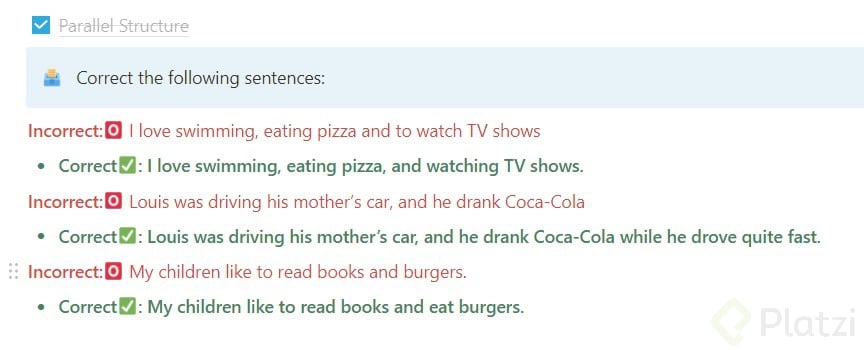
Consider this example [0:08]: I like eating pizza, listening to music and to play soccer. Something feels off, right? The first two verbs use the -ing form, but the last one switches to the infinitive. A correct version would be:
- I like eating pizza, listening to music and playing soccer.
- I like to eat pizza, to listen to music and to play soccer.
Both options are correct because every verb follows the same tense pattern.
How can you apply parallel structure in different situations?
Parallel structure goes beyond verb tenses. There are several situations where you need to pay attention to balance.
When nouns require specific verbs
Some nouns pair with particular verbs, and mixing them breaks the structure [1:27]. For example: They read books and music. The noun music does not pair with the verb read. The correct form is:
- They read books and listen to music.
Each noun gets the verb it naturally requires.
When noun number must be consistent
Keeping singular and plural forms consistent within a series is essential [1:47]. Look at this sentence: They sell pineapples, oranges and an apple in the supermarket. Two items are plural while one is singular, which breaks the balance. The corrected version is:
- They sell pineapples, oranges and apples in the supermarket.
When you need to give context to your reader
Parallel structure also helps you connect related ideas and provide meaning [2:10]. Compare these two sentences:
- I finished my project, and I ate cake. — These two actions seem unrelated.
- I finished my project and I ate cake to celebrate. — Now the reader understands the connection.
Adding context through parallel structure makes your writing more cohesive.
How does punctuation work with parallel structure?
Punctuation plays an important role when your series contains complex elements [2:33]. Consider a sentence with cities and countries:
- My cousin traveled to Bogota, Colombia, New York, USA, and Barcelona, Spain.
This version is confusing because commas separate both the cities from their countries and the blocks from each other. The solution is to use semicolons to separate the blocks:
- My cousin traveled to Bogota, Colombia; New York, USA; and Barcelona, Spain.
The semicolon creates clear divisions between each city-country pair, while the comma handles the internal separation.
Here is a quick checklist to keep your writing balanced:
- Use the same verb form across all elements in a series.
- Match each noun with its appropriate verb.
- Keep singular and plural forms consistent.
- Add context when two actions need a logical connection.
- Use semicolons to separate complex blocks within a series.
Now it is your turn. Try writing a series of elements using the parallel structure and share it in the comments.
Uso de la Estructura Paralela en Oraciones en Inglés