Contenido del curso



Data Privacy


Passwords y 2FA - Tu Full Security Stack
Resumen
The average person manages over 100 online accounts, yet most people rely on fewer than five unique passwords. That single reused credential becomes a master key for attackers, turning one breach into a full-scale compromise of your digital life. Understanding how passwords work as proof of identity — and how to strengthen them — is one of the most practical cybersecurity skills you can build today.
How do passwords connect to identification and authentication?
Every login involves two invisible steps happening in rapid succession. When you type your username, you are performing identification — you are claiming to be someone [0:24]. When you type your password, you are performing authentication — you are proving that claim [0:28]. Think of it like walking into a bank: saying your name is identification, while showing your ID card is authentication.
This process ties directly to the three pillars of information security. Strong access control protects confidentiality by keeping unauthorized eyes out. It protects integrity by ensuring only the right people modify data. And it protects availability by preventing attackers from locking you out of your own systems [0:42].
What makes a password truly strong?
Length and variety are the two critical factors [1:00]. A strong password should be at least eight characters long, mixing lowercase, uppercase, numbers, and symbols. The challenge is that truly random passwords are nearly impossible to remember.
How can you create memorable yet complex passwords?
Try the mnemonic trick [1:12]. Pick a phrase you already know — for example, the opening line of Don Quixote: "En un lugar de la Mancha." Then follow these steps:
- Capitalize selected letters.
- Append the service name, like "correo" for email.
- Add a year and a special character.
- Compress everything to first letters.
The result might look like LDLMC2019 — twelve characters covering all four character types, and only you know the underlying phrase [1:38].
Why must every account have a different password?
One strong password is not enough because of a technique called credential stuffing [1:48]. Attackers steal your password from one breached site, then automatically try it across your email, bank, and work tools. Same key, every door.
Imagine a shopping site gets breached and you use that same password for your company email [2:02]. What started as a personal problem instantly becomes a corporate security incident. The rule is simple: different keys for different doors.
How do password managers and 2FA protect you?
Managing dozens of unique, complex passwords sounds overwhelming, but a password manager solves this problem [2:16]. Think of it as a safe holding all your keys. You memorize one master password to open it, and the tool generates random credentials that sync across your devices.
The catch is significant: if someone cracks your master password, they access everything [2:30]. That master password must be the strongest one you own.
What is two-factor authentication and why does it matter?
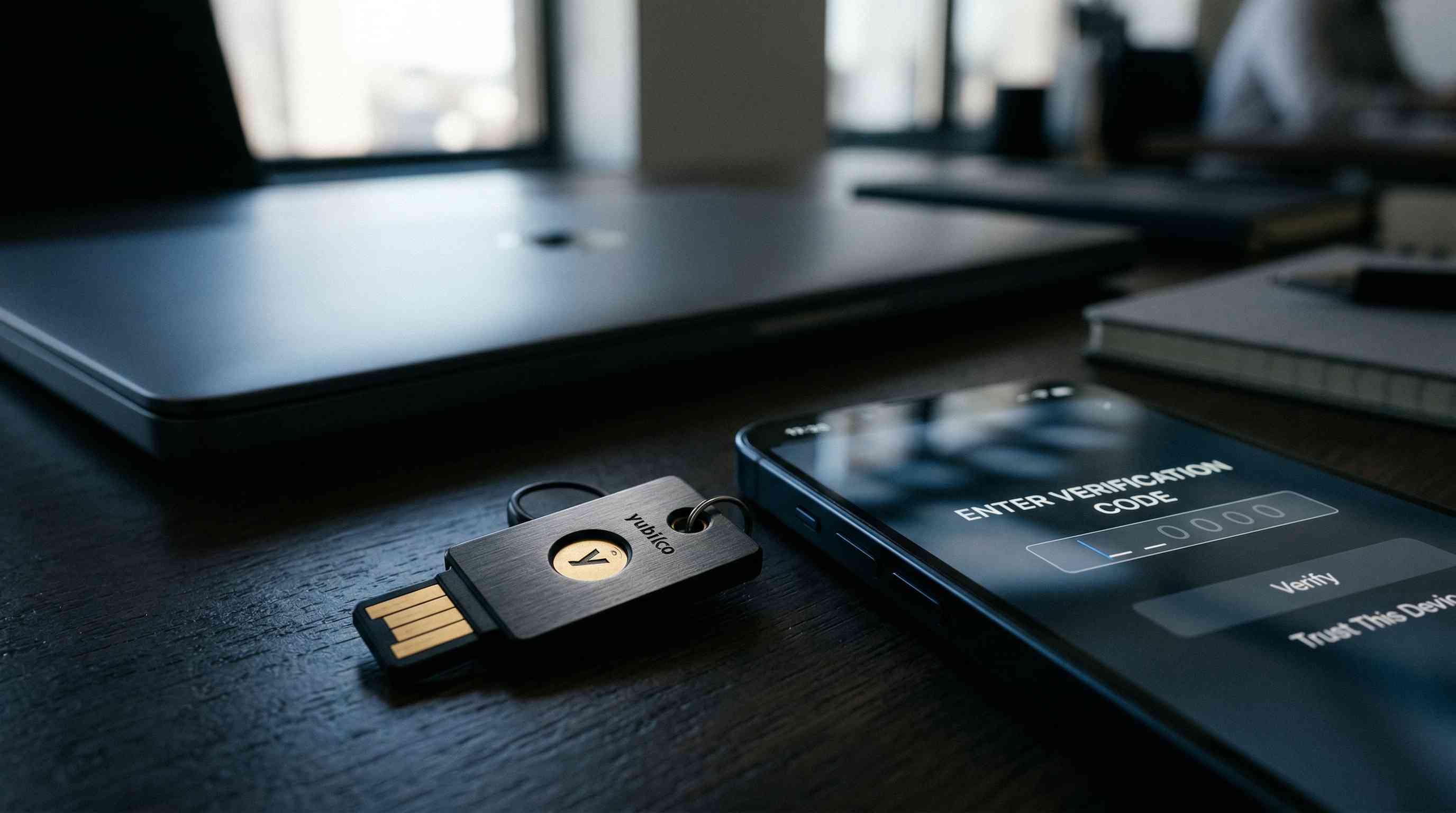
Two-factor authentication (2FA) requires two separate proofs of identity instead of one [2:38]:
- Something you know — your password.
- Something you have — a code on your phone.
It works like a bank vault where the key alone is not enough; a guard also checks your face [2:50]. Enabling 2FA everywhere is the single biggest security upgrade after adopting strong, unique passwords.
What are essential password habits to follow?
- Never share a password through any channel [3:08].
- Never save passwords in mobile browsers [3:12].
- Remember that most phishing emails exist to steal exactly one thing: your credentials [3:16].
Unique passwords contain the blast radius of a breach. 2FA blocks stolen credentials from being useful. Together, they form a layered defense strategy [3:24]. Every password decision you make is an act of access control — strong, unique, stored in a manager, and backed by 2FA. That is the full stack standing between an attacker and everything behind that door [3:34].