Países y nacionalidades en inglés
Clase 12 de 13 • Curso de Inglés Básico A1: Verbo To Be
Contenido del curso

El verbo "to be" en inglés
- 2

Uso y práctica del verbo "to be" en inglés básico
07:04 min - 3

Contracciones con el verbo To Be en inglés
04:34 min - 4

Formación de Oraciones Negativas con el Verbo "To Be" en Inglés
05:49 min - 5

Conjugar "to be" en inglés: contracciones y formas negativas
06:29 min - 6

Preguntas con el Verbo "To Be" en Inglés
06:59 min - 7

Uso de Contracciones en Respuestas en Inglés
07:22 min - 8

Práctica del verbo to be en preguntas y respuestas simples
01:10 min
Usa "this" para presentaciones


Preguntas con "where" en Inglés

Practica tu Inglés

Resumen
Build confidence asking and answering nationality questions in English. Practice the key question Where are you from?, connect countries with nationalities, and use clear pronunciation and natural contractions for fluent replies.
What are nationality questions in English?
We use where to ask about origin and nationality. There are two correct answer patterns: with from + country or with only the nationality adjective. Both are natural.
How do you ask and answer with where and from?
- Where are you from? I’m from Colombia. I’m Colombian.
- Where is he from? He’s from the United States. He’s American.
- Where are they from? They’re from France. They’re French.
- Where is she from? She’s from Mexico. She’s Mexican.
- Where am I from? You’re from Colombia. You’re Colombian.
Which contractions make answers sound natural?
- I am → I’m.
- He is / She is → He’s / She’s.
- They are → They’re.
- You are → You’re.
How to connect countries and nationalities?
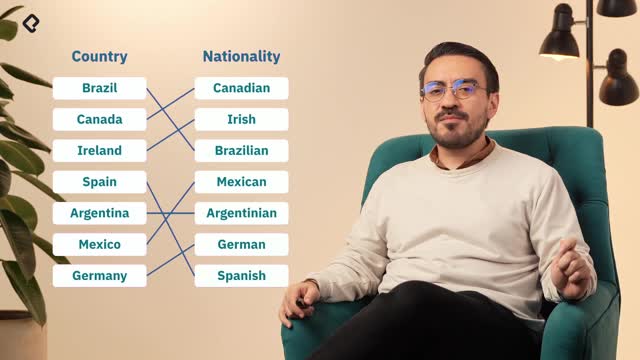
Link each country to its nationality adjective. Repeat aloud to practice pronunciation and spelling. Notice that nationality words are capitalized in English.
Which country–nationality pairs appear?
- Brazil → Brazilian.
- Canada → Canadian.
- Ireland → Irish.
- Spain → Spanish.
- Argentina → Argentinian.
- Mexico → Mexican.
- Germany → German.
- United States (of America) → American.
- France → French.
- Colombia → Colombian.
Which pronunciation tips matter?
- Spain, Spanish: not “E-spain”, not “E-spish”. Say “Spain”, “Spanish”.
- Germany, German: not “Herman”. Say “German”.
- Argentina: say “Ar-gen-ti-na” clearly.
How to practice with examples and answers?
Real mini-dialogues help you check form and meaning. Focus on the two valid answer options every time: from + country and nationality.
What sample dialogues show?
- “Paula, where are you from?” “I am from Argentina.” “So you’re Argentinian?” “Yes, I am Argentinian.”
- “Jess, where are you from?” “I’m from the United States of America.” “So you are American?” “Yes, I’m American.”
- “Luis, where are you from?” “I am from Brazil.” “So you’re Brazilian?” “Yes, I am Brazilian.”
What exercise answers can you check?
-
- Where are you from? I’m Irish. I’m from Ireland.
-
- Where are they from? They’re Canadian. They’re from Canada.
-
- Where is she from? She’s Mexican. She’s from Mexico.
-
- Where am I from? You’re Colombian. You are from Colombia.
Share your own answers and examples in the comments, and compare them with the model answers.