Mastering the Verb To Be in English
The verb to be is foundational in English grammar. It is not only one of the most commonly used verbs, but it also plays a key role in helping learners describe, question, and communicate effectively. This guide summarizes the core ideas and practical applications of the verb to be as outlined in the transcription.
Why the Verb To Be Is So Important
The verb to be is essential because it allows speakers to:
- Describe people, places, and things.
- Talk about themselves and others.
- Ask and answer questions in everyday situations.
- Introduce people or objects.
Example Uses:
- Describing people or feelings:
- She is happy.
- He is not angry.
- Describing objects or size:
Using the Verb To Be for Descriptions
When describing someone or something in the present, use the appropriate form of to be based on the subject.
Forms of the verb to be:
- I am
- You are
- He/She/It is
- We are
- They are
Example Sentences:
- I am tired.
- They are excited.
- It is small.
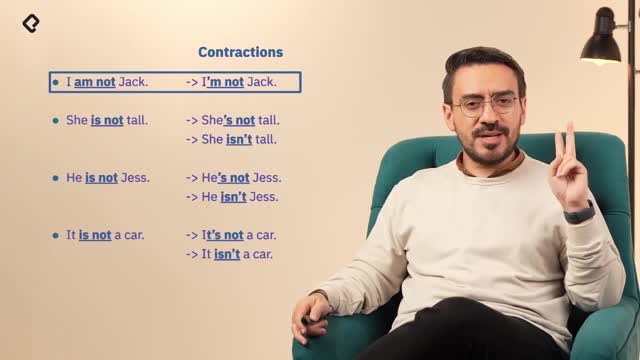
Contractions with the Verb To Be
Contractions are very common in spoken and informal written English. They help make speech sound more natural and fluent.
Common Contractions:
- She is → She’s
- They are → They’re
Hypothetical Examples:
- He’s a good friend.
- We’re ready to go.
Making Negative Sentences
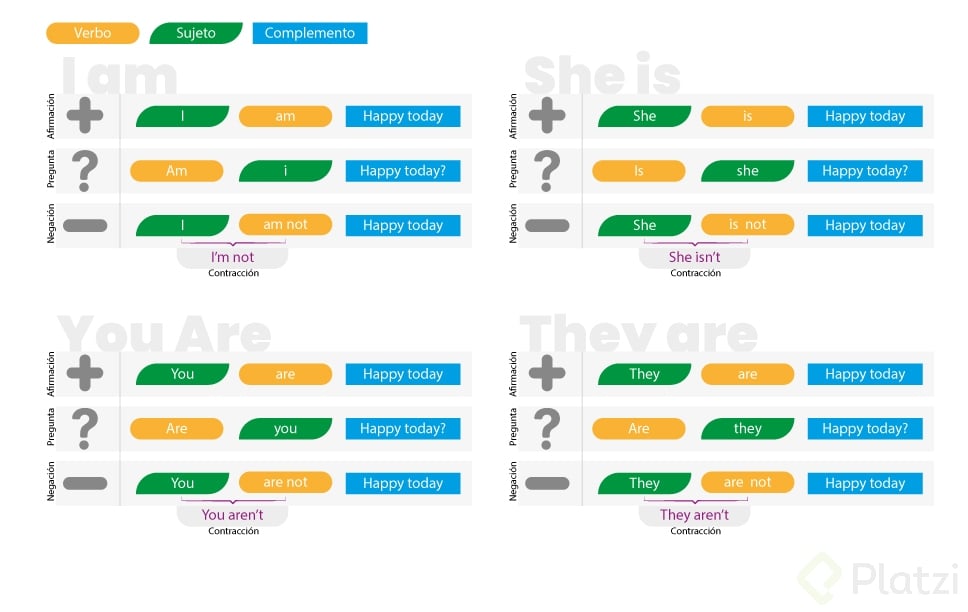
To create a negative sentence, simply add "not" after the verb to be.
Structure:
[Subject] + [form of to be] + not + [rest of sentence]
Examples:
- They are not sad.
- He is not angry.
You can also use contractions:
- He is not → He isn’t
- They are not → They aren’t
Asking Questions with the Verb To Be
To ask a yes/no question, invert the subject and the form of to be.
Question Structure:
[Form of to be] + [subject] + [rest of sentence]?
Examples:
- Is it cold? → Yes, it is.
- Are they happy? → No, they are not.
This structure is essential for basic conversations and interactions.
Introducing People and Things
The verb to be is also used to introduce someone or something using “This is”.
Examples:
- This is my friend Anna.
- This is my brother Juan.
- This is my coffee.
- This is my laptop.
This structure is especially useful in social and classroom settings.
Course Overview and Learning Support
In this course, the focus is on using the verb to be in the present tense. Learners will receive:
- Practice exercises in each class.
- Downloadable materials to reinforce learning.
- Guidance from an experienced teacher.
Instructor: John Carvajal
An English teacher with over 12 years of global teaching experience.
Conclusion: The Power of the Verb To Be
The verb to be is:
- Simple, yet versatile
- A fundamental building block of English
- Crucial for descriptions, questions, and introductions
By mastering the verb to be, learners gain the confidence to start speaking and writing in English more effectively. This course offers both the structure and support needed to become proficient.
Final Message:
Let’s master the use of the verb to be together—see you in the next class!