Cómo Hacer Suposiciones en Inglés Usando Modales
Curso de Inglés Intermedio B1: Adjetivos y Preguntas Indirectas
Contenido del curso

¿Cómo se utiliza la voz pasiva?


¿Cuándo se utilizan las preguntas indirectas?


Sugerencias, inferencias y suposiciones en inglés.


¿Cómo puedo formar adjetivos y utilizarlos en oraciones?
- 15

Creación de Adjetivos a partir de Sustantivos y Verbos con Sufijos
05:06 min - 16

Orden correcto de adjetivos en inglés
03:49 min - 17

Identificación de Sustantivos Abstractos y Concretos
01:42 min - 18

Gerúndio ou infinitivo: quando usar cada um
05:20 min - 19

Superlativos y presente perfecto en español
04:58 min - 20

Cómo describir lugares con gerundios y adjetivos
00:42 min - 21

Práctica de conversación en inglés para describir y opinar
00:00 min
Consolida tus habilidades
- 22
Autoevaluación del curso
- 23

Adjetivos en Inglés y Preguntas Indirectas: Curso Intermedio
01:14 min
Recursos
Resumen
Making assumptions is something we do every single day, often without thinking about it. In English, there are specific structures that help you express those guesses about past events with clarity and precision. Understanding these patterns will give you confidence when speaking and writing, especially when you want to speculate about what happened in a situation you didn't fully witness.
How do you form assumptions about the past in English?
The key to making assumptions lies in combining modal verbs with have + past participle. This structure allows you to talk about things you believe happened — or didn't happen — even when you don't have all the facts [0:52].
Consider this scenario: a man is sitting in a park, holding his head, looking worried. Based on the visual clues, you can say:
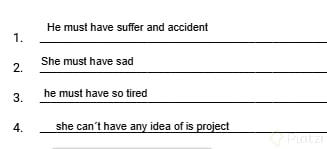
- He must not have set the alarm. You're guessing he overslept and missed something important.
- He must have forgotten his book. Perhaps he needed it for a university class.
- He can't have seen the bus number in time. He probably missed the right bus and now has to wait.
The structure is straightforward:
- Must / must not / can't + have + past participle.
Pay attention to the verb form after have. Regular verbs add -ed (like received), but irregular verbs change form depending on the verb (like seen, caught, won). Reviewing your list of irregular past participles is essential for using this structure correctly [2:20].
What is the difference between must have and can't have?
This is where many learners get confused, but the distinction is actually quite clear [2:42].
When do you use must not have?
Use must not have when you are fairly sure something happened in the past. You're making a strong assumption based on evidence. For example, "They must not have caught the plane on time" suggests you're quite confident they missed their flight.
When do you use can't have?
Use can't have when you believe something was impossible in the past. It expresses disbelief or strong doubt. Saying "She can't have received the dress for the party" means you find it very unlikely that she got the dress.
In short:
- Must (not) have = you're confident about your guess.
- Can't have = you think something was impossible or extremely unlikely.
How can you practice making assumptions with real examples?
Looking at images and creating your own sentences is one of the best ways to internalize this grammar. Take a picture of two people looking extremely happy [3:12]. Here are some possible assumptions:
- They must have won the lottery. Their level of happiness suggests something big happened.
- They can't have lost money. Maybe they feared losing money in a business deal, but it turned out well, and now they are relieved.
- They must have received an apartment. Getting a new home is certainly a reason to celebrate.
Notice how each assumption uses a different modal to express a different degree of certainty. Practicing with various images helps you get comfortable choosing between must have, must not have, and can't have depending on what you want to communicate.
Try creating your own assumptions and share them in the comments — it's a great way to get feedback and see how other learners approach the same images.
Cómo Hacer Suposiciones en Inglés Usando Modales