When you place more than one adjective before a noun in English, the order matters. Understanding the correct sequence makes your sentences sound natural and fluent, and it is one of those grammar rules that native speakers follow instinctively. Let's break down exactly how it works.
What is the correct order of adjectives in English?
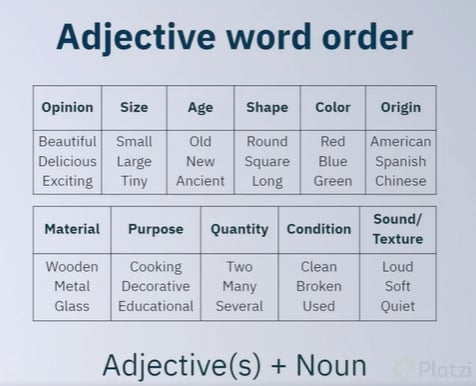
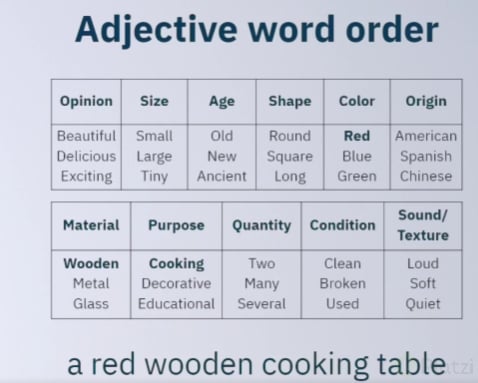
In English, adjectives follow a specific sequence known as the adjective order [0:37]. The standard categories, from first to last, are:
- Opinion – what you think about the noun (beautiful, nice, amazing, wonderful).
- Size – how big or small it is (big, small, tiny, little).
- Age – how old or new (new, old, antique).
- Shape – the form of the noun (round, square).
- Color – the shade (red, blue, black, colorful).
- Origin – where it comes from (Spanish, French, Italian, European).
- Material – what it is made of (wooden, leather, plastic).
- Purpose – what it is used for (cooking, sleeping).
Additional categories like quantity, condition, and sound or texture may also appear, but the ones listed above are the most common in everyday speech [1:17].
How does this order look in real sentences?
A short story in the lesson illustrates the pattern clearly [0:11]. Consider these noun phrases:
- Beautiful new places – opinion + age + noun.
- Nice little town – opinion + size + noun.
- Delicious European restaurants – opinion + origin + noun.
- Colorful natural landscapes – color + purpose/type + noun.
- Tiny quiet cafe – size + opinion + noun.
- Big antique windows – size + age + noun.
Notice that you rarely need all the categories at once. Most combinations involve two or three adjectives before the noun [2:50].
How can you practice adjective order?
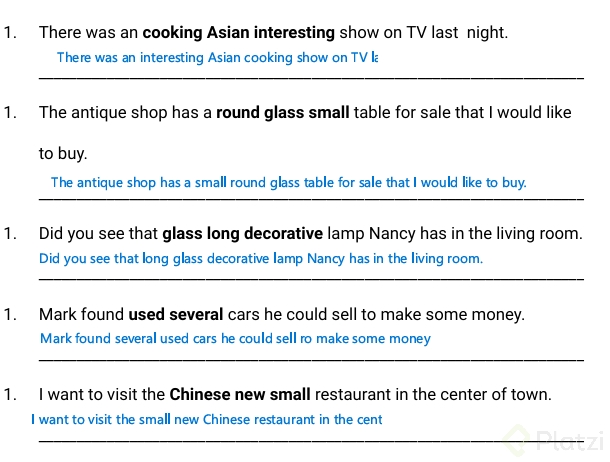
The lesson includes a short exercise where you organize scrambled adjectives [2:05]. Here are the correct answers:
- Big antique blue house – size + age + color.
- Amazing French plastic chair – opinion + origin + material.
- Small black leather boots – size + color + material.
- Wonderful old Italian restaurant – opinion + age + origin.
Why does mastering adjective order matter?
Using the right sequence is a sign of natural-sounding English. Even if listeners understand you when the order is off, following the pattern makes your speech smoother and more professional. A helpful tip: start with your opinion, then move through more objective qualities like size, age, and color before reaching origin and material [1:30].
Try creating your own noun phrases using two or three adjectives and check them against the table. Share your examples in the comments and see how natural they sound!