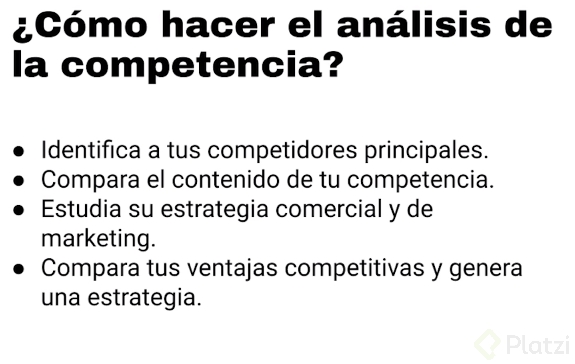
Preguntándole a Chat GPT 3.5 por mi caso de práctica, esto fue lo que arrojo:
Certainly, conducting a competitive analysis is a crucial step in understanding your market and refining your marketing strategy. Here's how to operationalize this process and some tools that can help:
**Step 1: Identify Competitors**
1. **Direct Competitors:** These are businesses that offer similar macro-conscious meal subscription services. To find them:
- Conduct keyword research: Use tools like Google Keyword Planner, SEMrush, or Ahrefs to identify websites and brands ranking for relevant keywords like "macro-conscious meal delivery" or "healthy lunch subscription."
- Explore social media and online communities: Look for businesses that your target audience discusses or recommends in forums, Facebook groups, or Reddit.
2. **Indirect Competitors:** These are businesses that may not offer the exact same service but cater to a similar audience or provide alternative solutions to your customers' needs. To find them:
- Use broader keyword searches: Expand your keyword research to include terms related to health and wellness, meal planning, dieting, or nutrition.
- Look at customer reviews: Check out reviews and comments on your direct competitors' websites or social media to see if customers mention alternative solutions they've tried.
**Step 2: Content Analysis**
Once you've identified your competitors, analyze their content to understand their marketing strategies:
1. **Website Content:**
- Study their website structure, design, and user experience.
- Analyze their blog posts, articles, and product descriptions for the topics they cover and the depth of information provided.
- Look for customer testimonials and case studies to understand their approach to social proof.
2. **Social Media Analysis:**
- Review their social media profiles on platforms like Facebook, Instagram, and Twitter.
- Examine the frequency and types of posts they share (e.g., recipes, success stories, promotions).
- Assess their engagement levels (likes, comments, shares) and the strategies they use to interact with their audience.
3. **Email Marketing:**
- If possible, subscribe to their email list to see the type of content they send to subscribers.
- Analyze the frequency, content, and design of their email campaigns.
4. **Content Marketing Tools:**
- Utilize content analysis tools like BuzzSumo or SEMrush to see which of their content pieces are performing well and generating social shares.
**Step 3: Study Their Marketing Strategy**
1. **Competitor Analysis Tools:**
- Tools like SEMrush, Ahrefs, and SpyFu can provide insights into your competitors' organic and paid search strategies, including the keywords they target, their backlink profile, and their advertising campaigns.
2. **Social Media Monitoring:**
- Use social media listening tools like Brandwatch, Mention, or Hootsuite to track mentions of your competitors and monitor their social media performance.
3. **Competitor Benchmarking:**
- Create a competitive benchmarking spreadsheet to compare your brand's performance metrics (e.g., website traffic, social media engagement, email open rates) with those of your competitors.
4. **SWOT Analysis:**
- Conduct a SWOT (Strengths, Weaknesses, Opportunities, Threats) analysis for each competitor to identify areas where your brand can differentiate itself.
By operationalizing these steps and leveraging the suggested tools, you can gain valuable insights into your competitors' strategies, content, and overall market positioning. This information will help you refine your own marketing strategy and stand out in the macro-conscious lunch subscription industry.