When to Use Past Simple and Continuous
Contenido del curso

Expresiones de Cantidad en Inglés


Haz descripciones en Inglés



Tipos de pronombres


Verbos "especiales" en Inglés


Conjunciones y su uso


Determinantes en Inglés

Ofrecimientos y solicitudes en Inglés


¡Sigue practicando tu Inglés!

Recursos
Resumen
Learning how to use when in past simple and past continuous sentences is a turning point in your English journey. You stop sounding like a beginner stringing facts together and start telling stories with rhythm, just like native speakers do. This guide shows you when each tense fits and how when glues two ideas into one fluent sentence.
What is the past simple and when should you use it?
You use the past simple to talk about an action that happened at a definite moment in the past. Think of sentences like I ate pizza yesterday or I saw my friend two weeks ago. The action is finished, and the time is clear.
This tense works with both regular and irregular verbs, so building your vocabulary list of irregular forms pays off fast. The structure is simple: subject plus verb in past form.
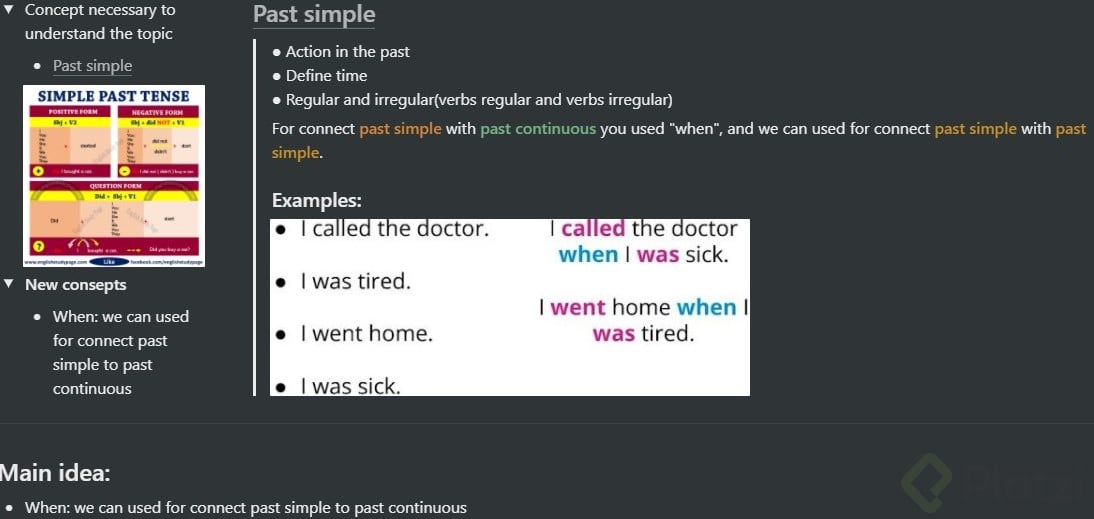
What is the past simple used for? It describes a finished action that happened at a specific time in the past, such as I called the doctor or I went home. The time can be stated or understood from context.
How do you join two past simple sentences with when?
Here is where when becomes your best friend. Instead of writing two short, choppy sentences, you can merge them into one smoother idea. Take I met him and I was at school. Together they become I met him when I was at school.
Try this mini exercise with four sentences: I called the doctor, I was tired, I went home, I was sick. Pause and combine them. The natural pairs are:
- I called the doctor when I was sick.
- I went home when I was tired.
Notice how when signals the reason or the moment that triggered the main action.
How does the past continuous work in English?
The past continuous describes an action that was in progress at some point in the past. It can refer to a definite time or a stretch of time where the action was unfolding. You form it with the verb to be in past simple (was or were) plus a verb ending in ing.
Examples like I was opening the door or I was going to school paint a picture of something happening, not something completed. That ongoing feeling is the heart of this tense.
How do you form the past continuous? Use was or were plus a verb with ing. For example, she was studying, they were running, I was walking home.
How do you combine past simple and past continuous with when?
This combo is where storytelling gets interesting. The pattern means something was happening when another thing happened. One action was already in motion, and a second action interrupted or joined it.
Look at these examples from the class:
- I met him when I was going to school.
- I was opening the door when you arrived.
The ongoing action uses past continuous. The sudden or shorter action uses past simple. When connects them and shows the exact moment they crossed paths.
Now practice with these four pieces: I was walking home, He broke his leg, I saw you, He was skiing. The natural matches are:
- I was walking home when I saw you.
- He broke his leg when he was skiing.
In both cases, one action was in progress while another one cut through it.
Why does mixing tenses with when matter for fluency?
Mixing tenses with when helps you describe real life the way it actually happens. Life is rarely one action at a time. You were cooking when the phone rang. You were studying when your friend texted. Native speakers use this structure constantly, and once you internalize it, your English sounds far more natural.
A quick recap of the logic:
- Past simple plus past simple: two finished actions linked in time.
- Past continuous plus past simple: an ongoing action interrupted by a sudden one.
- When is the bridge that connects both halves of the sentence.
When do I use past continuous instead of past simple? Use past continuous when the action was already happening at that moment, like I was reading. Use past simple when the action started and finished quickly, like the phone rang.
Try writing your own examples in the comments. Mix past simple with past simple, then past simple with past continuous. The more you practice combining ideas, the faster when will feel automatic in your speech.
When to Use Past Simple and Continuous