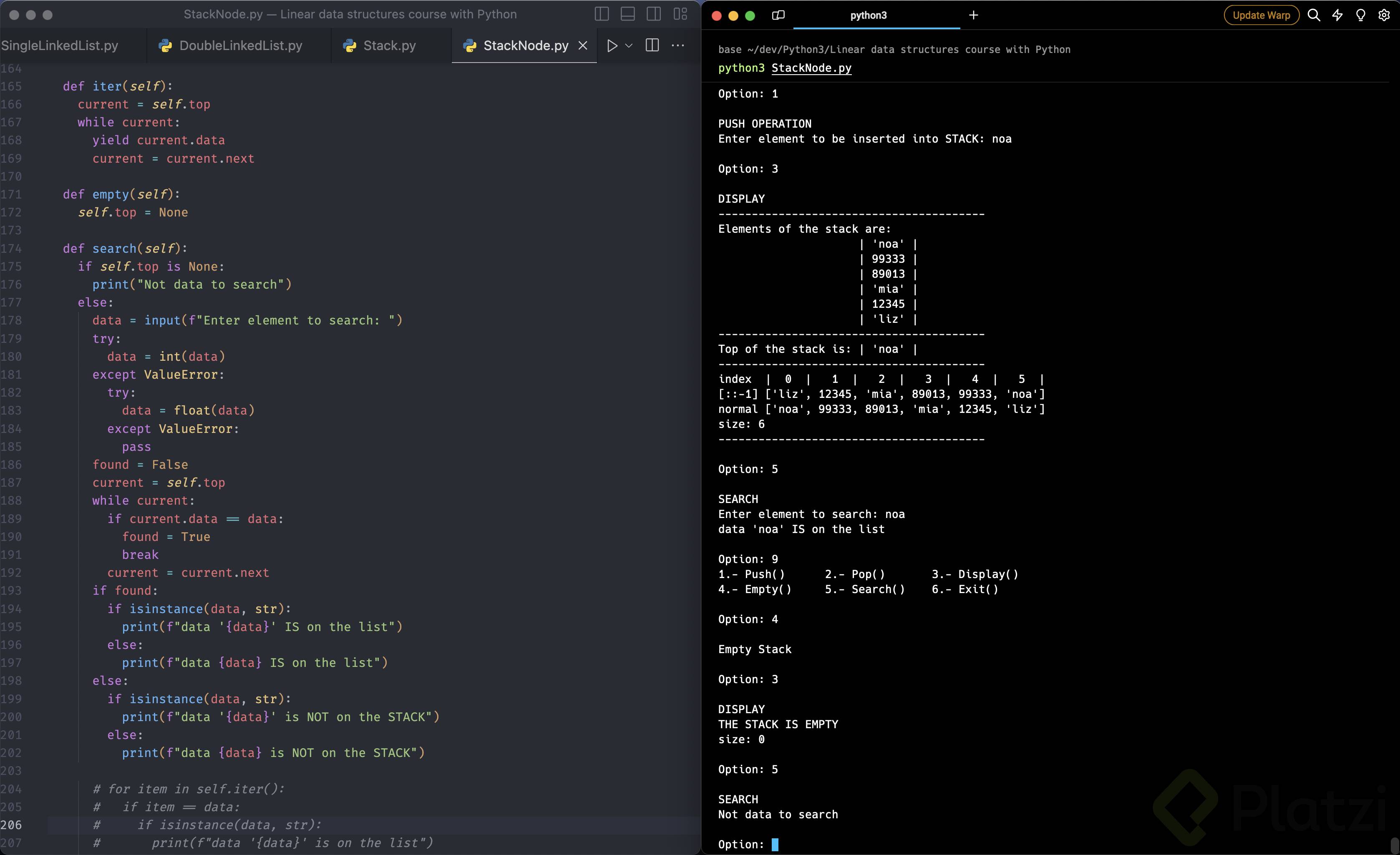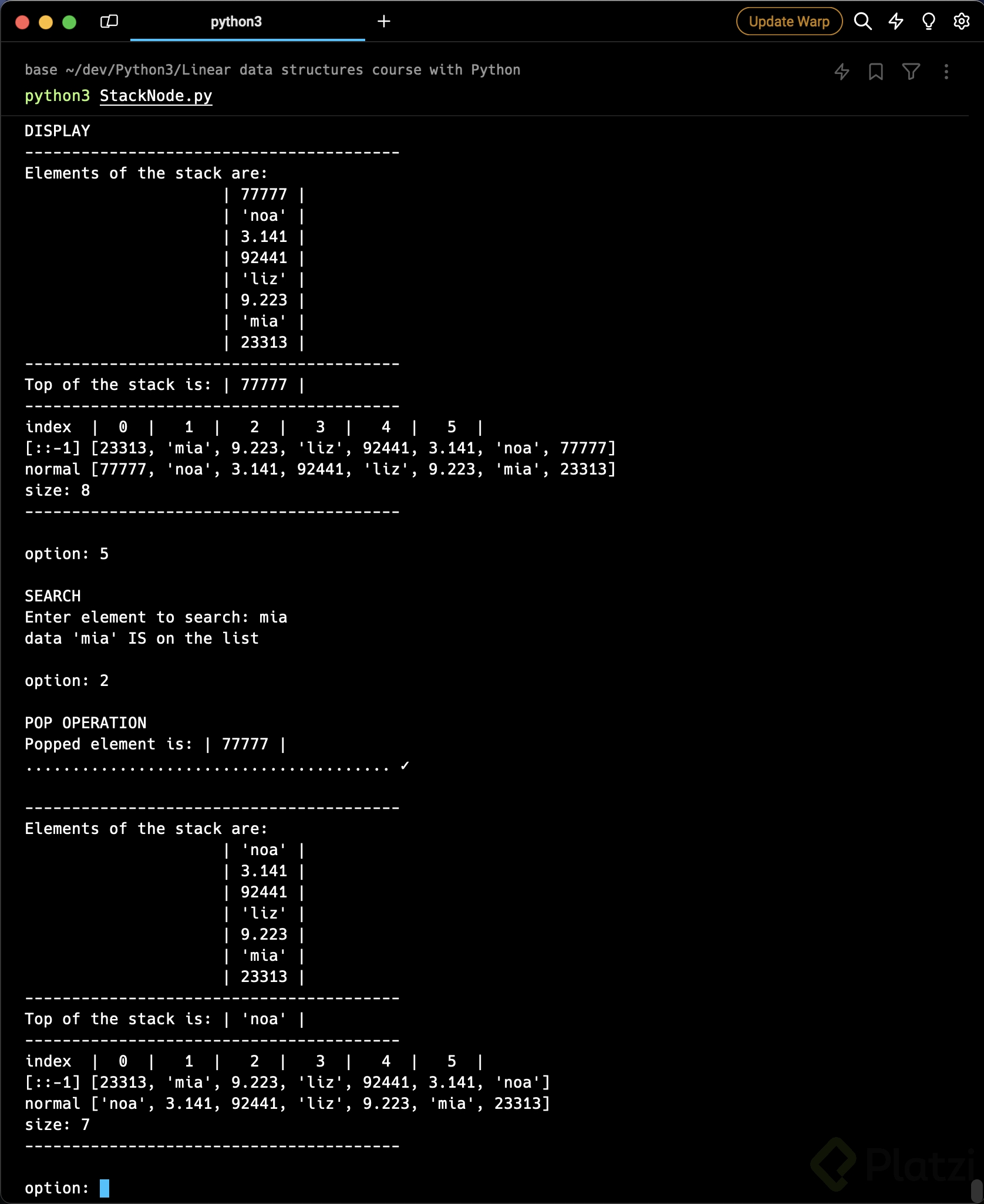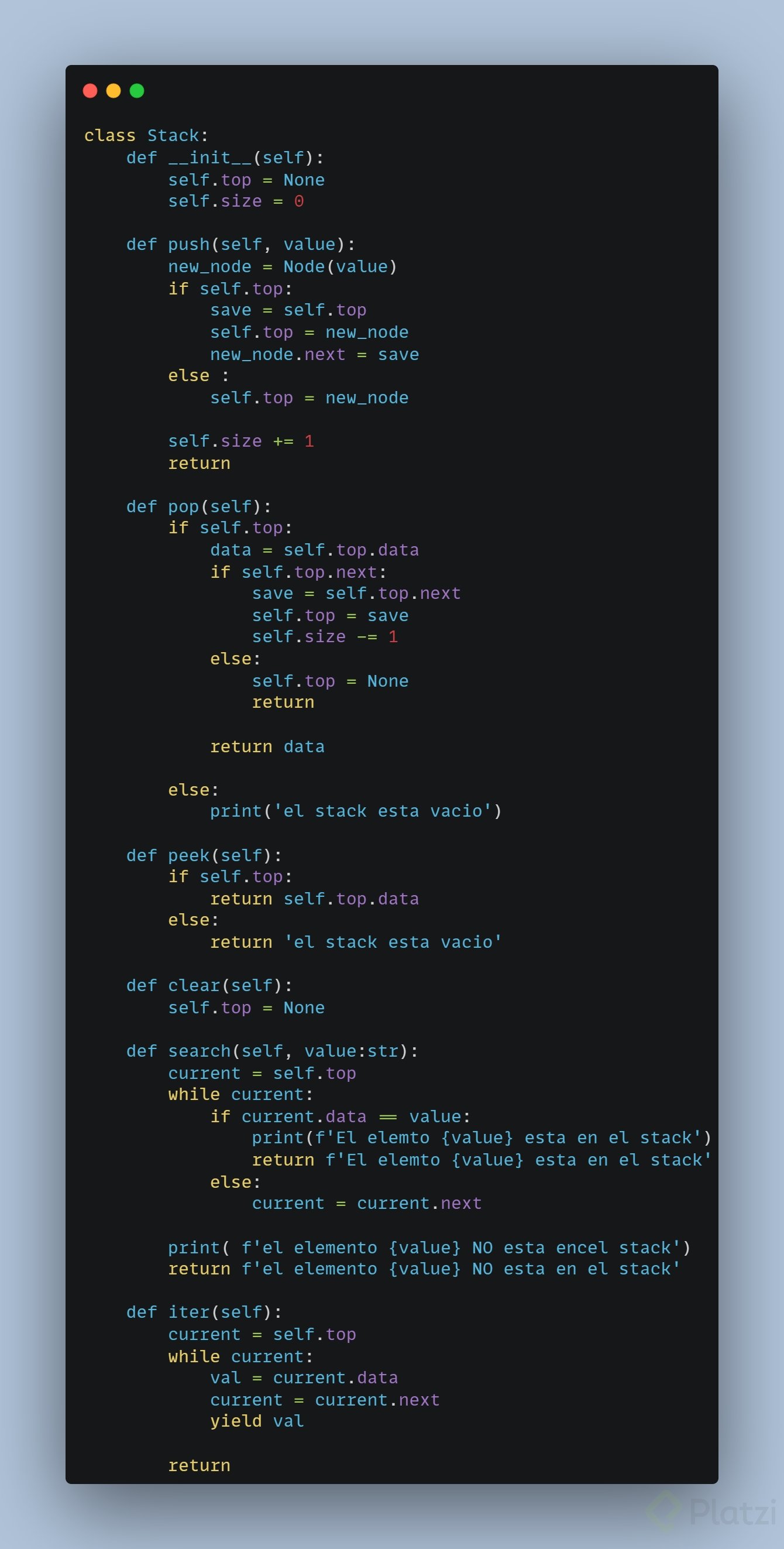
Implementar una pila o stack en Python usando nodos es una de las formas más elegantes de comprender cómo funciona esta estructura de datos dinámica. A continuación se desglosa paso a paso cómo construirla, qué métodos esenciales necesita y cuándo conviene usar nodos en lugar de arrays.
¿Cómo se inicializa un stack con nodos en Python?
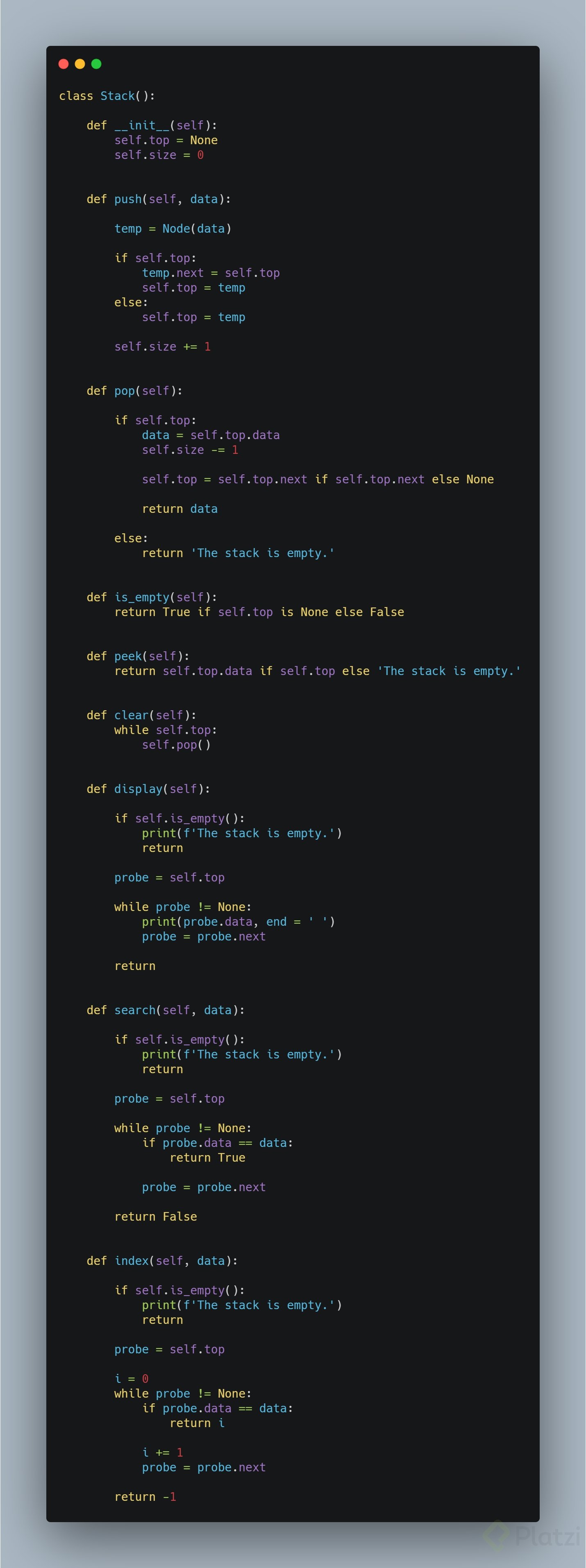
El primer paso es crear un archivo llamado stack.py e importar la clase Node [00:21]. La clase Stack se define con un método constructor que establece dos atributos fundamentales:
self.top: apunta al elemento que está en la cima del stack, inicialmente es None porque el stack comienza vacío.
self.size: indica el tamaño actual, comienza en cero.
Esto convierte al stack en una estructura de datos dinámica, capaz de crecer o decrecer conforme se agregan o retiran elementos [00:40].
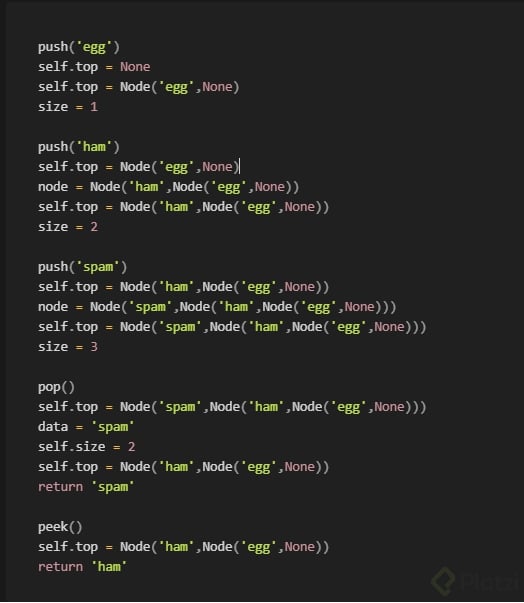
El método push recibe un dato, crea un nodo y lo coloca en la cima del stack [01:02]. Si ya existe un elemento en self.top, el nuevo nodo apunta hacia él mediante next. Después, self.top se actualiza al nodo recién creado y el tamaño incrementa en uno.
El método pop retira el elemento que está hasta arriba del stack y retorna su valor [01:42]. Primero verifica que exista un elemento en self.top. Si lo hay, guarda el dato, decrementa el tamaño y reposiciona self.top hacia el siguiente nodo. Cuando no queda ningún nodo después, self.top se vuelve None.
python
def pop(self):
if self.top:
data = self.top.data
self.size -= 1
if self.top.next:
self.top = self.top.next
else:
self.top = None
return data
else:
print("El stack está vacío")
Aquí se aplica el principio LIFO (last in, first out): el último elemento en entrar es el primero en salir [03:38].
¿Cómo consultar la cima con peek?
El método peek simplemente retorna el dato del elemento que está en la cima sin removerlo [02:34]. Si el stack está vacío, muestra un mensaje indicándolo.


python
def peek(self):
if self.top:
return self.top.data
else:
print("El stack está vacío")
¿Cómo vaciar el stack con clear?
El método clear utiliza un ciclo while que llama repetidamente a pop mientras exista un elemento en self.top [02:55]. De esta forma se eliminan todos los nodos de manera iterativa.
python
def clear(self):
while self.top:
self.pop()
¿Cuándo usar nodos y cuándo usar arrays para un stack?
Durante la prueba en terminal se agregaron tres elementos: egg, ham y spam usando push [03:12]. Al llamar a pop, salió spam primero porque fue el último en entrar, confirmando el comportamiento LIFO.
La diferencia entre implementar un stack con nodos o con arrays tiene implicaciones prácticas [04:30]:
Usa arrays cuando conoces de antemano el número máximo de elementos, ya que al crear un array defines su capacidad fija.
Usa nodos cuando los elementos son pocos y necesitas flexibilidad, porque la estructura crece dinámicamente sin un límite predefinido.
Sin embargo, al igual que con las linked lists, agregar muchos nodos incrementa la complejidad del código [04:40].
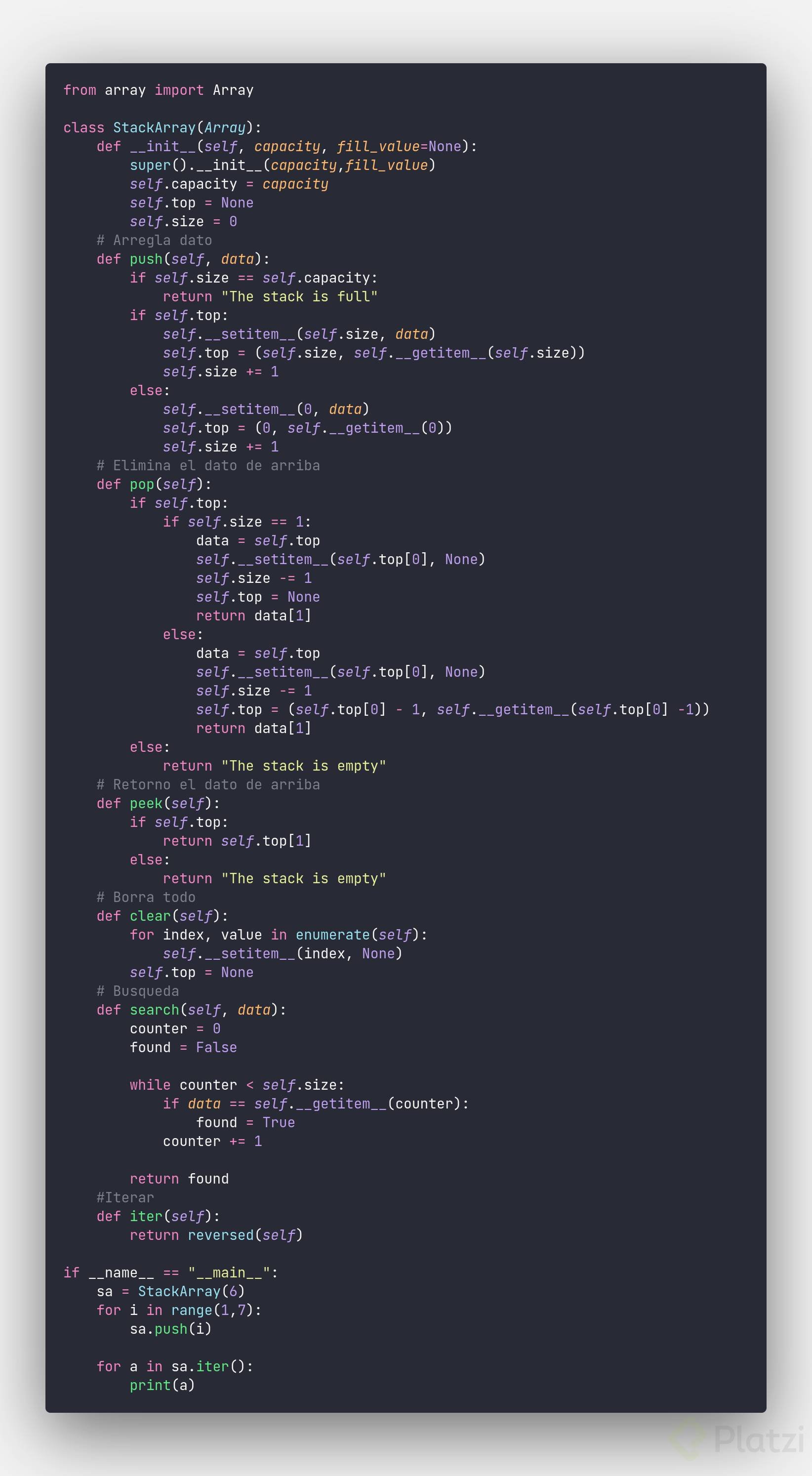
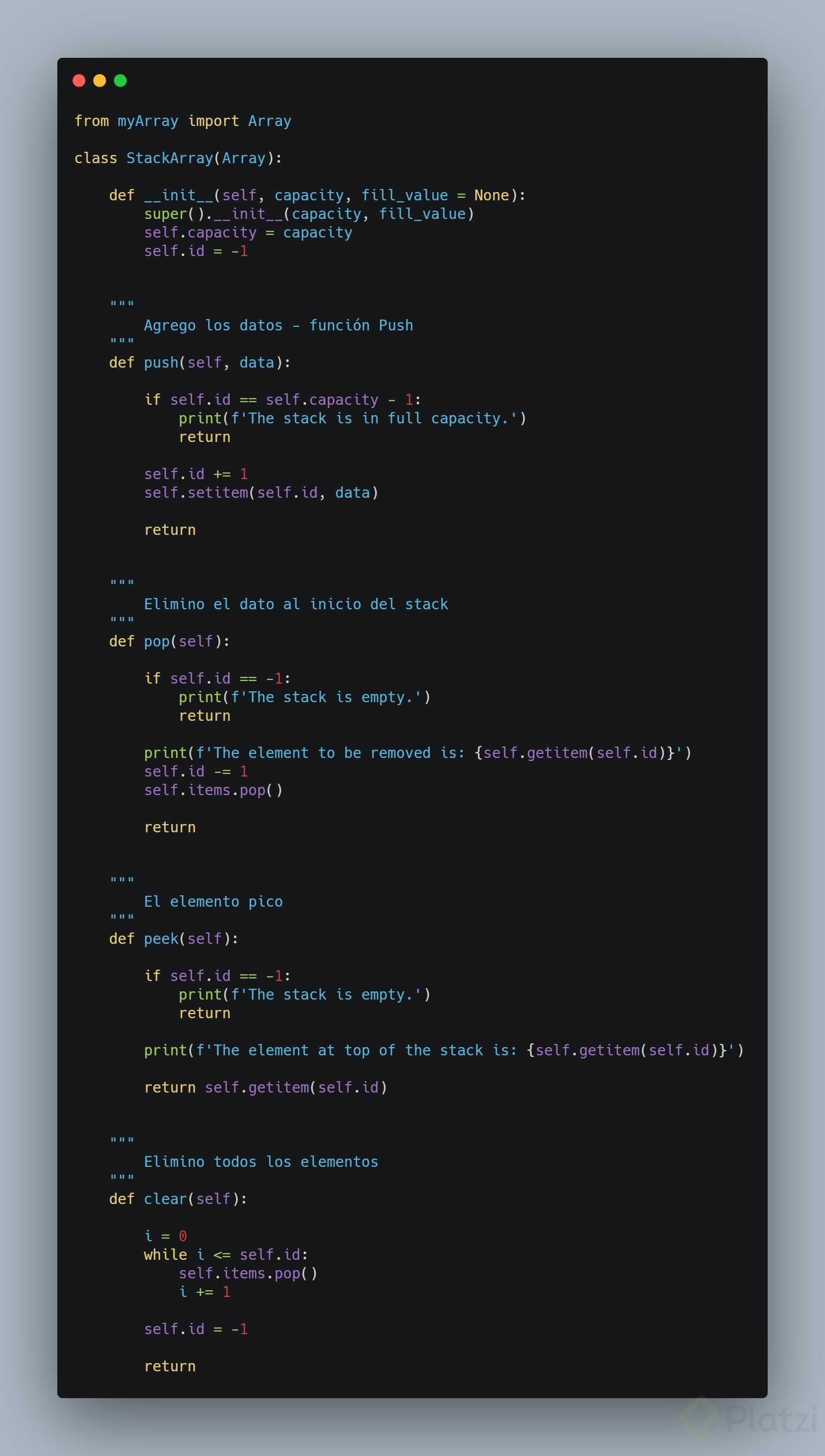
El reto propuesto consiste en añadir métodos para buscar un elemento en particular, crear un iterador que recorra el stack, implementar clear de una forma diferente, y finalmente construir una segunda clase stack basada en arrays con herencia, aplicando la misma lógica pero trabajando con índices [05:05]. ¿Se te ocurre otra forma de vaciar un stack sin usar pop repetidamente? Compártelo en los comentarios.
classArray: def __init__(self, capacity, fill_value=None): self.items=list()for _ inrange(capacity): self.items.append(fill_value) def __len__(self):returnlen(self.items) def __str__(self):returnstr(self.items) def __iter__(self):returniter(self.items) def __getitem__(self, index):return self.items[index] def __setitem__(self, index, new_item): self.items[index]= new_item
classStackArray(Array): def __init__(self, capacity, fill_value=None):super().__init__(capacity, fill_value) self.capacity= capacity
self.top=None self.size=0 def __str__(self): result =''if self.size<=0:return'Stack empty'for i in self.items:if i !=None: result += f'{i} 'return result
def push(self, data):if self.size== self.capacity:print('Stack full')return-1for i, value inenumerate(self.items):if value ==None: self.items[i]= data
self.top= data
self.size+=1break def pop(self):for i inrange(self.capacity-1,-1,-1):if self.items[i]!=None: self.items[i]=None self.size-=1if i >0: self.top= self.items[i-1]else: self.top=Nonebreak def peek(self):if self.top:return self.topelse:return"The stack is empty" def clear(self): self.__init__(self.capacity) def search(self, target_item):if self.size<=0:print("The stack is empty")else:if target_item in self.items:print(f'Target item {target_item} has been found')return self.items.index(target_item)else:print(f'Target item {target_item} is not in stack')return-1 def iter(self):for element in self.items:if element !=None:yield element
from node importNodeclassStack: def __init__(self): self.top=None self.size=0 def push(self, data): node =Node(data, self.top)if self.top: node.next= self.top self.top= node
else: self.top= node
self.size+=1 def pop(self):if self.top: data = self.top.data self.size-=1if self.top.next: self.top= self.top.nextelse: self.top=Nonereturn data
else:return("The stack is empty") def peek(self):return self.top.dataif self.topelse("The stack is empty") def clear(self):while self.top: self.pop() def search_element(self, data):if self.top: current = self.topwhilecurrent:if current.data== data:return(f'Elemet {data} founded') current = current.nextreturn(f'Elemet {data} not founded')
Para el método clear no quedaría más corto simplemente quitar el valor de self.top y poner el tamaño de la lista en cero o hay algo que me estoy saltando?
def clear(self): self.top=None self.size=0
Es una opción totalmente válida, lo importante es que hayas pensado en esa alternativa ;)
También pense en esta posibilidad. Borrando la referencia de self.top. Supongo que posteriormente el garbage collector elimina los nodos.
from mi_stack importStackdef run(): stack =Stack() stack.push('A') stack.push('B') stack.push('C') stack.push('D')show_stack(stack)print(stack.pop())print(stack.pop())show_stack(stack) stack2 =Stack() stack2.push('X') stack2.push('Y') stack2.push('Z') stack.add(stack2)show_stack(stack) stack.clear()show_stack(stack)def show_stack(stack):print('=======================') position =1for node instack:print(f'Position {position} dato {node.data}') position +=1if __name__ =='__main__':run()
También pensé en el Garbange collector, pero no sabía como llamarlo.
Muchas Gracias!
Reto
Código
Stack con nodos
from typing import Optional, Union
from typing import Iterable
from node import Node
classStack:"""A simple stack implementation.""" _size:int _top: Optional[Node]def__init__(self,*items):"""Initializes the stack.""" self._top =None self._size =0iflen(items)>0andisinstance(items[0], Iterable): items = items[0]for item in items: self.push(item)defis_empty(self):"""Checks if the stack is empty.
Returns:
bool: True if the stack is empty, False otherwise.
"""return self._size <=0defclear(self):"""Clears the stack.""" self._top =None self._size =0defcopy(self):"""Returns a copy of the stack.
Caution: This method returns a shallow copy.
Returns:
Stack: A copy of the stack.
""" new_stack = Stack() new_stack._top = self._top
return new_stack
defdepthcopy(self):"""Returns a deep copy of the stack.
Returns:
Stack: A deep copy of the stack.
""" new_stack = Stack() new_stack._top = self._top.depthcopy() new_stack._size = self._size
return new_stack
defextend(self, other:'Stack'):"""Extends the current stack with the items of the other stack.
Time complexity: O(n) where n is the length of the other stack.
Args:
other: The other stack to extend the current stack with.
"""if other._top isNone:returnNone bottom_node = other._top
while bottom_node.nextisnotNone: bottom_node = bottom_node.next bottom_node.next= self._top
self._top = other._top
self._size += other._size
returnNonedefpeek(self, raw:bool=False)-> Union[None, Node,object]:"""Returns the top item of the stack.
Raises IndexError if the stack is empty.
Args:
raw: If True returns the Node, otherwise it will return the node value.
Returns:
object: The top item of the stack.
"""ifnot self._top:raise IndexError('The stack is empty.')if raw:return self._top
return self._top.value
defpush(self, value:object):"""Pushes an item onto the stack.
Time complexity: O(1)
Args:
item: The item to be pushed onto the stack.
""" self._top = Node(value, self._top) self._size +=1defpop(self, raw:bool=False):"""Pops an item off the stack.
Raises IndexError if the stack is empty.
Time complexity: O(1)
Args:
raw: If True returns the Node, otherwise it will return the node value.
Returns:
object: The item that was popped off the stack.
"""if self._top isNone:raise IndexError('The stack is empty.') temp = self._top
self._top = temp.next self._size -=1if raw:return temp
return temp.value
def__len__(self):"""Returns the length of the stack.
Time complexity: O(1)
Returns:
int: The length of the stack.
"""return self._size
def__str__(self)->str:"""Returns a string representation of the stack.
Time complexity: O(n)
Space complexity: O(n)
Returns:
str: A string representation of the stack.
""" items =list(self)returnstr(items)def__contains__(self, item:object)->bool:"""Checks if the stack contains an item.
Args:
item: The item to check if the stack contains.
Returns:
bool: True if the stack contains the item, False otherwise.
""" pointer = self._top
while pointer isnotNone:if pointer.value == item:returnTrue pointer = pointer.nextreturnFalsedefitervalues(self)-> Iterable:"""Returns an iterator over the values of the stack.
Returns:
iterator: An iterator over the values of the stack.
""" pointer = self._top
while pointer isnotNone:yield pointer
pointer = pointer.nextdef__iter__(self)-> Iterable:"""Returns an iterator over the stack.
Returns:
iterator: An iterator over the stack.
"""return self.itervalues()def__add__(self, other):"""Returns a new stack containing the items of both stacks.
Args:
other: The other stack to add to the current stack.
Returns:
Stack: A new stack containing the items of both stacks.
""" new_stack = self.depthcopy() new_stack.extend(other.depthcopy())return new_stack
Stack con listas
from typing import Optional, Union
from typing import Iterable
classStack:"""A simple stack implementation with list.""" _items:listdef__init__(self,*items): self._items =list(*items)defis_empty(self)->bool:returnlen(self._items)==0defclear(self)->None: self._items.clear()defcopy(self)->'Stack': stack = Stack()for item in self._items: stack.push(item)return stack
defextend(self, other: Iterable)->None:for item inreversed(other): self.push(item)defpeek(self)-> Optional[object]:if self.is_empty():raise ValueError('Stack is empty.')return self._items[-1]defpop(self)-> Optional[object]:return self._items.pop()defpush(self, item:object)->None: self._items.append(item)defitervalues(self)-> Iterable:returnreversed(self._items)def__len__(self)->int:returnlen(self._items)def__str__(self)->str:returnstr(self._items)def__contains__(self, item:object)->bool:return item in self._items
def__iter__(self)-> Iterable:return self.itervalues()def__repr__(self)->str:returnf'Stack({self._items})'def__reversed__(self)-> Iterable:return self._items
def__add__(self, other: Union['Stack', Iterable])->'Stack': stack = self.copy()ifisinstance(other, Stack): stack.extend(other)else: stack.extend(other)return stack
Pruebas unitarias
Stack con nodos
# Unitestimport unittest
# Utilsfrom stack_with_node import Stack
classStackWithNodeTestCase(unittest.TestCase):"""Stack test cases."""deftest_empty_instantiation(self):"""Test instantiation of an empty stack.""" stack = Stack() self.assertEqual(len(stack),0)deftest_instantiation_with_items(self):"""Test instantiation of a stack with items.""" stack = Stack(['a','b','c']) self.assertEqual(len(stack),3)deftest_is_empty(self):"""Test is_empty method.""" stack = Stack() self.assertTrue(stack.is_empty())deftest_is_not_empty(self):"""Test is_empty method.""" stack = Stack(['a','b','c']) self.assertFalse(stack.is_empty())deftest_push(self):"""Test push method.""" stack = Stack() stack.push('a') self.assertEqual(len(stack),1)deftest_peek(self):"""Test peek method.""" stack = Stack(['a','b','c']) self.assertEqual(stack.peek(),'c')deftest_pop(self):"""Test pop method.""" stack = Stack(['a','b','c']) self.assertEqual(stack.pop(),'c') self.assertEqual(len(stack),2)for a, b inzip(stack,['b','a']): self.assertEqual(a, b)deftest_pop_empty(self):"""Test pop method.""" stack = Stack() self.assertRaises(IndexError, stack.pop)deftest_copy(self):"""Test copy method.""" stack = Stack(['a','b','c']) stack_copy = stack.copy() self.assertIsNot(stack_copy, stack)deftest_depthcopy(self):"""test depthcopy method.""" stack_1 = Stack([1,2,3]) stack_2 = stack_1.depthcopy() self.assertEqual(len(stack_2),len(stack_1))for a, b inzip(stack_1, stack_2): self.assertIsNot(a, b)deftest_iter(self):"""Test iter method.""" stack = Stack(['a','b','c']) self.assertEqual(list(stack),['c','b','a'])deftest_extend(self):"""Test extends method.""" stack_1 = Stack([1,2,3]) stack_2 = Stack([4,5,6]) stack_1.extend(stack_2) self.assertEqual(len(stack_1),6)for a, b inzip(stack_1,[6,5,4,3,2,1]): self.assertEqual(a, b)deftest_add_operator(self):"""Test add operator.""" stack_1 = Stack([1,2,3]) stack_2 = Stack([4,5,6]) stack_3 = stack_1 + stack_2
self.assertEqual(len(stack_3),6)for a, b inzip(stack_3,[6,5,4,3,2,1]): self.assertEqual(a, b)
Stack con listas
# Unitestimport unittest
# Utilsfrom stack_with_array import Stack
classStackWithNodeTestCase(unittest.TestCase):"""Stack test cases."""deftest_empty_instantiation(self):"""Test instantiation of an empty stack.""" stack = Stack() self.assertEqual(len(stack),0)deftest_instantiation_with_items(self):"""Test instantiation of a stack with items.""" stack = Stack(['a','b','c']) self.assertEqual(len(stack),3)deftest_is_empty(self):"""Test is_empty method.""" stack = Stack() self.assertTrue(stack.is_empty())deftest_is_not_empty(self):"""Test is_empty method.""" stack = Stack(['a','b','c']) self.assertFalse(stack.is_empty())deftest_push(self):"""Test push method.""" stack = Stack() stack.push('a') self.assertEqual(len(stack),1)deftest_push_multiple(self):"""Test push method.""" stack = Stack() stack.push('a') stack.push('b') stack.push('c') self.assertEqual(len(stack),3)for a, b inzip(stack,['c','b','a']): self.assertEqual(a, b)deftest_peek(self):"""Test peek method.""" stack = Stack(['a','b','c']) self.assertEqual(stack.peek(),'c')deftest_pop(self):"""Test pop method.""" stack = Stack(['a','b','c']) self.assertEqual(stack.pop(),'c') self.assertEqual(len(stack),2)for a, b inzip(stack,['b','a']): self.assertEqual(a, b)deftest_pop_empty(self):"""Test pop method.""" stack = Stack() self.assertRaises(IndexError, stack.pop)deftest_copy(self):"""Test copy method.""" stack = Stack(['a','b','c']) stack_copy = stack.copy() self.assertIsNot(stack_copy, stack)deftest_iter(self):"""Test iter method.""" stack = Stack(['a','b','c']) self.assertEqual(list(stack),['c','b','a'])deftest_extend(self):"""Test extends method.""" stack_1 = Stack([1,2,3]) stack_2 = Stack([4,5,6]) stack_1.extend(stack_2) self.assertEqual(len(stack_1),6)for a, b inzip(stack_1,[6,5,4,3,2,1]): self.assertEqual(a, b)deftest_add_operator(self):"""Test add operator.""" stack_1 = Stack([1,2,3]) stack_2 = Stack([4,5,6]) stack_3 = stack_1 + stack_2
self.assertEqual(len(stack_3),6)for a, b inzip(stack_3,[6,5,4,3,2,1]): self.assertEqual(a, b)
Reto 2:
Tengo una duda que no me termina de quedar clara. En que ocasiones o que casos de uso tienen este tipo de estructuras de datos. Hasta el momento hemos visto nodos y stacks pero no me termina de quedar claro cunado seria util implentar cada uno o ambos
Reto 1
from nodes importNodeclassStack(): def __init__(self): self.top=None #Top or Head self.size=0 def push(self, data): ##other way to push
"""Add an element in top""" node =Node(data)if self.top: node.next= self.top self.top= node
else: self.top= node
self.size+=1 def pop(self, data):"""Remove element on top and returns data"""if self.top: data = self.top.data self.size-=1if self.top.next: self.top= self.top.nextelse: self.top=Nonereturn data
else:return'The stack is empty' def peek(self):"""Returns top element in stack"""if self.top:return self.top.dataelse:return'The stack is empty' def clear(self):"""Erase all data from stack"""while self.top: self.pop()return'The stack now is empty' def iter(self):"""Create a stack iterator"""while self.top: value = self.top.data self.top= self.top.nextyield value
def search(self, data): count =0for node in self.iter(): count +=1if data == node:print(f'Data {data} found!')break elif count == self.size:print('Data not found!') def printList(self): current = self.topprint('Data in Single Linked List:', end='\n')while current is not None:print(current.data, end=" ") current = current.nextprint('')if __name__ =='__main__': stack =Stack()for i inrange(6,0,-1): stack.push(i) stack.search(6) stack.pop() stack.peek() stack.printList()
Reto 2, utilice herencia y agregación
from class_array importArrayfrom stack importStackclassstackFromArray(Stack): def __init__(self, data=Array(1)):super().__init__()for i indata: self.push(i)if __name__ =='__main__': s =stackFromArray(Array(3)) s.printList()
Gracias!
Paso a pasito:
El reto #1
El reto #2
Para simplificar la clase realizé el Stack usando nuestro anterior Double Linked List como padre.
Les dejo el código en github.
Considero que nos permite concentrarnos un poco más en entender el tipo de dato que en reinventar los métodos usados anteriormente.
Segundo reto completado!
classArrayStack(Array): def __init__(self, capacity, fill_value=None):Array.__init__(self, capacity, fill_value) self.top_index= self.__len__()-1 self.size=0 def iter(self):for elm infilter(lambda x: x !=None, self.items):yield elm
def push(self, data):if self.top_index==0:print("The stack is full")else:if not self.items[self.top_index]: self.items[self.top_index]= data
else: self.top_index-=1 self.items[self.top_index]= data
self.size+=1 def pop(self):if self.size>0: val = self.items[self.top_index] self.items[self.top_index]=None self.top_index+=1 self.size-=1return val
else:return"The stack is empty"
Stacks basados en Arrays usando la Clase anterior Array
from array_1 importArrayclassStack(Array): def __init__(self, capacity =10):super().__init__(capacity, fill_value=None) self.size=0 #El array empieza vacío
self.capacity= capacity
def push(self, data): #Define la capacidad del array
if self.size< self.capacity: #Reemplazamos el None con el dato a ingresar
self.items[self.size]= data
#Movemos el tope lógico para que la siguiente vez, reemplazamos la siguiente posición
self.size+=1else:return'El Stack está lleno' def pop(self):if self.size==0:return'El stack está vacío'else: self.size-=1 data = self.items[self.size] self.items[self.size]=Nonereturn data
def peek(self):if self.size==0:return'El stack está vacío'else: last = self.size-1return self.items[last] def clear(self):for i inrange(self.capacity): self.items[i]=None self.size=0 self.items[self.size]= data
#Movemos el tope lógico para que la siguiente vez, reemplazamos la siguiente posición
self.size+=1else:return'El Stack está lleno' def pop(self): #al ser un stack e ir llenando desde index 0, si ese indice está vacío, todo el stack debería estar vacío
if self.size==0:return'El stack está vacío'else: self.size-=1 data = self.items[self.size] self.items[self.size]=Nonereturn data
def peek(self):if self.size==0:return'El stack está vacío'else: last = self.size-1return self.items[last] def clear(self):for i inrange(self.capacity): self.items[i]=None self.size=0
Envie dos comentarios para compartir mi solución a los retos y me apareció que estaban en revisión, porque sucede eso??
¡Hola! Es porque tal vez tu comentario tiene enlaces a sitios no seguros o contiene alguna palabra no admitida 🤔 ¿Puedes subir una captura de lo que intentabas enviar?
Creo que era por qué era muy largo, no le veo otra razón solo eran los dos comentarios que ya subi de la solución de los retos
Reto 1.- Buscar un elemento
def search_element(self, data): current = self.topwhilecurrent:if current.data== data:return"Element found"else: current = current.nextreturn "Element not found
Reto 1.- Retornar elementos
def list_elements(self):while self.top:print(self.top.data) self.top= self.top.nextreturn"The stack is empty"
def clear(self): self.__init__()
A stack is a linear data structure that follows the Last In, First Out (LIFO) principle. Elements can be added (pushed) and remove (popped) only from the top of the stack.