Colocaciones en el Idioma Inglés: Uso y Ejemplos Comunes
Clase 2 de 13 • Curso de Inglés Intermedio Alto B2: Hábitos y Aproximaciones
Contenido del curso
Clase 2 de 13 • Curso de Inglés Intermedio Alto B2: Hábitos y Aproximaciones
Contenido del curso

Camilo Andrés Villegas Roche

Josías Gómez

Aiala dm

Juan Camilo Noreña López

Cristian Camilo Bulla Murcia

Samuel Henao

Adriana Victoria Peña
Camilo Andrés Villegas Roche

Isaac Marti Ubeda Gonzalez

Jamer David Rebolledo Quiroz

Mateo Campaña
Adriana Victoria Peña

Humberto Guardado

Alejo SB
Mateo Campaña
Adriana Victoria Peña

Juan Manuel McCanchow

Gabriel Obregón

Carolina Echeverria
Laura Jeannette Zepeda Rodas

Orlando Galdamez Guevara

jose juan martinez

Alejandro Zuñiga Saavedra

Andrés Felipe Barreto Hernandez
Andrés Felipe Barreto Hernandez
Juan Camilo Noreña López
Aiala dm
Hi! In my opinion we should study collocations by memorizing a list, since they are like specific word combinations that sound correct or incorrect due to the develpment of the language
Read a lot of books, articles or comics in English, as well as watch movies or TV series, maybe can be more useful to learn more about this topic. Same to how learn that "collocations" in Spanish.
Excelente aporte! Gracias
Claps!!!
Quick question. In 01:58, third example, should not we say "I arrived late due to heavy rain" instead of "I arrived late to due heavy rain"?
Hi Samuel,
Great catch. Thank you. We will make sure to make the change.
Yes you´re right, it was a typing mistake, but if you listen carefully, you´ll notice that she said it right
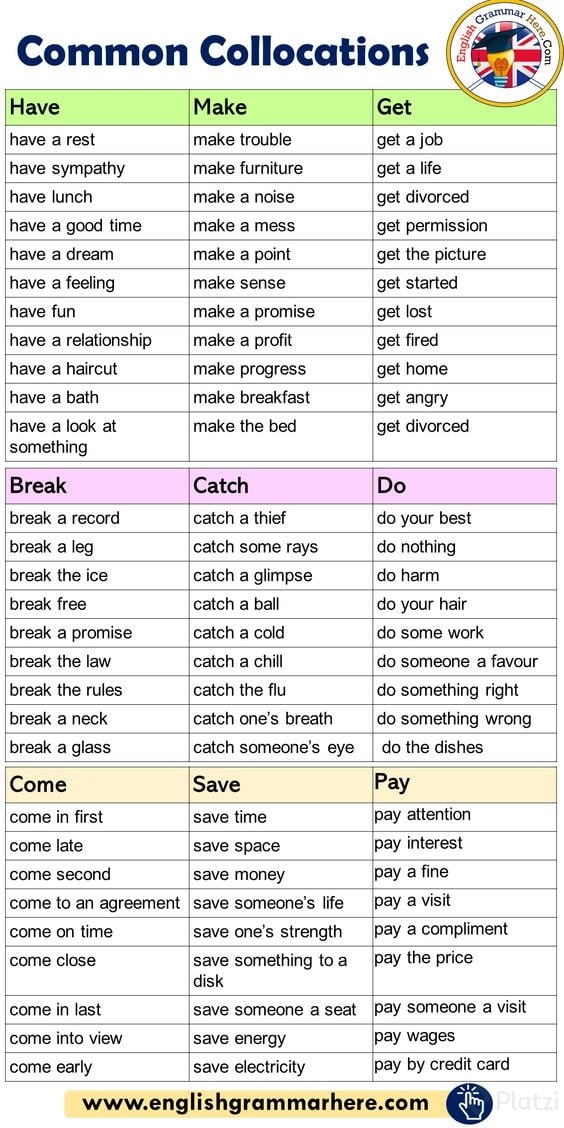
Here are some examples of collocations:
1. *Make a decision*: "I need to make a decision about which university to attend."
2. *Heavy rain*: "There was heavy rain last night, causing flooding in some areas."
3. *Fast food*: "She doesn't eat much fast food because she prefers healthier options."
4. *Take a break*: "Let's take a break and grab some coffee before we continue working."
5. *Bear in mind*: "When preparing for the interview, bear in mind that punctuality is important.
This will be the main issue to worry about.
Workshop:
Hi everyone, today in this meeting, we’re going to discuss the marketing campaign to the sunglasses store.
Before we start, It’s important to mention, there is a strong possibility to work with a celebrity to promote the brand. Based on data analysis, could help us to increase the loyalty percentage for the next 6 months.
First, all we’ll present their idea based on solution for increase the brand across people age range between 20-30, that life in U.S. and love Old Money Style. Then we’ll rank the best idea to start working on it. Is the concept perfectly clear?
Great job!
can you do a favor for me?
They gave a round of applause
He sincerely apologized for his mistake
Exercise:
Hi everyone, today in this meeting, we’re going to discuss the marketing campaign to the sunglasses store.
Before we start, It’s important to mention, there is a strong possibility to work with a celebrity to promote the brand. Based on data analysis, could help us to increase the loyalty percentage for the next 6 months.
First, all we’ll present their idea based on solution for increase the brand across people age range between 20-30, that life in U.S. and love Old Money Style. Then we’ll rank the best idea to start working on it. Is the concept perfectly clear?
Thank for participating!
In my previous role at AB Company, I collaborated closely with colleagues on a marketing project aimed at launching a new product line. To achieve success, we adopted several strategies to foster teamwork.
First, we held regular brainstorming sessions to encourage open communication and share ideas. This collaborative environment allowed us to leverage each team member's strengths and expertise. We also established clear goals and deadlines, which helped us stay on track and maintain accountability.
Additionally, we utilized project management tools to streamline our workflow and ensure everyone was on the same page. By fostering a culture of trust and support, we were able to resolve conflicts quickly and keep morale high.
Ultimately, our combined efforts resulted in a successful launch that exceeded our sales targets and strengthened our team's bond. This experience reinforced the importance of teamwork and effective collaboration in achieving shared objectives.
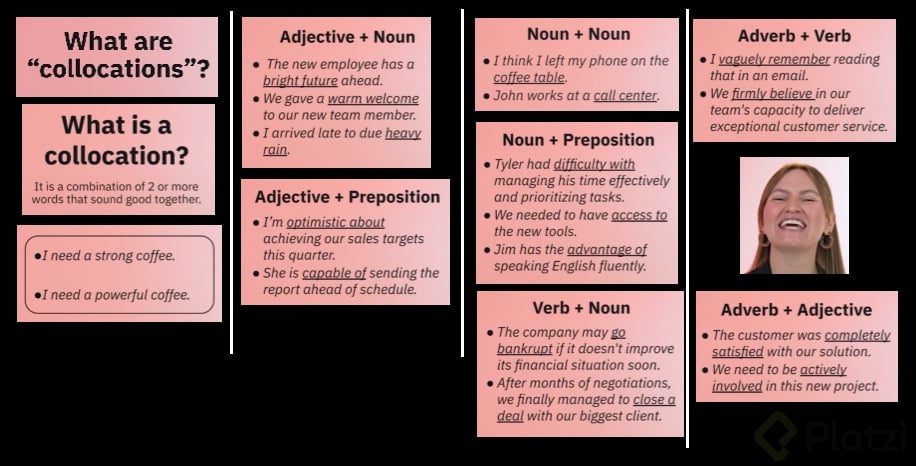
What is a collocation?
Definition:A collocation is a combination of two or more words that sound natural together.
Examples:
Types of collocations
We reach a mutual agreement to reduce the budget.
I take full responsibility for the project delay.
We should have a bright future together.
One project where I collaborated closely with colleagues was when we had to meet a tight deadline. We worked as a team to distribute responsibilities efficiently and maintain clear communication. I made an effort to build trust, encourage open feedback, and stay solution-focused
Colocaciones son combinaciones de palabras que suenan naturales juntas, como "hacer un favor" y "dar una ronda de aplausos". Por otro lado, los phrasal verbs son verbos que cambian de significado al combinarse con partículas, como "give up" (rendirse) o "look into" (investigar). La clave para distinguirlos es que las colocaciones no siempre alteran el significado del verbo original, mientras que los phrasal verbs sí lo hacen. Con práctica, podrás identificar ambos en contextos diferentes.
¿Qué son los "Collocations" en inglés?
Worksheet:
Choose the correct word to complete the collocation.
1. They couldn’t approve the time off request without a (logical / valid) reason.
2. He was (really / quite) sure that our team has thoroughly reviewed all the necessary
documents before submitting the proposal.
3. Luisa gave us a good (part / piece) of advice to always double-check our calculations
before submitting the financial report
4. The ongoing debate (about / of ) the company's remote work policy continues to spark
opinions among employees and management.
5. It all depends (on / in) the amount of people that sign up for the course.
6. Keith didn’t come to work because he (caught / got) a cold.
7. To excel in this role, it's important to communicate (effectively / correctly) with team
members.
8. In our next meeting, our (main / primary) issue will be addressing the persistent
software bugs causing delays in our development timeline.
9. I can’t help you right now. I am busy (with / on) with several tasks that require my
immediate attention. However, I will be available to assist you as soon as I am free.
10. You know what. I think you have (a point / an idea).
Noun + Noun
I think I left my phone on the <u>coffee table</u>
John work at a <u>call center</u>
Noun + Preposition
difficulty managing <u>difficulty managing</u> his time effectively and prioritizing tasks.
We needed to have <u>access to </u>the new tools.
Jim has the <u>advantage of </u>speaking English fluently.
Adjective + Preposition
I'm <u>optioptimisticmistc about </u>achieving our sales targets this quarter.
She is <u>capable of </u>sending the report ahead of schedule
Adjective + Preposition
Victor is <u>experienced in </u>analysis and software development.
Verb + Noun
The company may <u>go bankrupt </u>if it doesn't improve its financial situation soon.
Verb + Noun
As an assistant, I need to <u>take notes </u>in meeting.
Adverb + Verb
I <u>vaguely remember reading</u> that in an email.
Can you do a favor for me?
They gave a round of plause
He sincerely apologized for the mistake
What is a collocation?
I need a strong coffee.
Adjective + Noun
The new employee has a <u>bright future</u> ahead.
We gave a <u>warm welcome</u> to our new team member.
I arrived late to due <u>heavy rain</u>.
Adverb + Adjective
The customer was <u>completely satisfied </u>with our solution.
We need to be <u>actively involved </u>in this new project.
Collocation: Combination of 2 or more words that sound good together.
Adjetive + Noun
Adverb + Adjective
Noun + Noun
Noun + Preposition
Adjective + Preposition
Verb + Noun
Adverb + verb


