Knowing how to properly use quotations and statistics is essential for any writer who wants to build credible arguments while avoiding plagiarism. These tools allow you to back up your opinions with verifiable sources, giving your writing authority and trustworthiness.
What is a quotation and why does it matter?
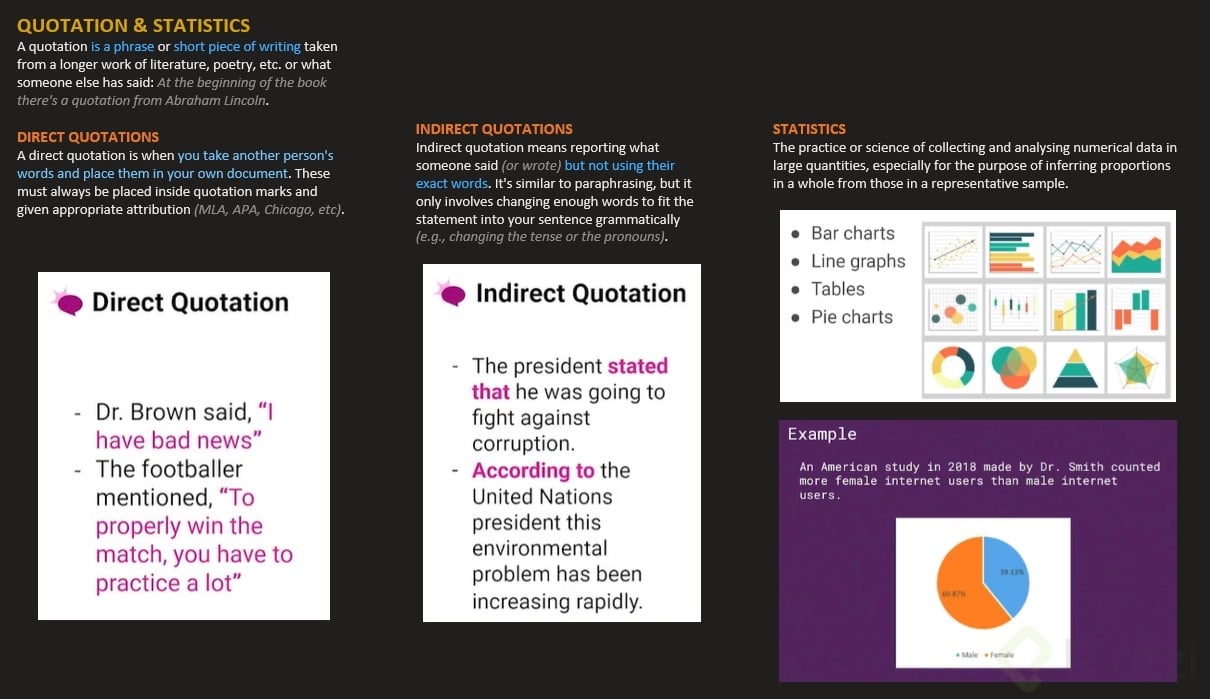
A quotation is a sentence or phrase taken from a book, poem, or play, as defined by the Cambridge Dictionary [0:22]. Understanding how to use quotations correctly prevents plagiarism and strengthens your arguments with the exact words of experts, authors, or public figures.
There are two main types:
- Direct quotations: you reproduce the exact words someone said and place them inside quotation marks. For example: Dr. Brown said, "I have bad news." [0:42].
- Indirect quotations: you paraphrase what someone said. You change the tense and do not use quotation marks. Instead, you rely on expressions like "The president stated that..." or "According to..." [1:10].
The key difference is precision. Direct quotations preserve the original wording, while indirect quotations convey the same idea in your own words.
How can statistics support your writing?
Statistics are considered facts [1:32], and they can appear in several formats:
- Bar charts.
- Line graphs.
- Tables.
- Pie charts.
Imagine you want to argue that women should pay attention to the amount of time they spend on the internet. You can support that opinion by referencing data: "According to Dr. Smith, 2018, women tend to spend more time on the internet than men" [1:56]. This is a clear example of how a topic sentence expressing your opinion can be backed up with statistical evidence.
What are the best tips for citing quotations and statistics?
Following a few simple guidelines will make your writing more professional and academically sound [2:22]:
- Always cite your sources. Remember there are different citation levels: in-text citation and works cited.
- Use reporting verbs such as assert, insist, report, and suggest to introduce what other people have said.
- Use introductory expressions like according to, as stated by, or as claimed by to smoothly integrate sources into your sentences.
How can you practice these skills?
Three quick checks help reinforce what you have learned [2:55]:
- Direct quotations need quotation marks — true.
- It is recommended to let the reader know the source you took information from — true.
- Quotations and statistics can be considered facts — true.
A great exercise is to write a paragraph where your topic sentence states your opinion and you support it with relevant quotations and statistics. Try it out and share your paragraph in the comments so you can get feedback and keep improving your academic writing skills.