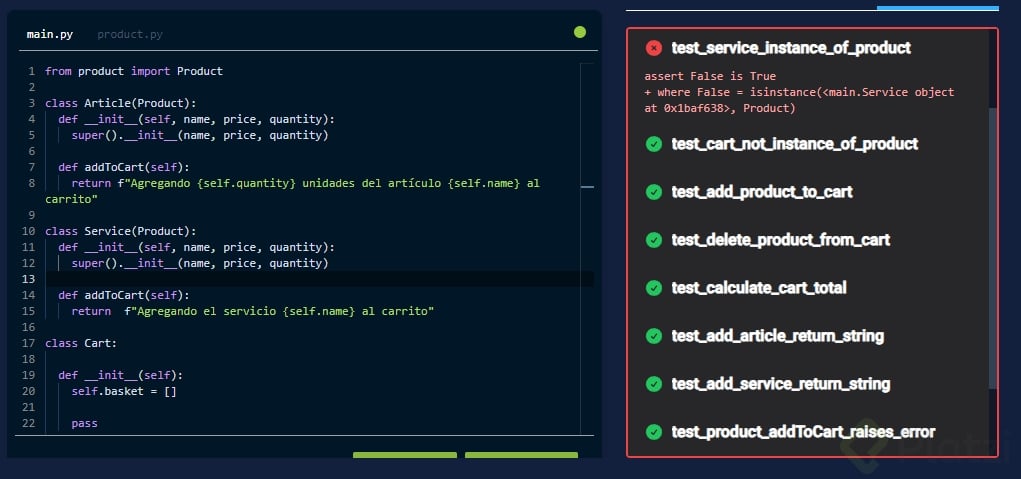
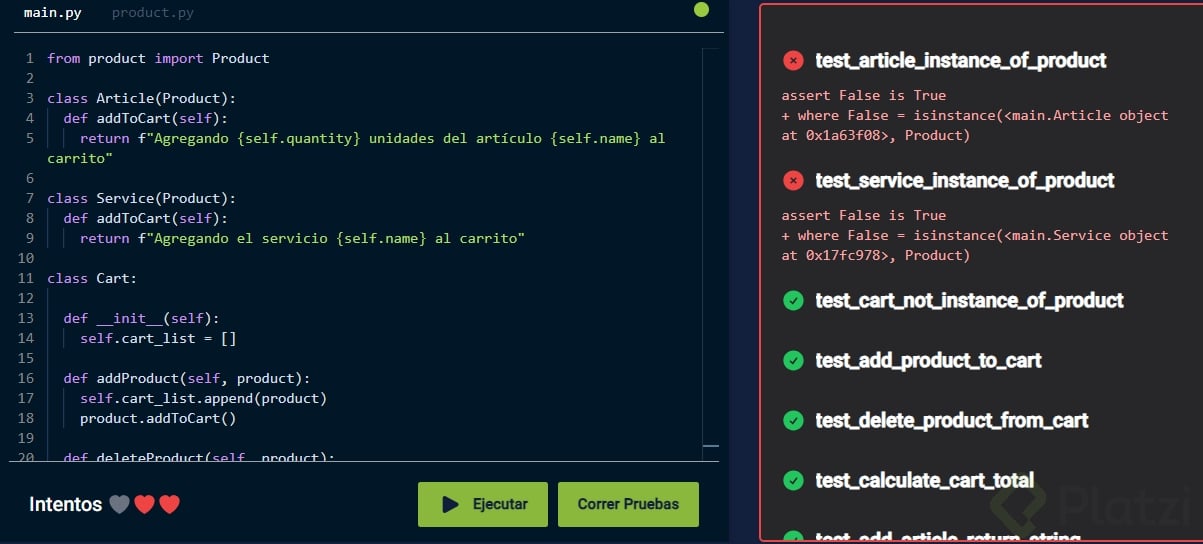
Los test ya en los ejercicios anteriores me estaba haciendo dudar cuando hacian el test. Pero en este ejercicio si ya lo demostró
Debería ponerle un poco más de cuidado porque uno pensando que la falla la tiene el código nuestro sigo dandole horas de más en el código y se pierde tiempo en avanzar el reto.
Me quede con las ganas de la serpentina. Pero en el fondo sabemos que está bien 😅
Solución 😄…
Se intentó, pero parece que hay bugs en los primeros 2 tests. Sería genial si pudieran revisarlo, saludos 👋.
.
.
.
.
.
from product importProductclassArticle(Product): def __init__(self, name, price, quantity):super().__init__(name, price, quantity) def addToCart(self):return f"Agregando {self.quantity} unidades del artículo {self.name} al carrito"classService(Product): def __init__(self, name, price, quantity):super().__init__(name, price, quantity) def addToCart(self):return f"Agregando el servicio {self.name} al carrito"classCart: def __init__(self): self.products=[] def addProduct(self, product): product.addToCart() self.products.append(product) def deleteProduct(self, product): self.products.remove(product) def calculateTotal(self):returnsum( product.price* product.quantityfor product in self.products) def getProducts(self):return self.products
Hay un error me parece:
No pasan estas dos pruebas ni colocando la solución que da la plataforma
test_article_instance_of_product
assert False is True+ where False=isinstance(<main.Article object at 0x1b55820>,Product)test_service_instance_of_product
assert False is True+ where False=isinstance(<main.Service object at 0x1be8e98>,Product)
Sí, tal parece anda mal...
.
.
.
.
.
.
.
.
.
classArticle(Product): def addToCart(self):return f"Agregando {self.quantity} unidades del artículo {self.name} al carrito"classService(Product): def addToCart(self):return f"Agregando el servicio {self.name} al carrito"classCart: def __init__(self): self.products=[] def addProduct(self, product): self.products.append(product)return product.addToCart() def deleteProduct(self, product): self.products.remove(product) def calculateTotal(self):returnsum(product.price* product.quantityfor product in self.products) def getProducts(self):return self.products
Aquí mi solución, a seguir practicando
Hola, mi solucion, ya van varios test que apesar que el codigo cumple muestran error. deberian revisar eso. gracias
from product importProductclassArticle(Product): def __init__(self, name, price, quantity):super().__init__(name, price, quantity) def addToCart(self):return f"Agregando {self.quantity} unidades del artículo {self.name} al carrito"classService(Product): def __init__(self, name, price, quantity):super().__init__(name, price, quantity) def addToCart(self):return f"Agregando el servicio {self.name} al carrito"classCart: def __init__(self): self.productos=[] def addProduct(self, product):print(product.addToCart()) self.productos.append(product) def deleteProduct(self, product):if product in self.productos: self.productos.remove(product) def calculateTotal(self):returnsum(p.pricefor p in self.productos) def getProducts(self):return self.productos```from product importProductclassArticle(Product): def \_\_init\_\_(self, name, price, quantity):super().\_\_init\_\_(name, price, quantity) def addToCart(self):return f"Agregando {self.quantity} unidades del artículo {self.name} al carrito"classService(Product): def \_\_init\_\_(self, name, price, quantity):super().\_\_init\_\_(name, price, quantity) def addToCart(self):return f"Agregando el servicio {self.name} al carrito"classCart: def \_\_init\_\_(self): self.productos= \[] def addProduct(self, product):print(product.addToCart()) self.productos.append(product) def deleteProduct(self, product):if product in self.productos: self.productos.remove(product) def calculateTotal(self):returnsum(p.pricefor p in self.productos) def getProducts(self):return self.productos
from product importProductclassArticle(Product): def addToCart(self):print(f"Agregando {self.quantity} unidades del artículo {self.name} al carrito")return f"Agregando {self.quantity} unidades del artículo {self.name} al carrito"classService(Product): def addToCart(self):print(f"Agregando el servicio {self.name} al carrito")return f"Agregando el servicio {self.name} al carrito"classCart: def __init__(self): self.products=[] def addProduct(self, product): product.addToCart() self.products.append(product) def deleteProduct(self, product): #self.products.remove(product) self.products=[item for item in self.productsif item.name!= product.name] def calculateTotal(self):returnsum(product.price* product.quantityfor product in self.products) def getProducts(self):return self.products def listarProducts(self):for product in self.products:print(product.name, product.price, product.quantity)book =Article("Libro",100,2);course =Service("Curso",120,1);cart =Cart()cart.addProduct(book)cart.addProduct(course)book =Article("Libro",100,2)course =Service("Curso",120,1)cart.addProduct(book)cart.addProduct(course)print(cart.calculateTotal())cart.listarProducts()cart.deleteProduct(book)print(cart.calculateTotal())cart.listarProducts()```from product importProductclassArticle(Product): def addToCart(self):print(f"Agregando {self.quantity} unidades del artículo {self.name} al carrito")return f"Agregando {self.quantity} unidades del artículo {self.name} al carrito"classService(Product): def addToCart(self):print(f"Agregando el servicio {self.name} al carrito")return f"Agregando el servicio {self.name} al carrito"classCart: def \_\_init\_\_(self): self.products= \[] def addProduct(self, product): product.addToCart() self.products.append(product) def deleteProduct(self, product): #self.products.remove(product) self.products= \[item for item in self.productsif item.name!= product.name] def calculateTotal(self):returnsum(product.price \* product.quantityfor product in self.products) def getProducts(self):return self.products def listarProducts(self):for product in self.products:print(product.name, product.price, product.quantity)book =Article("Libro",100,2);course =Service("Curso",120,1);cart =Cart()cart.addProduct(book)cart.addProduct(course)book =Article("Libro",100,2)course =Service("Curso",120,1)cart.addProduct(book)cart.addProduct(course)print(cart.calculateTotal())cart.listarProducts()cart.deleteProduct(book)print(cart.calculateTotal())cart.listarProducts()
Mi solucion:.
.
.
.
.
.
.
.
.
.
.
.
.
.
.
.
.
from product importProductclassArticle(Product): def addToCart(self): # Tu código aquí 👈
return f'Agregando {self.quantity} unidades del artículo {self.name} al carrito'classService(Product): def addToCart(self): # Tu código aquí 👈
return f'Agregando el servicio {self.name} al carrito'classCart: def __init__(self): # Tu código aquí 👈
self.shoppingList=[] def addProduct(self, product): # Tu código aquí 👈
product.addToCart() self.shoppingList.append(product) def deleteProduct(self, product): # Tu código aquí 👈
for item in self.shoppingList:if item.name== product.name: self.shoppingList.remove(product)break def calculateTotal(self): # Tu código aquí 👈
returnsum(item.price* item.quantityfor item in self.shoppingList) def getProducts(self): # Tu código aquí 👈
return self.shoppingList
it's ok
🛡️🛡️Escudo anti-spoilers🛡️🛡️
Mi solución al reto (aunque no se puede completar por el error que tiene la plataforma en los 2 primeros test):
from product import Product
classArticle(Product):defaddToCart(self):#print(f"Agregando {self.quantity} unidades del articulo {self.name}")returnf"Agregando {self.quantity} unidades del articulo {self.name}"classService(Product):defaddToCart(self):#print(f"Agregando el servicio {self.name} al carrito")returnf"Agregando el servicio {self.name} al carrito"classCart:def__init__(self): self.products =[]defaddProduct(self, product): self.products.append(product) product.addToCart()defdeleteProduct(self, product): self.products =[p for p in self.products if p.name != product.name]defcalculateTotal(self):#print(sum(p.price * p.quantity for p in self.products)) returnsum(p.price * p.quantity for p in self.products)defgetProducts(self):return self.products
.
.
.
.
.
.
.
.
.
.
Mi solución (con los dos mismos errores que les arroja al resto de compañeros en los dos primeros test del Playground)
from product importProductclassArticle(Product): def addToCart(self):return f"Agregando {self.quantity} unidades del artículo {self.name} al carrito"classService(Product): def addToCart(self):return f"Agregando el servicio {self.name} al carrito"classCart: def __init__(self): self.products=[] def addProduct(self, product): self.products.append(product)print(product.addToCart()) def deleteProduct(self, product): self.products.remove(product) def calculateTotal(self): total =sum(product.price* product.quantityfor product in self.products)return total
def getProducts(self):return self.products
Pensé que me iba a resultar más complicado pero pasé bien! Excepto los dos primeros test como todo el mundo jajaja
.
.
.
.
..
.
.
.
.
from product importProductclassArticle(Product): def addToCart(self):return f"Agregando {self.quantity} unidades del artículo {self.name} al carrito" pass
classService(Product): def addToCart(self):return f"Agregando el servicio {self.name} al carrito" pass
classCart: def __init__(self): self.products=[] pass
def addProduct(self, product): product.addToCart() self.products.append(product) pass
def deleteProduct(self, product): self.products=[prod for prod in self.productsif prod.name!= product.name] pass
def calculateTotal(self): total =0for product in self.products: total += product.quantity* product.pricereturn total
pass
def getProducts(self):return self.products pass
No entendí por qué el test validan que la subclase no sea instancia de la superclase si tengo entendido que por heredar de ella esto la hace una instancia, aun así comparto el logro:
.
.
from product importProductclassArticle(Product): def __init__(self, name, price, quantity):super().__init__(name, price, quantity) def addToCart(self):return f"Agregando {self.quantity} unidades del artículo {self.name} al carrito"classService(Product): def __init__(self, name, price, quantity):super().__init__(name, price, quantity) def addToCart(self):return f"Agregando el servicio {self.name} al carrito"classCart: def __init__(self): self.basket=[] def addProduct(self, product): product.addToCart() self.basket.append(product) def deleteProduct(self, product): self.basket.remove(product) def calculateTotal(self):returnsum(item.price* item.quantityfor item in self.basket) def getProducts(self):return self.basket
from product import Product
classArticle(Product):defaddToCart(self):returnf"Agregando {self.quantity} unidades del artículo {self.name} al carrito"classService(Product):defaddToCart(self):returnf"Agregando el servicio {self.name} al carrito"classCart:def__init__(self): self.cart_list =[]defaddProduct(self, product): self.cart_list.append(product) product.addToCart()defdeleteProduct(self, product): self.cart_list.remove(product)defcalculateTotal(self):returnsum(product_in_cart.price * product_in_cart.quantity for product_in_cart in self.cart_list)defgetProducts(self):return self.cart_list
no se olviden que también para designar variables desde la clase padre se debe poner: