Contenido del curso
Helpful Connectors
Umm... reductions
- 6

Reducciones en inglés: wanna, gonna y más
04:24 min - 7

Cómo sonar natural con question reductions
04:39 min - 8

Uso de Muletillas y Reducciones en Inglés Conversacional
04:32 min - 9

Role play en el cine: reductions y fillers
02:33 min - 10

Quiz de conectores y reducciones en inglés
Viendo ahora - 11

Práctica de conversación en inglés (contexto cotidiano)
00:00 min
Cause and effect
Speaking naturally
Conclusion
Quiz de conectores y reducciones en inglés
Resumen
Practicing connectors and reductions is one of the fastest ways to sound natural in English conversations. This quiz walks you through five real sentences where you choose the best linking word or contracted form, so you can spot how native speakers actually connect ideas and shorten phrases when they speak.
If you are an intermediate learner who already knows basic grammar but freezes when linking two sentences or understanding fast speech, these examples will sharpen both your writing and your listening.
How do you choose the right connector between two contrasting ideas?
When two sentences show different sides of the same topic, you need a connector that signals contrast without sounding too formal.
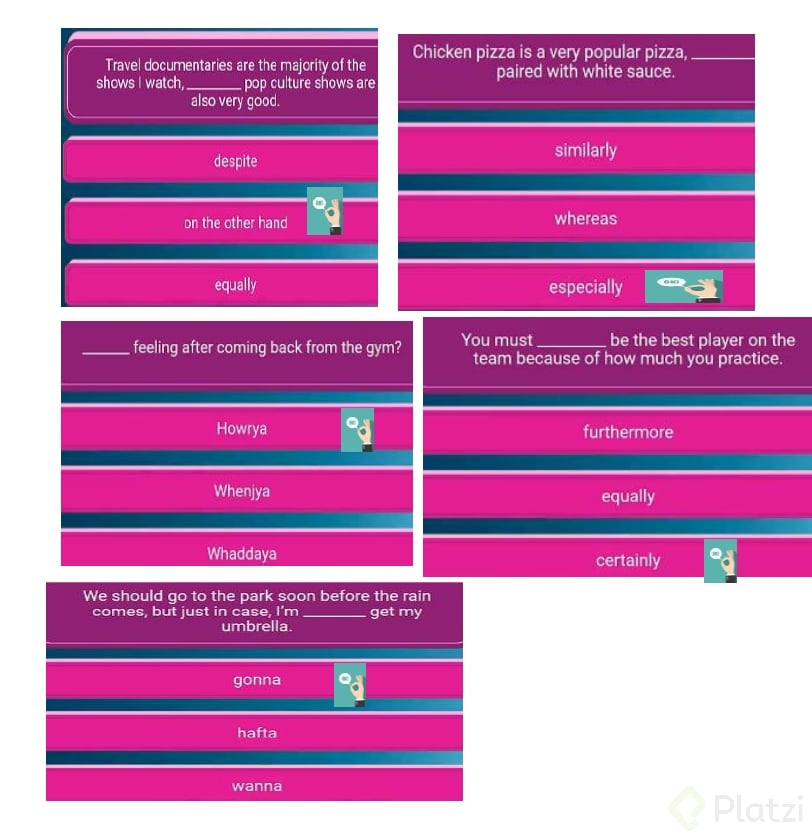
Look at this sentence: Travel documentaries are the majority of the shows I watch. ___ pop culture shows are also very good. The options were despite, on the other hand, and equally. The right answer is on the other hand, because it introduces a second point of view that contrasts with the first.
What does on the other hand mean? It introduces a contrasting idea or alternative perspective. You use it when you already mentioned one option and want to add a different one.
Despite needs a noun or ing form right after it, and equally signals similarity, not contrast. That is why neither fits here.
When should you use especially instead of similarly or whereas?
The second item asks you to complete: Chicken pizza is a very popular pizza, ___ paired with white sauce. The correct word is especially.
You use especially to highlight a specific case inside a more general statement. Chicken pizza is popular in general, and the white sauce version stands out as the best example.
- Similarly compares two equal things.
- Whereas sets up a contrast between two clauses.
- Especially points to one outstanding detail inside a bigger idea.
That small distinction changes the meaning of your sentence completely, so picking the right connector is not a decoration, it is precision.
What are reductions in spoken English and how do they work?
Reductions are the shortened forms native speakers use when they speak fast. They are not slang, they are natural pronunciation patterns that join words together.
In the quiz you saw: ___ feeling after coming back from the gym? with options how're you, when'd you, and what're you. The answer is how're you, the reduction of how are you. The full question becomes how are you feeling after coming back from the gym?
What is a reduction in English? It is the contracted pronunciation of two or more words spoken quickly together, like how are turning into how're or going to turning into gonna.
Later in the quiz, the sentence I'm ___ get my umbrella uses the reduction going to. The full sentence reads: We should go to the park soon before the rain comes, but just in case, I'm going to get my umbrella. In casual speech you would even hear it as I'm gonna get my umbrella.
Why do reductions matter for listening comprehension?
If you only train your ear with textbook English, you will struggle when someone says whatcha doing instead of what are you doing. Recognizing reductions like how're, when'd, what're and going to helps you understand movies, podcasts and real conversations without rewinding every five seconds.
How do you express certainty with the connector certainly?
The fourth sentence was: You must ___ be the best player on the team because of how much you practice. The choices were furthermore, equally, and certainly. The answer is certainly.
Certainly reinforces must and shows strong confidence in what you are saying. The full sentence becomes: You must certainly be the best player on the team because of how much you practice.
- Furthermore adds extra information.
- Equally signals comparison or balance.
- Certainly expresses conviction or strong belief.
Using the right intensity word changes how confident you sound, and confidence is half of fluency.
Quick recap of the connectors and reductions you just practiced
Here are the five answers in one place so you can review them at a glance:
- On the other hand, to contrast two ideas.
- Especially, to highlight a specific case.
- How're you, the reduction of how are you.
- Certainly, to express strong certainty.
- Going to, the reduction used for future plans.
If any of these felt unclear, go back and review the connectors module before moving on. Which connector or reduction do you find hardest to use in your own conversations? Share it in the comments.