Master the Write an email task with confidence: focus on the rubric, timing, word count, and the exact skills examiners value. Deliver a comprehensive response under time pressure while keeping grammar, vocabulary, and mechanics accurate.
What is the write an email task?
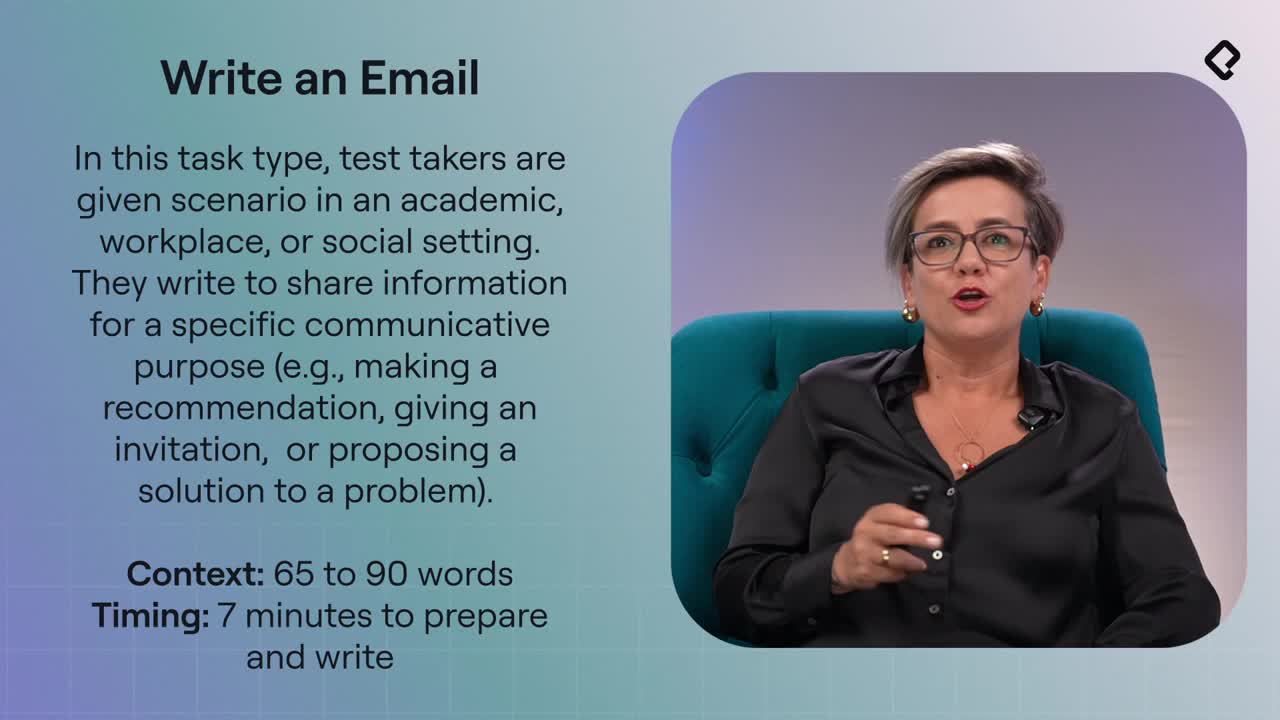
You receive an academic or social scenario and must write and share information to meet a specific communication goal. The response must be clear, accurate, and aligned with the instructions.
- Write 65–90 words.
- You have seven minutes to prepare and write.
- Use complete sentences and a wide range of structures.
- Follow mechanical conventions: spelling, punctuation, capitalization.
- Read carefully and include all required content.
How does the rubric score lexical and grammatical accuracy?
The rubric evaluates your ability to produce language with lexical and grammatical accuracy. High-level writing can still include acceptable errors that do not block meaning, especially under a time constraint.
- A top response shows elaboration and syntactic variety.
- Appropriate social conventions are followed.
- Errors may appear, but meaning remains clear.
- Scoring is fair, consistent, and reflective of real-world language use.
- Descriptors explain how to reach a score of five; see the Class Resources for full rubrics and a sample response.
Which key vocabulary and examples guide you?
- lexical and grammatical accuracy: focus of scoring on precise vocabulary and correct forms. example: “focusing on lexical and grammatical accuracy.”
- mechanical conventions: rules for form. example: “spelling, punctuation, and capitalization.”
- syntactic variety: varied sentence structures. example: “there is syntactic variety.”
- appropriate social conventions: polite, suitable tone. example: “Appropriate social conventions are followed.”
- acceptable errors: mistakes that do not obscure meaning. example: “responses are not expected to be entirely error-free.”
- time constraint: limited time to write. example: “you are completing the task under a time constraint.”
- comprehensive response: fully covers instructions. example: “Ensure your response is comprehensive and detailed.”
- bullet points: specific prompts to address. example: “Address all the bullet points in the directions.”
What tips improve your score quickly?
Follow these steps to meet the task’s demands and the rubric’s expectations.
- Read the context and information carefully.
- Address all bullet points in the directions.
- Write complete sentences with correct vocabulary and grammar.
- Ensure your response is comprehensive and detailed.
Explore the Class Resources to view the full rubrics and practice more. The next lesson covers the Write for an Academic Discussion task.
Have questions or want feedback? Share your 65–90-word email in the comments.