TOEFL Reading: 5 Question Types Explained
Contenido del curso

Reading
Listening


Writing
Speaking
Recursos
Resumen
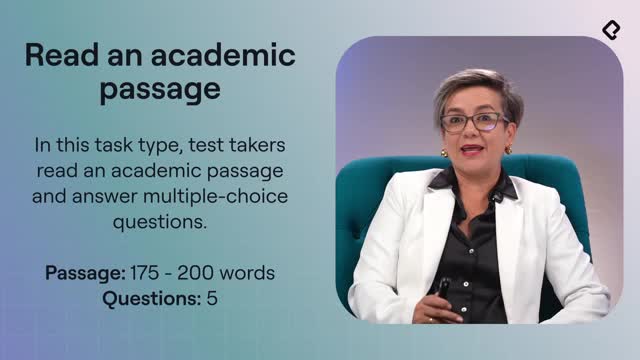
The TOEFL iBT reading academic passage task is the final challenge of the reading section, and knowing how it works can boost your score significantly. You will face short academic readings followed by five multiple-choice questions designed to measure how well you understand main ideas, vocabulary, inferences, and rhetorical purpose. This breakdown is for test-takers who want a clear strategy before exam day.
What does the TOEFL reading academic passage task evaluate?
This task checks much more than your ability to read English. It measures how you process academic content under pressure.
You will be tested on your ability to grab the main point of a passage, spot important details, and recognize how writers use grammar to suggest information they never state directly. You also need to handle a wide range of academic vocabulary, figurative and idiomatic expressions, and ideas built with grammatical complexity [00:32].
On top of that, you must connect ideas across sentences and paragraphs and identify the rhetorical structure of the text, meaning how the author organizes arguments, examples, and conclusions.
What is rhetorical structure in TOEFL reading? It is the way an author organizes a text to achieve a purpose, like comparing, explaining causes, or giving examples. Recognizing it helps you answer questions about why the author included certain information.
What kind of passages will you read?
The good news is that the passages are short and informative, similar to what you would find in a high school or college textbook [01:00].
Topics typically include:
- Life sciences and physical sciences.
- Social sciences and history.
- Art and music.
- Business and economics.
Each passage runs between 175 and 200 words and is followed by five questions [01:14]. That length is manageable, but every word counts.
What types of questions appear in this section?
The five questions are not random. Each one targets a specific reading skill, and recognizing the type helps you answer faster.
The five categories you will see are factual information, vocabulary in context, inferences, relationships between ideas, and the purpose of part or all of the text [01:24].
How do factual and vocabulary questions work?
Factual questions ask about details directly stated in the passage. A common variation is the except question, where you must pick the option that is not true according to the text. These can feel tricky because your brain naturally looks for correct statements, not incorrect ones [03:10].
Vocabulary questions show you a word from the passage and ask which option is closest in meaning. For example, the word milestone appeared in one practice passage and the correct synonym was a key choice [02:07]. Context is everything here, so always reread the sentence around the target word.
How do I answer vocabulary in context questions on TOEFL? Read the full sentence where the word appears, predict the meaning from context, and then match your prediction to the closest answer choice. Avoid relying only on memorized definitions.
What is a rhetorical purpose question?
This is the type that asks why the author mentions something specific, like why a passage about animal behavior brings up cleaner fish [03:55]. You are not being asked what the information says, but why it is there.
To answer well, think about the function of that detail: is it an example, a contrast, supporting evidence, or a counterargument? That logic leads you to the right choice.
Which strategies help you score high on this task?
The instructor shared a clear set of tips that work as a checklist before and during the exam [04:25].
- Identify the main topic and the organizational structure of the passage.
- Look for topic sentences and supporting details in each paragraph.
- Pay attention to transitions and connecting words like however, therefore, or in contrast.
- Focus on the big picture, the major ideas, and the overall organization.
- Do not get stuck on tiny details, like one single word you do not understand.
That last point matters more than it seems. Spending two minutes on an unknown word can cost you an entire question elsewhere. Skip, infer from context, and keep moving.
How should you practice before test day?
Mistakes during practice are expected and encouraged because they show you exactly where your weaknesses live [05:05]. Use every wrong answer as a map: was it vocabulary, inference, or rhetorical purpose that tripped you up? That diagnosis is more valuable than the score itself.
Which of these five question types feels hardest for you right now? Drop it in the comments and let's troubleshoot it together.
TOEFL Reading: 5 Question Types Explained