
TOEFL Listening: Choose the Right Response
Contenido del curso


Reading
Listening


Writing
Speaking
Recursos
Resumen
The TOEFL Essentials listening section measures how well you understand spoken English in both academic and everyday situations, through monologues and dialogues delivered in four different accents. If you are preparing for the exam, knowing the structure of each task and what skills it tests will help you walk into the test with a clear plan.
What does the TOEFL Essentials listening section include?
You will hear English the way real people use it: in classrooms, casual chats, and public announcements. Speakers come from North America, the UK, Australia, and New Zealand, so your ear needs to be ready for different pronunciations and rhythms [0:25].
The section is built around four task types, each one testing a slightly different listening skill.
- Listen and choose a response: a single sentence, one question.
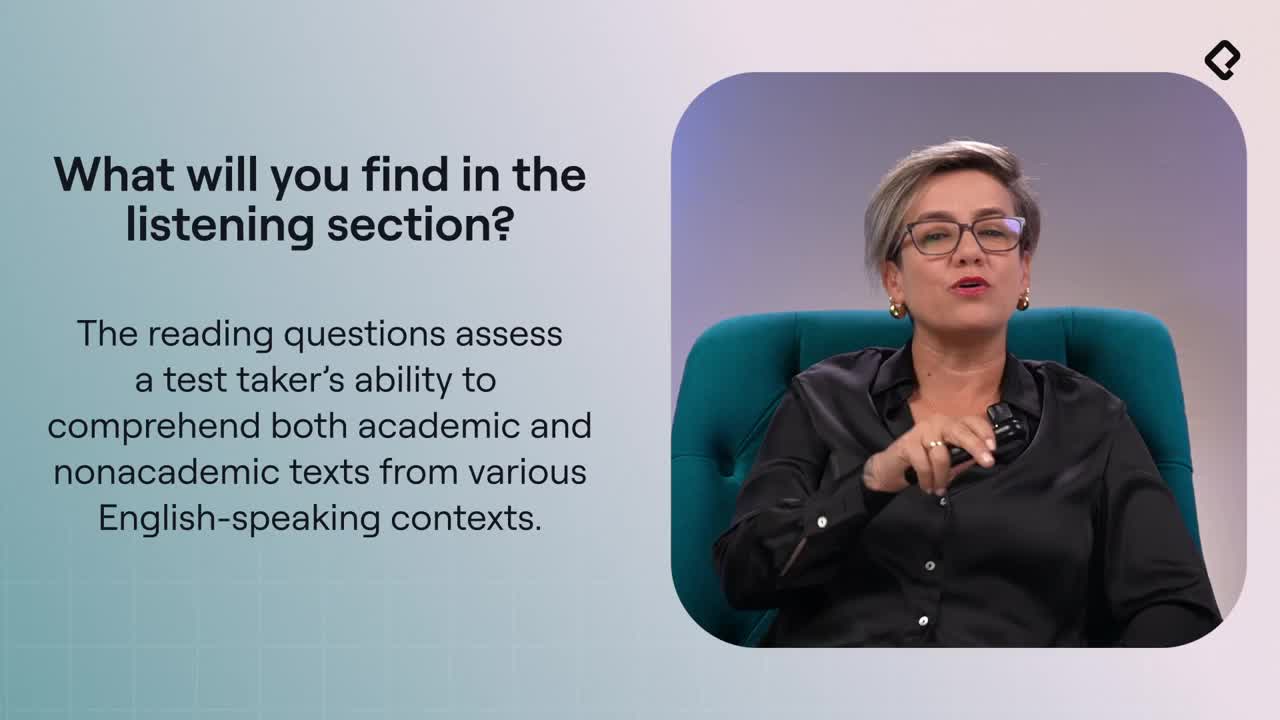
- Listen to a conversation: a short dialogue of 35 to 200 words with two questions.
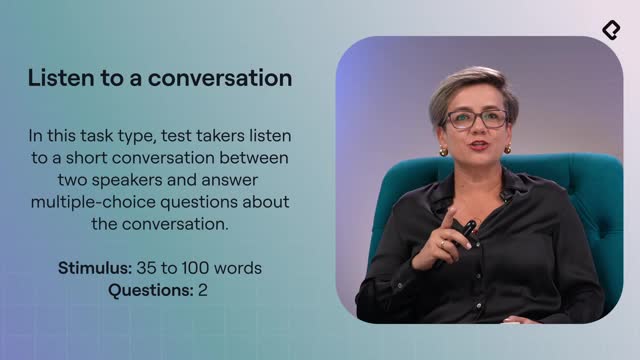
- Listen to an announcement: 45 to 85 words long, two questions per announcement.
- Listen to an academic talk: the longest format, 175 to 250 words, with four questions [1:00].
Length does not equal difficulty. The academic talk is longer, but that does not automatically make it harder than a quick exchange where every word matters.
What accents will I hear on the TOEFL Essentials listening section? You will hear four: North American, British, Australian, and New Zealand English. Practicing with all of them prevents surprises on test day.
How does the listen and choose a response task work?
This is the shortest task in the section, and it tests something deceptively simple: your ability to react naturally to what someone says. You hear one short statement or question, and you pick the best reply from four written options [1:45].
The spoken prompt is not shown on screen, you hear it only once, and note-taking is not allowed. That means your focus has to be sharp from the first second.
The skill behind this task is understanding both literal meaning (what the words say) and implied meaning (what the speaker actually wants). Picking up on implication is what makes natural social interaction possible, and it is exactly what the test wants to measure [2:00].
Why is the appropriate response not always the most direct one?
Here is where many test-takers slip. The correct answer is the appropriate response, not necessarily a literal reply to the words you heard. Someone asking "Didn't I just see you in the library an hour ago?" is not really requesting a yes or no. They are opening a small social moment, and your answer needs to fit that moment [3:30].
In the practice example about a book on a desk, the prompt was "Where did that book on your desk come from?" and the correct answer was "It was a gift from my sister" [4:00]. Notice how the reply gives the origin of the book in a conversational way, which is exactly what the question invited.
What does "appropriate response" mean on the TOEFL? It means the reply that fits the situation socially and logically, even if it is not a direct word-for-word answer to the question.
How can you answer correctly under pressure?
Since you only hear the prompt once and cannot take notes, your strategy has to be tight. A few habits make a real difference.
- Listen carefully from the very first word, because the prompt is short and plays only once.
- Identify the type of question if it is one: who, what, where, when, why, or how. Each one points you toward a specific kind of answer.
- Check that your choice is appropriate, not just grammatically correct. A response can sound fine on its own and still not match the situation [4:45].
A wh-question like "where" needs a place or origin in the answer. A yes-no question often invites a short confirmation plus a comment. Training your ear to spot the question word in the first second gives you a head start before you even read the options.
What skills should you practice before test day?
Beyond grammar, this task rewards pragmatic listening, the ability to read between the lines of a conversation. You can build it by listening to short dialogues in podcasts, shows, or daily conversations and asking yourself what the natural reply would be before someone gives it.
Pair that with exposure to the four target accents. Familiarity reduces hesitation, and hesitation is what eats your time on a one-shot prompt.
Which accent feels hardest for you right now? Drop it in the comments and share what you are doing to train your ear.
TOEFL Listening: Choose the Right Response