
How to Understand Campus Announcements Fast
Contenido del curso


Reading
Listening


Writing
Speaking
Recursos
Resumen
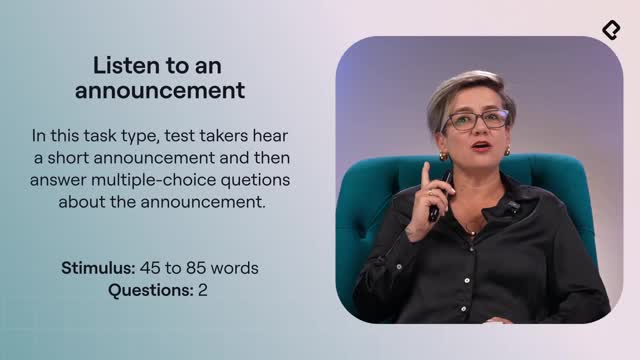
Following an English lecture is one thing, but catching the details of a campus announcement is another skill entirely. The Listen to an Announcement task tests whether you can pick up the who, the why, and the what of a short school message, and answer two quick questions about it. If you're prepping for an academic English exam, this is one of those tasks where strategy beats luck.
What is the Listen to an Announcement task in academic English?
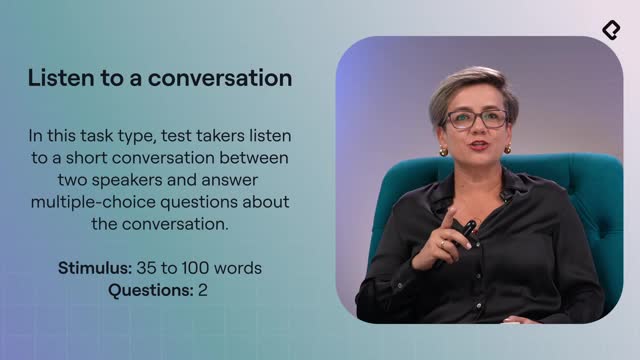
This task plays a short school-related announcement once, and then asks you two multiple-choice questions about what you heard. The audio can come from a teacher, an administrator, a club president, or anyone in an educational role, and it usually covers schedules, directions, rules, or upcoming events.
The two questions tend to follow a predictable pattern:
- A detail question, like where an event will happen or when it starts.
- A purpose question, like why the speaker is making the announcement.
- A reason question, like why the speaker mentions a specific fact.
What is the Listen to an Announcement task? It's a short academic listening exercise where you hear one school announcement and answer two questions about its details and purpose.
How does a real announcement example sound?
Here's the sample played in the lesson, almost word for word:
Good afternoon, everyone. I'm excited to inform you that Dr. Cynthia Palmer, a renowned expert in environmental science, will be giving a guest lecture next Monday at 2:00 PM in Waldman Auditorium. Dr. Palmer will discuss the latest advancements in sustainable energy solutions and their impact on global climate change. Due to her popularity and the high interest in her work, I highly recommend arriving early to secure a seat.
Notice how packed it is. In just a few sentences you get a name, a date, a time, a location, a topic, and a recommendation. That density is exactly why this task feels tricky the first time.
What were the two example questions and answers?
The lesson walked through two questions about that same announcement:
- What is the announcement about? The correct answer was A, the option describing Dr. Palmer's upcoming guest lecture.
- Why does the professor mention Dr. Palmer's popularity? The correct answer was D, the option explaining that students should arrive early to get a seat.
The first question checks whether you caught the main idea. The second checks whether you understood the reason behind a specific detail, not just that the detail existed.
Why are the who and the why so important?
If you only remember two words from this task, make them who and why. Identifying who is speaking tells you the setting, a teacher in class, an admin over a loudspeaker, a club leader at a meeting, and that context shapes everything else you hear. Understanding why they're speaking points you straight to the main idea.
After that, your job is to lock in the supporting details. Times, locations, and requirements are the usual suspects, and they're almost always the targets of the detail question.
What should I focus on while listening to an announcement? Focus first on who is speaking and why, then on specific details like times, locations, and any requirements mentioned.
How can I practice this listening task effectively?
The lesson closed with three practical tips, and they're worth turning into a checklist you can use every time you practice:
- Listen carefully to identify the setting and the speaker from the very first sentence.
- Pin down who is making the announcement and the purpose behind it.
- Catch concrete details such as times, locations, names, and any instructions or requirements.
A useful drill is to listen to a short announcement once, pause, and then say out loud the who, the why, the when, and the where. If you can answer those four in one breath, you'll handle both questions without stress.
What comes next after this listening task?
The next step in this learning path is the final listening task, Listen to an Academic Talk, where the audio gets longer and the ideas more layered. Mastering announcements first builds the exact habit you'll need there: catching purpose and details on a single listen.
Which part of the announcement task feels hardest for you, the main idea or the specific details? Drop your answer in the comments and let's compare notes.
How to Understand Campus Announcements Fast