Reading Daily Life Texts on the TOEFL iBT
Contenido del curso

Reading
Listening


Writing
Speaking
Recursos
Resumen
Mastering the Reading Daily Life section of the TOEFL iBT requires a specific set of skills that differ from traditional academic reading. This task presents short, real-world texts you might encounter in everyday situations, and knowing how to approach them can make a significant difference in your score.
What is the Reading Daily Life task in the TOEFL iBT?
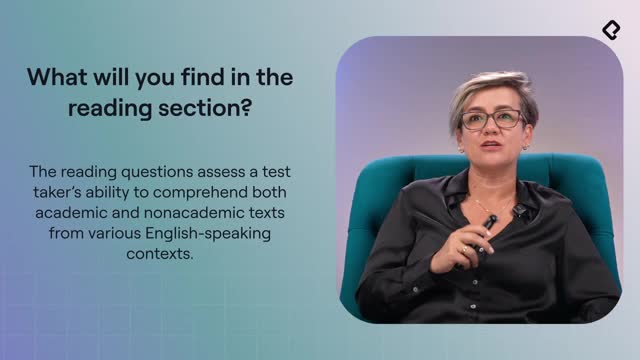
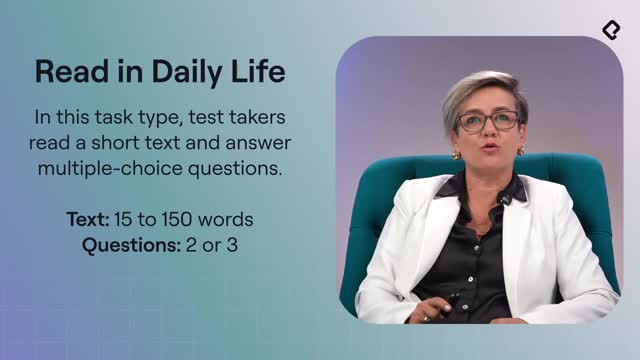
The Reading Daily Life task features short, non-academic passages that reflect texts people commonly find in everyday situations around the world [0:10]. These include posters, social media posts, menus, emails, advertisements, and news articles. Unlike standard essays, these texts often use bullet points or different sections, which means you can scan and jump around to find what you need instead of reading every word from start to finish [0:33].
Each text is typically 15 to 150 words long and comes with just two or three multiple-choice questions [0:49].
What skills does this task assess?
The questions in this section evaluate a wide range of reading abilities [0:57]:
- Understanding factual information directly stated in the text.
- Determining vocabulary in context, meaning the specific sense of a word based on how it is used.
- Making inferences, which involves drawing logical conclusions from information that is implied but not explicitly stated.
- Identifying the purpose of part or all of the text.
- Recognizing formal and idiomatic language.
- Interpreting telegraphic language, the kind of abbreviated or condensed phrasing often found in signs, ads, and notices.
- Skimming and scanning for key details quickly and efficiently.
How do these skills apply to real examples?
During practice, you might encounter a notice-style text with questions about its factual content [1:18]. For instance, one question asks you to identify specific details from a notice, where the correct answer is B [1:30]. A second question on the same notice requires closer reading, and the correct answer turns out to be C [1:40].
Another example uses a social media post as the reading stimulus [1:55]. The first question asks about the main purpose of the post, testing your ability to identify the author's intent. The correct answer is B [2:13]. A follow-up question focuses on why a specific detail, the Thompson family stall, is popular, and the correct answer is C [2:27]. The third question asks about additional features the market offers besides food and crafts, with A being the correct answer [2:42].
If you did not get all the answers correct, that is perfectly fine. The focus is on practice and skill building [2:52].
What are the best tips for tackling this task?
Two practical strategies can improve your performance significantly [3:00]:
- Always check the text type first. Before reading the content, identify whether it is an email, a sign, an advertisement, or something else. This helps you predict the structure and purpose of the text [3:08].
- Take a quick look and ask yourself what you are reading. Figuring out the format gives you immediate context about what the main point or message is supposed to be [3:16].
These strategies connect directly to the skills of skimming and scanning. Rather than reading every word carefully, you train yourself to locate relevant information fast, which is exactly what this task rewards.
For extra practice on this specific task, check the Class Resource section for additional exercises [3:30]. Share your answers and thoughts in the comments below to keep building your confidence with real-world reading texts.
Reading Daily Life Texts on the TOEFL iBT