
How to Score a 5 on Listen and Repeat
Contenido del curso



Reading

Listening


Writing


Speaking

Recursos
Resumen
The listen and repeat task is one of two speaking activities in the TOEFL Essentials test, designed to measure how accurately you process and reproduce spoken English. If you are preparing for the exam, knowing exactly what scorers expect can be the difference between a 3 and a 5.
What is the listen and repeat task in TOEFL Essentials?
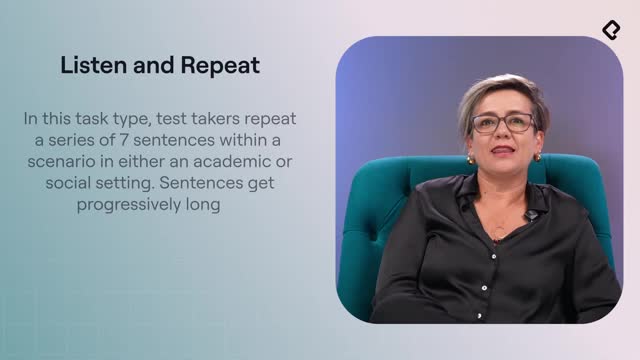
In this task, you repeat a series of sentences set within an academic or social scenario. Each scenario gives a communicative purpose to what you hear, and a visual representation helps you picture the setting.
The structure is simple but demanding:
- You hear a sentence.
- You get a two second pause.
- You repeat exactly what was said.
Sentences start short and get progressively longer and more complex. The goal is to test your ability to process and reproduce English intelligibly, not to paraphrase or improvise.
Is the speaking section adaptive? No. Just like the writing section, speaking is linear and non adaptive. Every test taker receives the same questions in the same fixed order.
How are listen and repeat responses scored?
Understanding the rubrics is essential because they tell you exactly what scorers are looking for. Familiarity with these criteria directly impacts your final score.
What does each score level mean?
Here is how the levels break down:
- Score of 5: an exact repetition of the prompt. Same words, same order, no mispronunciations that make the sentence unintelligible.
- Score of 4: minor changes in words or grammar that don't substantially change the meaning. If you make a mistake but self correct before finishing, you can still land here.
- Score of 3: the response is less fully correct, but it remains a complete sentence.
Paraphrasing, skipping a word, or pronouncing something so unclearly that it can't be understood will keep you out of the top score. The bar for a 5 is precision.
Can I get a 5 if I paraphrase the sentence? No. A score of 5 requires an exact repetition. Paraphrasing, missing a word, or unintelligible mispronunciation drops your score.
How should I practice listen and repeat prompts?
The best practice strategy is recording yourself and scoring your own attempts using the official rubrics. Listen back and ask yourself: did I repeat it word for word, or did I improvise?
Some examples from real prompts include:
- We have a variety of wildlife.
- Please, no outside food or drinks, and do not feed the animals.
- Avoid banging or tapping on the displays and enclosures.
Notice how the sentences grow in length and complexity. That progression mirrors what you'll face on test day, so train your short term memory with longer chunks gradually.
What are the best tips to score higher on listen and repeat?
Three habits make a measurable difference in this task:
- Avoid taking notes. The window between listening and repeating is too short for writing. Use that time to listen carefully and lock the sentence into memory.
- Repeat exactly what you hear. No synonyms, no rewording, no fixing the speaker's grammar. Your job is reproduction, not editing.
- Repeat the sentence only once. If there is leftover time on the clock after you finish, leave it alone. Trying again can hurt your score instead of helping it.
Also remember that you'll find the official rubrics and additional practice prompts in the class resources section, which are great companions to your self assessment routine.
Have you tried recording yourself with these prompts yet? Share your experience in the comments and let's compare strategies.
How to Score a 5 on Listen and Repeat