Contenido del curso

Fundamentos de POO


POO Avanzada


Asincronismo y consumo de APIs


Genéricos


Próximos pasos

Métodos

Contenido del curso

William Cortes
Entendí que: métodos => Funciones dentro de una clase. propiedades ó atributos => Variables (ó constantes) dentro de una clase.

Luis Ariza
¡¡Entendiste bien!! 👍

Josue Cerron Tuesta
Así es bro!

Axel Enrique Galeed Gutierrez
Les comparto mis apuntes. :D
¿Qué hacen los métodos?
Describen el comportamiento de los objetos.
Sintaxis
class nameClass { constructor (parameters) { statements } methodName (parameters: dataTypes): dataType { statements } }

Eduardo Esteban Álvarez Castañeda
Ojo que una buena práctica, es crear los nombres de las clases en formato PascalCase
Axel Enrique Galeed Gutierrez
Hola, @Proskynete, tenés toda la razón, se me escapó ese typo.

Jordy Mairena Montoya
Mi solucion
export type formatDate = 'days' | 'months' | 'years'; class MyDate { year: number; month: number; day: number; leapYear: boolean = false; // by deafault the year is not leap year private _months: { [key: number]: string; } = { 1: 'January', 2: 'February', 3: 'March', 4: 'April', 5: 'May', 6: 'June', 7: 'July', 8: 'August', 9: 'September', 10: 'October', 11: 'November', 12: 'December' }; private _month31: number[] = [1, 3, 5, 7, 8, 10, 12]; // list of months that have 31 days constructor(year: number, month: number, day: number) { this.year = this._validYear(year); this._leapYear() this.month = this._validMonth(month); this.day = this._validDay(day); } printFormat(format: string = 'dd / mm / yy'): string { if (this._validError() == null) { // if validError returns null then there are no errors format = format.replace('yy', this.year.toString()); format = format.replace('dd', this.day.toString()); format = format.replace('mm', this.month.toString()); format = format.replace('mn', this._months[this.month]); return format; } else { return this._validError()!; // notation ! tells typescript that the programmer is in control } } private _validError(): string | null { // if any attribute has the value of zero then it is out of range and there is an error let error: string = '#outRange!'; // out of tange error indicator if (this.year == 0) { return `${error} year`; // error message } if (this.month == 0) { return `${error} month`; // error message } if (this.day == 0) { return `${error} day`; // error message } return null; // whithout errors } private _validYear(year: number) { // if the year is greater than zero it is valid if(year > 0) { return year; } else { return 0; } } private _validDay(day: number) { // validate the day if (day > 0) { if (this.month === 2) { // if the month is february let evaluateDay: number = 28; if (this.leapYear) { // if leap year evaluateDay++; } if (day <= evaluateDay) { return day; } else { return 0; } } else { // if it is any month except february let evaluateDay: number = 30; if (this._month31.includes(this.month)) { // if the month has 31 days evaluateDay++; } if (day <= evaluateDay) { return day; } else { return 0; } } } else { return 0 } } private _validMonth(month: number) { // Validated that the month is between 1 and 12 if (month > 0 && month < 13) { return month; } else { return 0; } } private _leapYear() { /** * @ Check if the year is a leap year */ let result: number; result = (this.year / 4) % 2; // formula if ((n/4) % 2 == 0) if(result == 0) { this.leapYear = true; } } add(amount: number, format: formatDate) { if (this._validError() == null) { if (format == 'days') { for (let i = 0; i < amount; i++) { this.day += 1; if (this._validDay(this.day) == 0) { // Validated the day based on the month and year /* if _validDay returns 0 the valid days for the current month were exceeded then the month is increased and day is restarted */ this.month++; if (this.month == 13) { this.year++; this.month = 1; } this.day = 1; } } } else if (format == 'months') { for (let i = 0; i < amount; i++) { this.month++; if (this.month > 12) { this.year++; this.month = 1; } } } else if (format == 'years') { if (amount > 0) { this.year += amount; } } } } } const myDate = new MyDate(2000, 2, 29); console.log(myDate.printFormat('dd of mn of yy')); myDate.add(36, 'days'); console.log(myDate.printFormat()); myDate.add(40, 'months'); console.log(myDate.printFormat('mm - dd - yy'));

Ronaldo Delgado
Genial!

CHRISTIAN OLIVER SOLANO NUÑEZ
mi solución para sumar fechas considerando años bisiestos :
add(amount:number, type: 'days' | 'months' | 'years') { if(type === 'days') { if(this.month === 4 || this.day === 6 || this.day === 9 || this.day === 11) { this.sumByDays(amount, 30); }else if(this.month === 2){ if(this.isLeapYear(this.year)){ this.sumByDays(amount, 29); } else { this.sumByDays(amount, 28); } }else { for(let x = 1; x <= amount; x++){ if(this.day < 31){ this.day++; }else { this.day = 0; this.day++; if(this.month === 12){ this.month = 1; this.year += 1; }else { this.month += 1; } } } } } if(type === 'months') { for(let x = 1; x <= amount; x++){ if(this.month < 12){ this.month++; }else { this.month = 0; this.month++; this.year += 1; } } } if(type === 'years') { this.year += amount; } }; sumByDays(sum: number, days: number){ for(let x = 1; x <= sum; x++){ if(this.day < days){ this.day++; }else { this.day = 0; this.day++; this.month += 1; } } }; isLeapYear(year: number){ //calculo año bisisesto return ((year % 4) === 0 && (year % 100) != 0 || ((year % 400) === 0)); };

Kevin Daniel Guzman Delgadillo
¿Y si añado por ejemplo 100 días o 24 meses? ... si se lo preguntaron aquí está el código:
export class MyDate { year: number; month: number; day: number; constructor(year: number, month: number, day: number) { this.year = year; this.month = month; this.day = day; } printFormattedDate(): string { return `${this.year}/${this.month}/${this.day}`; } add(amount: number, type: 'd' | 'm' | 'y') { const funcOperators = { d: (amount: number) => { this.day += amount; if (this.day > 30) this.day = this.day % 365 % 30; return Math.floor(amount / 30); }, m: (amount: number) => { this.month += amount; if (this.month > 12) this.month = this.month % 12; return Math.floor(amount / 12); }, y: (amount: number) => { this.year += amount; return 0; }, }; let found = false; Object.keys(funcOperators).forEach((key) => { if (key === type) found = true; if (found) amount = funcOperatorskey as 'd' | 'm' | 'y'; }); } } const date = new MyDate(2021, 1, 1); console.log(date.printFormattedDate()); date.add(365, 'd'); date.add(12, 'm'); date.add(1, 'y'); console.log(date.printFormattedDate()); ```export class MyDate { year: number; month: number; day: number;   constructor(year: number, month: number, day: number) { this.year = year; this.month = month; this.day = day; }   printFormattedDate(): string { return `${this.year}/${this.month}/${this.day}`; }   add(amount: number, type: 'd' | 'm' | 'y') { const funcOperators = { d: (amount: number) => { this.day += amount; if (this.day > 30) this.day = this.day % 365 % 30;   return Math.floor(amount / 30); }, m: (amount: number) => { this.month += amount; if (this.month > 12) this.month = this.month % 12;   return Math.floor(amount / 12); }, y: (amount: number) => { this.year += amount; return 0; }, };   let found = false; Object.keys(funcOperators).forEach((key) => { if (key === type) found = true; if (found) amount = funcOperators\[key as 'd' | 'm' | 'y']\(amount); }); }} const date = new MyDate(2021, 1, 1);console.log(date.printFormattedDate());date.add(365, 'd');date.add(12, 'm');date.add(1, 'y');console.log(date.printFormattedDate());

Jesus Abel Jimenez Bracho
" Los metodos definen el comportamiento de los objetos."

Javier Alejandro Albornoz Pérez
Solución tomando en cuenta los meses de 30 días:
addDate(amount: number, type: 'YY' | 'DD' | 'MM') { if (type === 'DD') { this.day += amount; if (this.day > 30) { this.day -= 30; this.month += 1; } } if (type === 'MM') { this.month += amount; if (this.month > 12) { this.month -= 11; this.year += 1; } } if (type === 'YY') { this.year += amount; } return `${this.year}/${this.month}/${this.day}`; } }
Johan Sebastian
class MyDate { year: number; month: number; day: number; constructor(year: number, month: number, day: number) { this.year = year; this.month = month; this.day = day; } printFormat(): string { return `${this.day}/${this.month}/${this.year}`; } add(amount: number, type: 'days' | 'months' | 'years') { if (type === 'days') { if (amount < 31) { this.day += amount; } else if (amount >= 31) { amount = 1; this.day = amount; this.month += amount; } } else if (type === 'months') { if (amount < 12) { this.month += amount; } else if (amount >= 12) { amount = 1; this.year += amount; this.day = amount; this.month = amount; } } else if (type === 'years') { this.year += amount; } } } const myDate = new MyDate(2002, 4, 10); console.log('Date =>', myDate.printFormat()); myDate.add(2, 'days'); console.log('Date =>', myDate.printFormat()); myDate.add(31, 'days'); console.log('Date =>', myDate.printFormat()); myDate.add(11, 'months'); console.log('Date =>', myDate.printFormat()); myDate.add(12, 'months'); console.log('Date =>', myDate.printFormat());

Kellbis Salazar
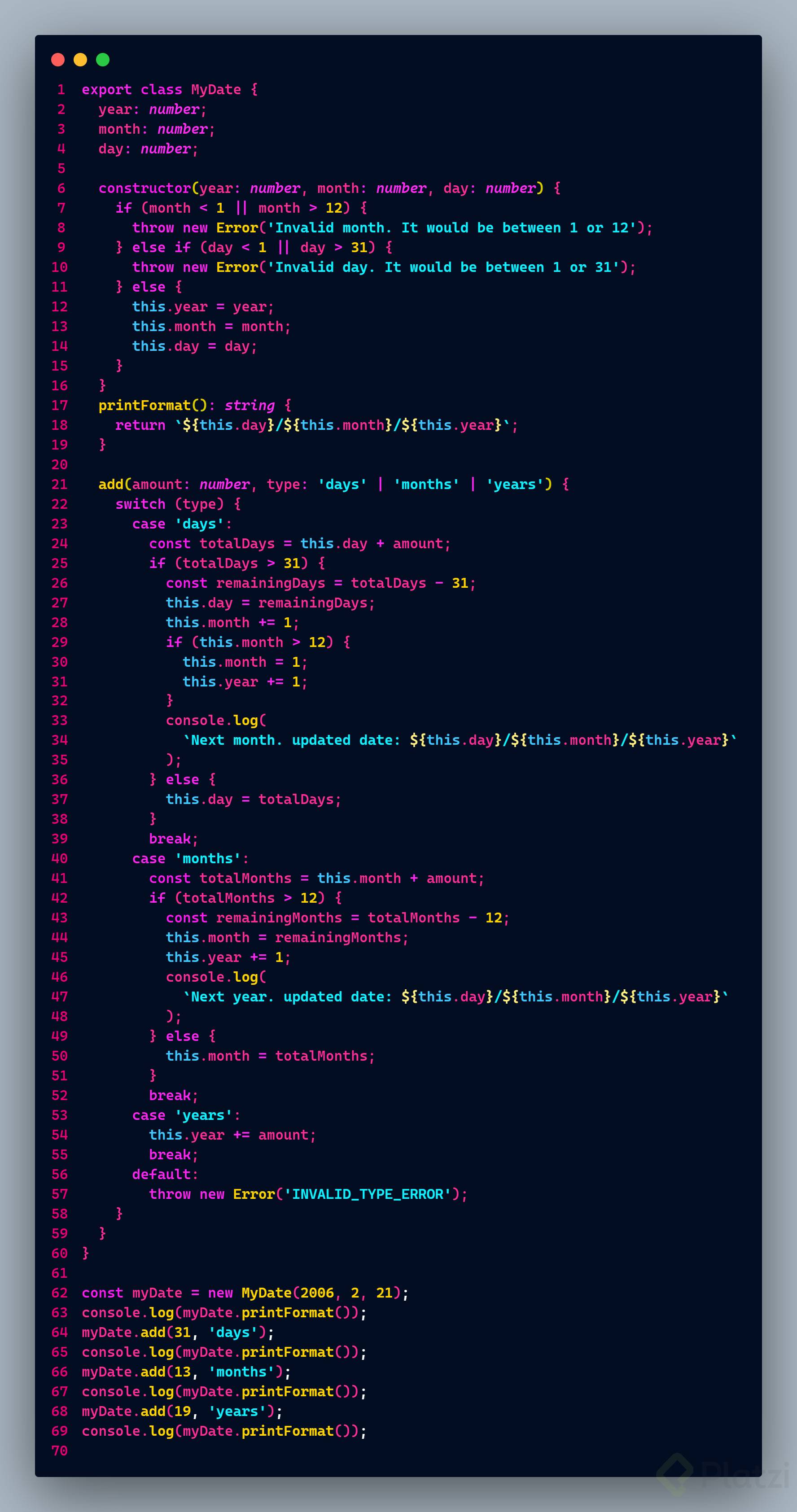
Este fue lo que me puse a implementar, hice una validacion para que al momento de crear una fecha el mes no sea mayor a 12 y dia no sea mayor a 31 solo para implementar algo de innovacion al codigo.
Tambien aproveche de usar el inusable switch y agregar logica de suma de dias, meses y years:

Victor Perozo
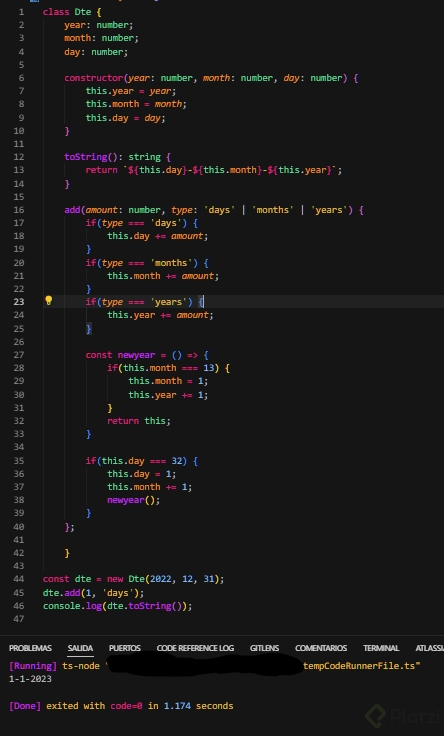
${this.day}-${this.month}-${this.year}; }
add(amount: number, type: 'days' | 'months' | 'years') { if(type === 'days') { this.day += amount; } if(type === 'months') { this.month += amount; } if(type === 'years') { this.year += amount; }
const newyear = () => { if(this.month === 13) { this.month = 1; this.year += 1; } return this; } if(this.day === 32) { this.day = 1; this.month += 1; newyear(); } }; }
const dte = new Dte(2022, 12, 31);dte.add(1, 'days');console.log(dte.toString());
Andrés Corral
Para hacer el add mas eficiente y escalable
add(amount: number, type: 'day' | 'month' | 'year'){
if (['day', 'month', 'year'].includes(type)) { this[type] += amount; } else {
throw new Error('Invalid type provided'); } }

Paula Catalina Delgado Almendrales
Mi solución:
export class MyDate{ year: number; month: number; day: number;
constructor(year: number,month: number,day: number){ this.year= year; this.month =month; this.day = day; }
printFormat(): string{
return ${this.day}/${this.month}/${this.year};
}
add(amount: number, type: 'days'|'months'|'years'){
if(type==='days'){
if (this.month == 12) {
let diaMayor = 31;
let diasRestantes = diaMayor - this.day;
let diferencia = amount - diasRestantes
if(diferencia != 0 ){
this.day -= this.day;
this.day += diferencia;
this.month=0
this.month+=1;
this.year+=1;
}
if(diferencia==0){
this.day += amount ;
}
if(diferencia >=32){
this.day = diferencia - diaMayor;
this.day =this.day + 1;
// this.month=0
this.month+=1;
return this.day ;
}
return this.day;
return this.month;
return this.year
} if (this.month == 2) { let diaMayor = 28; let diasRestantes = diaMayor - this.day; let diferencia = amount - diasRestantes if(diferencia != 0 ){ this.day -= this.day; this.day += diferencia; this.month+=1; } if(diferencia==0){ this.day += amount ; } if(diferencia >=29){ this.day = diferencia - diaMayor; this.day =this.day + 1; this.month+=2; return this.day ; } return this.day; return this.month; return this.year } if(this.month==12 && this.day<31){ let diaMayor=31; let diasRestantes = diaMayor - this.day; let diferencia = amount - diasRestantes if(diferencia != 0 ){ this.day -= this.day; this.day += diferencia; this.month=0; this.month+=1; this.year +=1; } if(diferencia==0){ this.day += amount ; } if(diferencia >=32){ this.day = diferencia - diaMayor; this.day =this.day + 1; this.month+=2; return this.day ; } return this.day; return this.month; return this.year } let diaMayor=31; let diasRestantes = diaMayor - this.day; let diferencia = amount - diasRestantes console.log(diaMayor,diasRestantes,diferencia,this.day); if(diferencia > 0){ if(diferencia >=32){ this.day = diferencia - diaMayor; this.day =this.day + 1; this.month+=2; return this.day ; } if(diferencia != 0 ){ this.day -= this.day; this.day += diferencia; this.month+=1; } if(diasRestantes == 0){ this.day =0; this.day + amount; this.month +=0 } if (this.month==12 && this.day>=31) { this.day = 0 this.month = 0; this.month +=1 this.year += 1 this.day += amount; } }else if(diferencia < 0){ this.day += amount; } } if(type==='months'){ if(this.month>=12){ this.year += 1; for (let index = 0; this.month>=12; index++) { this.month = 0; this.month+=1; } return this.month; } this.month+=amount; } if(type==='years'){ this.year+=amount; }
} } const myDate = new MyDate(2020,2,25);
console.log('Mi fecha de nacimiento es: ' ,myDate.printFormat());
myDate.add(10,'days');
console.log('Mi fecha final1 es: ', myDate.printFormat()); const myDate2 = new MyDate(2020,2,25); myDate2.add(10,'months');
console.log('Mi fecha final2 es: ', myDate2.printFormat()); const myDate3 = new MyDate(2020,2,25); myDate3.add(10,'years');
console.log('Mi fecha final3 es: ', myDate3.printFormat());

Jose Gregorio Sarabia Lugo
export class MyDate { year : number; month: number; day: number; constructor(year: number, month: number, day: number) { this.year = year; this.month = month; this.day = day; } monthArray = [ 'January', 'February', 'March', 'April', 'May', 'June', 'July', 'August', 'September', 'October', 'November', 'December'] printFormat(): string { return `${this.day}-${this.monthArray[this.month]}-${this.year}`; } add(amount: number, type: 'day' | 'month' | 'year') { this[type]+= amount; return this.printFormat(); } } const date = new MyDate(2013,11, 6); console.log(date.printFormat()); // 6-December-2013 console.log(date.add(-4, 'month')); // 6-August-2013

David Rangel
Esta es mi propuesta de solución, por su puesto puede mejorar:
export enum DateEnum { Days = 'days', Months = 'months', Years = 'years', } export class MyDate { year: number; month: number; day: number; constructor(year: number, month: number, day: number) { this.year = year; this.month = month; this.day = day; } printFormat(): string { return `${this.year}/${this.month}/${this.day}`; } add(amount: number, type: DateEnum) { if (type === DateEnum.Years) { this.year += amount; } if (type === DateEnum.Months) { if (this.month + amount > 12) { // contabiliza la cantidad de años que pueden ser con los meses disponibles this.year = this.month + amount / 12; // calcula los meses puros que se agregan a la cuenta de meses this.month = this.month + (amount % 12) * 12; } else { this.month += amount; } } if (type === DateEnum.Days) { let pendingDays: number; // valida si es un año bisiesto if ( this.year % 4 === 0 || (this.year % 100 === 0 && this.year % 400 === 0 && this.day + amount > 365) ) { this.year = (this.day + amount) / 366; pendingDays = amount - 366; while (pendingDays > 0) { // calcula para febrero if (this.month === 2) { if (this.day + amount > 29) { this.month = this.month + 1; pendingDays = amount - 29; } else { this.day = this.day + amount; pendingDays = pendingDays - amount; } } // calcula para meses de 31 días else if ([1, 3, 5, 6, 7, 8, 10, 12].includes(this.month)) { if (this.day + amount > 31) { this.month = this.month + 1; pendingDays = amount - 31; } else { this.day = this.day + amount; pendingDays = pendingDays - amount; } } // calcula para meses de 30 días else { if (this.day + amount > 30) { this.month = this.month + 1; pendingDays = amount - 30; } else { this.day = this.day + amount; pendingDays = pendingDays - amount; } } } } // calcula si es un año no bisiesto o normal else if ( this.year % 4 !== 0 || (this.year % 100 !== 0 && this.year % 400 !== 0 && this.day + amount > 365) ) { this.year = (this.day + amount) / 365; pendingDays = amount - 365; while (pendingDays > 0) { // calcula para febrero if (this.month === 2) { if (this.day + amount > 28) { this.month = this.month + 1; pendingDays = amount - 28; } else { this.day = this.day + amount; pendingDays = pendingDays - amount; } } // calcula para meses de 31 días else if ([1, 3, 5, 6, 7, 8, 10, 12].includes(this.month)) { if (this.day + amount > 31) { this.month = this.month + 1; pendingDays = amount - 31; } else { this.day = this.day + amount; pendingDays = pendingDays - amount; } } // calcula para meses de 30 días else { if (this.day + amount > 30) { this.month = this.month + 1; pendingDays = amount - 30; } else { this.day = this.day + amount; pendingDays = pendingDays - amount; } } } } this.day += amount; } } } const myDate = new MyDate(1993, 7, 9); console.log(myDate.printFormat()); myDate.add(3, DateEnum.Days); console.log(myDate.printFormat()); myDate.add(3, DateEnum.Months); console.log(myDate.printFormat()); console.log(myDate.year); console.log(myDate.month); console.log(myDate.day);

Pedro Carreño
Cuando resulta mas conveniente usar clases sobre usar funciones?

Jose Ever Muñoz Muñoz
Las clases son para usarse como moldes cuando necesites crear muchas veces una programación o una programación muy similar vas a poder reutilizar las clases, las funciones se usan para cosas más específicas como convertir un string a entero o sumar dos números, cosas menos complejas

Valentina Llorente Hernández
¿Qué es un método?
Un método es como una acción que puede hacer un objeto. Es una función que vive dentro de una clase y le dice al objeto qué hacer.

Juan David Marin Rodriguez
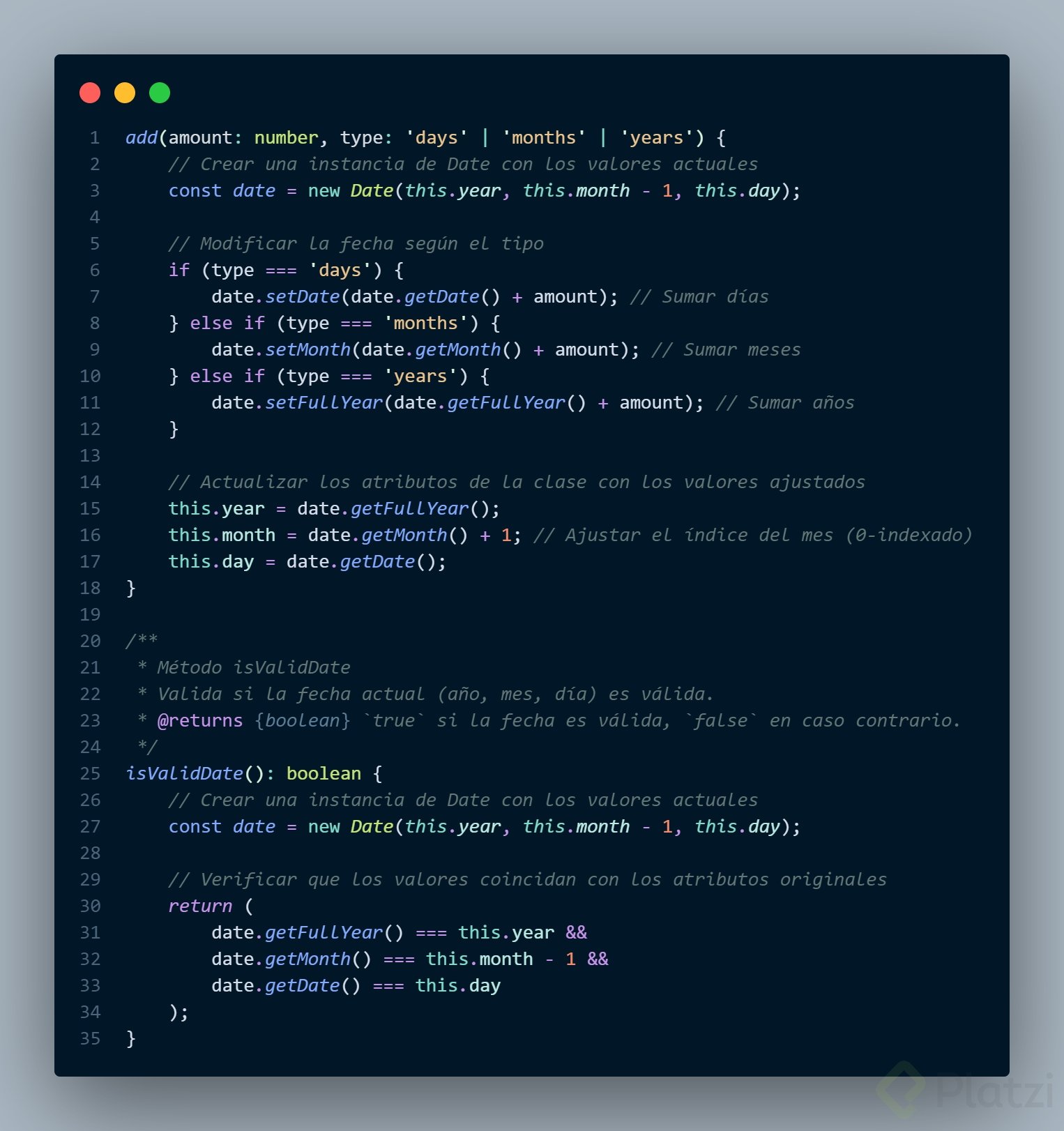
De esta manera se puede validar si llegamos a un mes máximo se suma el año y un día máximo se suma mes.

Diego Raciel Ortega Hernandez
Los constructores son los que definen los parámetros de la clase. Es decir, cuando creamos una instancia los argumentos que le pasamos van dirigidos al constructor y luego esos parámetros guardados en los atributos se utilizan en los métodos de la clase.
Corriganme si estoy mal o entendí mal.

oscar.rusinque
Según lo que que entiendo, el constructor es un método especial donde se inicializan los parármetros de de la clase , cuando se irealiza una nueva instancia se llama automaticamente el constructor para inicializar dichos parametros de la clase con los valores proporcionados por la nueva instancia y así ya se puede usar en los demás métodos de la clase. En el constructor no necesariamente se tienen que inicializar los parámetros, se pueden inicializar al declararlos o en otros métodos tmbien los constructores como un método tiene su visibilidad

Winslow Taylor Geldres Oliveros

Ronaldo Delgado
excelente video