Cuando estamos creando nuestra historia, necesitamos saber cómo se creará. para eso podemos usar algunos tipos y técnicas de montaje que nos ayudarán a crear un buen montaje y tener una parte de edición más fácil.
###Tipos
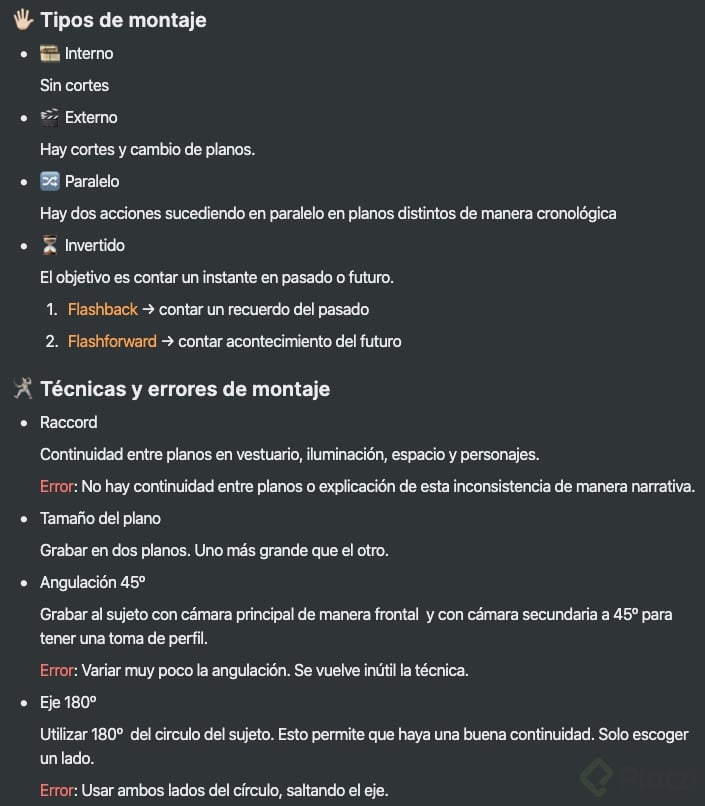
Montaje interno: Este tipo de montaje es perfecto para contar una historia en una sola toma, sin ningún tipo de cortes.


Montaje externo: Este tipo es perfecto para usar cuando necesitamos contar una historia con diferentes puntos de vista, lo que significa una escena con cortes.
Montaje paralelo: Este tipo funciona cuando necesitamos dos o más puntos de vista al mismo tiempo en la historia que estamos contando.
Montaje invertido: Este tipo nos funcionará cuando necesitemos mostrar un flashback o una visión del futuro de la historia que estamos contando.
###Técnicas
Entonces, ¿cómo podemos filmar este tipo de montaje? Bueno, existen múltiples técnicas y estándares para hacer esto, los principales son:
- Raccord: Es la forma de vincular varias escenas y tener la misma iluminación, ropa, personas, posiciones, etc. Esto con el propósito de cambiar el punto de vista de la escena sin crear ningún aspecto extraño de nuestra historia.
- Es importante tener los mismos aspectos de la toma anterior para no crear errores en nuestra escena.
- Tamaño del plano: Es cuando filmamos una escena en dos distancias, una más cercana a nuestro objetivo que la otra, que debe estar en el mismo ángulo pero más allá de la primera.
- 45 ° Grado: Esta técnica se basa en tener dos puntos de vista de la misma escena, donde una cámara está frente al objetivo y la otra está a 45 ° Grado de la primera.
- Eje de 180 °: Esta técnica se basa en tener un punto de vista de 180 ° Grado de la misma escena.
- Es importante no cambiar el punto de vista fuera del primer grado de 180 ° donde comienza a filmarse la escena.
// --- English ---
When we are creating our story, we need to know how will be created. for that we can use some types and Techniques of mounting that will help us to create a good Mounting and have an easier Edition part.
###Types
Intern Mounting: This type of mounting it's perfect for tell a story in just one take, without any kind of cuts.
Extern Mounting: This type it's the perfect for used when we need to tell a story with different point of views, which means a scene with a cuts.
Parallel Mounting: This type works when we need two or more points of view at the same time in the story that we are telling.
Invert Mounting: This type will work us when we need to show a flashback or a vision of the future of the story that we are telling.
###Techniques
So, how we can film these type of Mounting? Well, exists multiple techniques and standards for do this, the principals are:
- Raccord: It's the way of link multiple scenes and have the same illumination, Clothes, persons, positions, etc. This with the purpose of change the point of view of the scene without create any weird aspect of our story.
- It's important have the same aspects of the before take for not create errors in our scene.
- Plane Size: It's when we film a scene in two distances, one closest to our objective that the other, that must be a in the same angle but further that the first one.
- 45° Degree: This technique is based in have two point of view of the same scene, where one camera it's in front of the objective and the other one it's 45° Degree from the first one.
- 180° Axis: This technique is based in have 180° Degree point of view of he same scene.
- It's important not change the point of view outside of the first 180° degree where start to be filmed scene.