Apostrophe S for Family Relationships
Contenido del curso

Habla de preferencias personales en Inglés


Habla de tu familia en Inglés



Habla de prendas de vestir en Inglés


Habla de tu rutina personal en Inglés


Habla de lugares y compras en Inglés


¡Practica tu Inglés!

Apostrophe S for Family Relationships
Resumen
Wondering how to answer who is that? in English while showing who owns what or how people relate to each other? The apostrophe S is your shortcut to express possession, connection to a place, and relationships between people, all in one tiny mark.
You will use this every day when talking about family, friends, and belongings, so mastering it early will make your conversations sound natural and clear.
What does apostrophe S mean in English grammar?
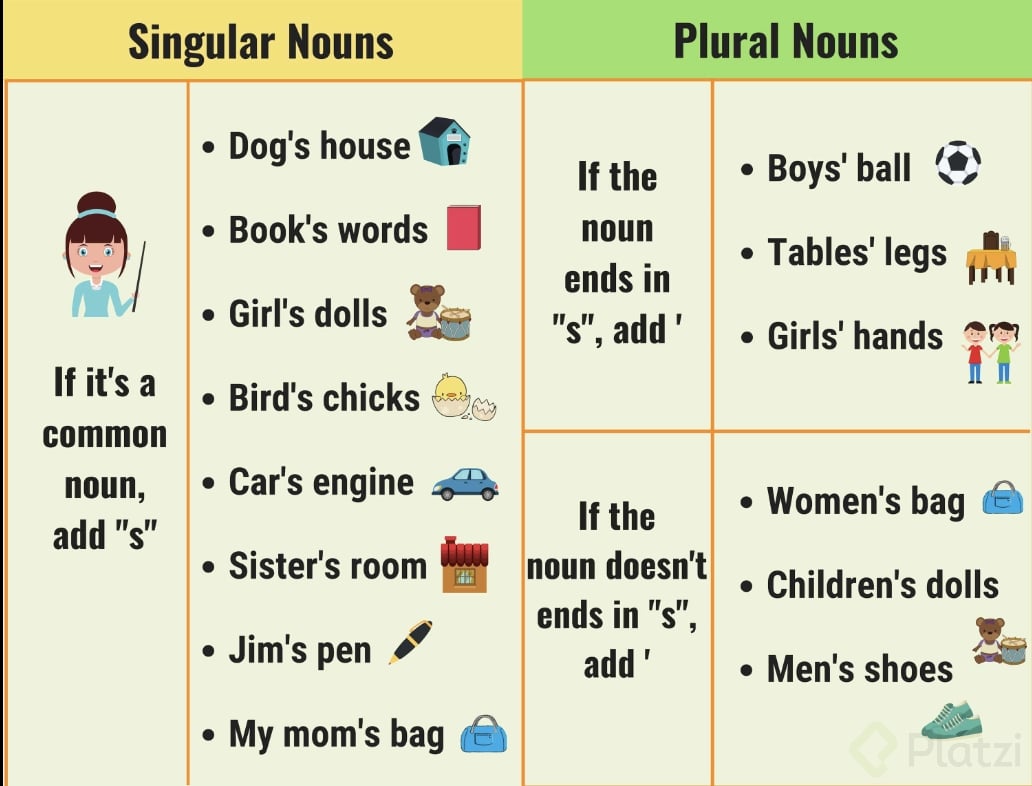
The apostrophe S ('s) is a small punctuation mark with a big job. It tells the listener that something or someone is linked to another person, place, or thing.
What is apostrophe S used for? It shows possession, connection to a place, or a relationship between two people. Example: She is my cousin's best friend.
There are three clear uses you should recognize when you hear or read them.
When does something belong to a person?
Use 's to say that an object belongs to someone. If you ask where is Lucy's book?, you are not asking about just any book. You are asking about the specific book that belongs to Lucy.
- That's my father's laptop. The laptop belongs to my father.
- That is my sister's car. The car belongs to my sister.
When is a person connected to a place?
You can also use 's to link a person with a place they attend or are part of.
- Arnold's school is across the store. Arnold is the person, the school is the place, and 's makes the connection.
How do you show relationships between people?
This is where family vocabulary shines. You can describe how one person relates to another using 's.
- Kelly is my brother's swimming coach.
- She is my cousin's best friend.
Both sentences describe a link: the coach belongs to my brother's world, the best friend belongs to my cousin's world.
How do I use the apostrophe with plural nouns like brothers or sisters?
Here is where many English learners get stuck. When the noun is already plural and ends in S, you do not add another S. You only add the apostrophe after the existing S.
Where does the apostrophe go with plural nouns? After the S that is already there. Example: my brothers' toys means the toys belong to more than one brother.
Compare these two:
- My brother's toys are on the floor. One brother.
- My brothers' toys are on the floor. Two or more brothers.
Another example with family: My sisters' English teacher is kind. This means I have more than one sister, and they share the same teacher.
Can you use two apostrophe S in one sentence?
Yes, and it happens more often than you think, especially when several possessions chain together.
Imagine this scene: you have friends, your friends have children, and those children have toys. You can say: Those are my friend's children's toys.
- The first 's connects the children to your friend.
- The second 's connects the toys to the children.
Each 's builds one more layer of the relationship. Read it slowly and you will see the logic click into place.
What happens when two people share the same thing?
When two named people own something together, you do not need to add 's to both names. You only add it after the last person mentioned.
- This is Sally and Emilio's house. The house belongs to both Sally and Emilio, but only Emilio carries the 's.
This rule keeps your sentences clean and avoids repetition.
Quick practice: can you complete these sentences?
Try these three examples before checking the answers. They all come from everyday family situations.
- The clothes belong to my brother. My ___ clothes are very elegant.
- The hat belongs to my grandmother. My ___ hat is pretty.
- The house belongs to Sally and Emilio. This is ___ house.
The correct answers are:
- My brother's clothes are very elegant.
- My grandmother's hat is pretty.
- This is Sally and Emilio's house.
If you got all three right, you are ready to describe your entire family tree using possessives. If not, go back and reread the plural rule, since that is the trickiest part.
Keep practicing with your worksheet and try describing your own family members, their belongings, and their relationships. Which sentence about your family will you build first? Share it in the comments.