




astrid katherine diaz leon
at 2:37 there is a strange robotic sound, is it Ethos or Logos or both? xd

Marina Barraza
Thanks for your comment. We are working to solve it!
Persuadir a una audiencia no es cuestión de suerte. En el mundo profesional, dominar los tres pilares de la retórica marca la diferencia entre un mensaje que se olvida y uno que genera acción. Estas tres herramientas —ethos, pathos y logos— son los modes of persuasion que todo comunicador efectivo debe conocer.
¿Qué es ethos y cómo construye confianza?
El primer pilar, ethos, se centra en la credibilidad del orador [00:13]. Quien habla demuestra lo que sabe, su carácter y su ética profesional. Para lograrlo utiliza hechos, estadísticas y opiniones imparciales (unbiased opinions).
Un ejemplo claro lo ilustra bien: "As sales manager from Zed Tech and because of our recent 5% boost in sales, I foresee an increase in the sale of laptop computers in the next five years" [00:30]. Aquí el sales manager apela a su experiencia directa y respalda su afirmación con un dato concreto —el crecimiento del 5 %—. De este modo forma una conexión genuina con la audiencia.
¿Cómo funciona pathos para conectar emocionalmente?
El segundo pilar, pathos, apela a las emociones del público [01:02]. El orador recurre a técnicas de storytelling, metáforas y vocabulario con carga emocional (emotionally charged vocabulary).
Observa este ejemplo: "Your house is your castle. Use our surveillance equipment to protect what's most important to you, your family" [01:12]. La palabra castle es una metáfora que eleva el valor del hogar, mientras que la mención de your family activa el instinto de protección. Esa combinación genera una respuesta emocional inmediata.
¿Por qué logos es esencial para argumentar con solidez?
El tercer pilar, logos, se basa en la lógica y el razonamiento [01:30]. El orador presenta evidencia concreta: cita especialistas, menciona case studies o emplea apoyos visuales (visual aids).
Ejemplo: "A study conducted by car manufacturers confirmed that 20% of accidents occur during the evening" [01:42]. Al citar un estudio, el mensaje gana peso porque se apoya en datos verificables, no en opiniones.
¿Cómo reforzar los tres pilares?
Existen varias formas de dar soporte a ethos, pathos y logos [02:00]:
¿Puedes identificar cada pilar en la práctica?
Poner a prueba el conocimiento es la mejor forma de afianzarlo. Tres casos de ejemplo ayudan a practicar [02:14]:
¿Qué considerar antes de aplicar la retórica?
Antes de preparar cualquier presentación o discurso, es necesario analizar la situación [03:12]:
Responder estas preguntas te permite elegir el pilar adecuado —o combinar varios— para que tu mensaje sea realmente persuasivo. Comparte en los comentarios cuál de los tres pilares utilizas más en tu entorno profesional y por qué.
astrid katherine diaz leon
at 2:37 there is a strange robotic sound, is it Ethos or Logos or both? xd
Marina Barraza
Thanks for your comment. We are working to solve it!

Gabriel Obregón
Rhetoric has three main pillars, also known as the modes of persuasion: ethos, pathos, and logos.
Ethos
Ethos is about building trust with the audience. The speaker demonstrates their knowledge, credibility, character, and ethics by using facts, statistics, and unbiased opinions.
Example: "As Sales Manager from Zed Tech and because of our recent 5% boost in sales, I foresee an increase in the sale of laptop computers in the next five years."
Pathos
Pathos appeals to the audience's emotions. The speaker uses storytelling techniques, metaphors, and emotionally charged vocabulary to connect with the audience.
Example: "Your house is your castle. Use our surveillance equipment to protect what's most important to you, your family."
Logos
Logos relies on logic and reasoning. The speaker uses evidence to support their arguments, citing specialists, mentioning case studies, or using visual aids.
Example: "A study conducted by car manufacturers confirmed that 20% of accidents occur during the evening."

Orlando Galdamez Guevara
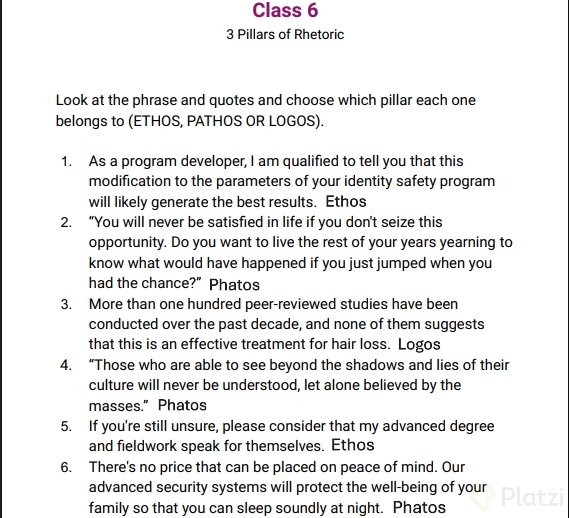
1- Ethos
2- Pathos
3- Logos
4- Pathos
5- Ethos
6- Pathos

Maria Paula Santofimio

Luis Renato Cabañas Rodríguez
1- Ethos
2- Pathos
3- Logos
4- Pathos
5- Ethos
6- Pathos

alfredo antonio martinez albayero
· As a program developer, I am qualified to tell you that this modification to the parameters of your identity safety program will likely generate the best results. ETHOS
· “You will never be satisfied in life if you don't seize this
opportunity. Do you want to live the rest of your years yearning to know what would have happened if you just jumped when youhad the chance?” PATHOS
· More than one hundred peer-reviewed studies have been conducted over the past decade, and none of them suggests that this is an effective treatment for hair loss. LOGOS
· “Those who are able to see beyond the shadows and lies of their culture will never be understood, let alone believed by the masses.” PATHOS
· If you're still unsure, please consider that my advanced degree and fieldwork speak for themselves. ETHOS
· There's no price that can be placed on peace of mind. Our advanced security systems will protect the well-being of your family so that you can sleep soundly at night. PATHOS

Cristian Camilo Bulla Murcia

Simon Cárdenas
I have an MCER of 150 i already know this stuff

Jhojan Naranjo Quintero
always be humble dude
Simon Cárdenas
I am humble and sry my MCER is of 130
Jhojan Naranjo Quintero
develop a passion for learning. If you do, you will cease to grow

Kevin José Carvajal Menjivar

julio.agudelo
Platzi Team
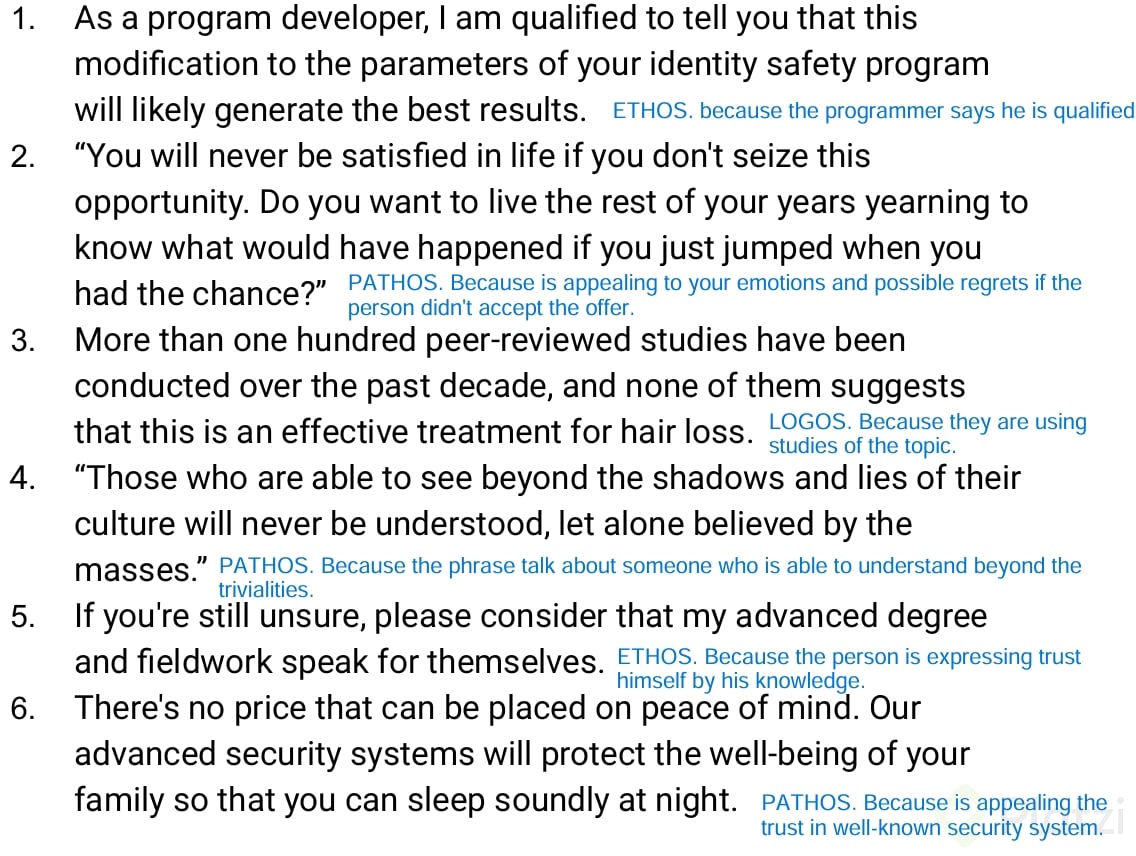
· Ethos: Because hi is trying to convince from his experience.
· Pathos: It is phatos because his is touching the aware of take desitions.
· Logos: Its logos for the evidence used for the arguments.
· Pathos: it touch, the feel to be alone because of be critic.
· Ethos: Because is creates credibility from his advanced degree.
· Pathos: for the security of their families.
juan carlos santos arriola
The three pillars of rhetoric, often referred to as the rhetorical appeals, are:
1. Ethos (Credibility): This pillar focuses on the character and credibility of the speaker. It involves establishing trust and authority in order to persuade the audience. A speaker with strong ethos is seen as knowledgeable, ethical, and trustworthy, which enhances the persuasive power of their message.
2. Pathos (Emotional Appeal): Pathos appeals to the audience's emotions. It seeks to evoke feelings such as sympathy, anger, joy, or fear to create a connection with the audience. By tapping into the audience's emotions, the speaker can motivate them to respond or take action based on those feelings.
3. Logos (Logical Appeal): Logos relies on logic and reason. It involves using facts, statistics, logical arguments, and evidence to support claims. A strong logical appeal helps the audience understand the rationale behind the argument and encourages them to accept the conclusions drawn from the evidence presented.
Together, these three pillars—ethos, pathos, and logos—form the foundation of effective communication and persuasion in rhetoric. A skilled speaker or writer uses all three to create a compelling and persuasive message.

Paolo Quintero
Look at the phrase and quotes and choose which pillar each one belongs to (ETHOS, PATHOS OR LOGOS)

Francisco Ruiz Mendieta

Camila Ortega Hinojosa

Sofía Valentina Hernandez

Andrés Llerena