Contenido del curso

Let's talk!
- 2

Idioms y Phrasal Verbs en Conversaciones diarias
05:56 min - 3

Identificación y uso de modismos en inglés cotidiano
03:09 min - 4

Idioms en Inglés: Significado y Uso Práctico
04:58 min - 5

Comprensión de Idiomas: Expresiones y Significados en Inglés
03:14 min - 6

Idiomas y Expresiones Comunes en Inglés: Ejercicios Prácticos
00:47 min - 7

Aprende Phrasal Verbs en Inglés: Significados y Ejemplos Prácticos
06:24 min
Time
- 8

Modismos de Tiempo en Inglés: Significado y Uso Práctico
05:29 min - 9

Lectura y Comprensión de Historias Cortas
02:47 min - 10

Expresiones de Tiempo en Inglés: Modismos y Uso Práctico
04:47 min - 11

Idioms de Tiempo en Inglés: Ejercicio de Comprensión y Práctica
Viendo ahora - 12

Phrasal Verbs en Inglés: Uso y Significado Práctico
04:30 min - 13
Práctica de conversación en inglés (contexto cotidiano)
00:00 min
It's a family affair
- 14

Modismos en Inglés Relacionados con la Familia
06:35 min - 15

Expresiones Idiomáticas en Inglés: Comprensión y Práctica
05:14 min - 16

Idioms en Inglés sobre la Familia: Significados y Ejemplos
04:29 min - 17

Relaciones familiares y autoconocimiento personal
03:18 min - 18

Phrasal Verbs con "Put": Significados y Uso Práctico
04:07 min
Till the next time!

Idioms de Tiempo en Inglés: Ejercicio de Comprensión y Práctica
Resumen
Putting idioms into practice through a real exercise is one of the most effective ways to make new vocabulary stick. This reading activity focuses on idioms of time, reinforcing expressions that are essential for everyday English communication.
How does the fill-in-the-blanks exercise work?
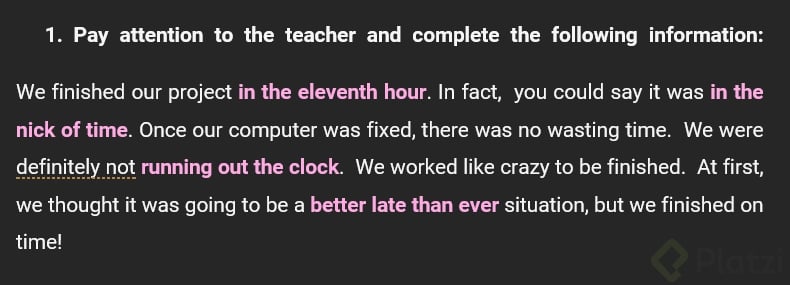
The activity is straightforward: you listen to a short story and fill in the missing idioms as you go. Before starting, it is important to download the worksheet so you can participate fully [0:10]. The story is read aloud twice — once for you to complete the blanks, and a second time with the highlighted answers so you can check your work [1:03].
This approach helps you connect meaning and context simultaneously, which is key for retention.
What time idioms appear in the story?
The story uses several important idioms related to time. Each one carries a specific meaning that goes beyond the literal words.
- In the 11th hour [0:30]: completing something at the very last possible moment before a deadline.
- In the nick of time [0:38]: finishing or arriving just barely in time, with almost no time to spare.
- Wasting time [0:46]: spending time doing nothing productive or useful.
- Running out the clock [0:52]: deliberately letting time pass without making an effort, often used in sports when a team is trying to preserve a lead.
- Better late than never [1:01]: an expression meaning it is preferable to do something late than not do it at all.
- On time [1:10]: at the scheduled or expected moment, neither early nor late.
How do these idioms connect in context?
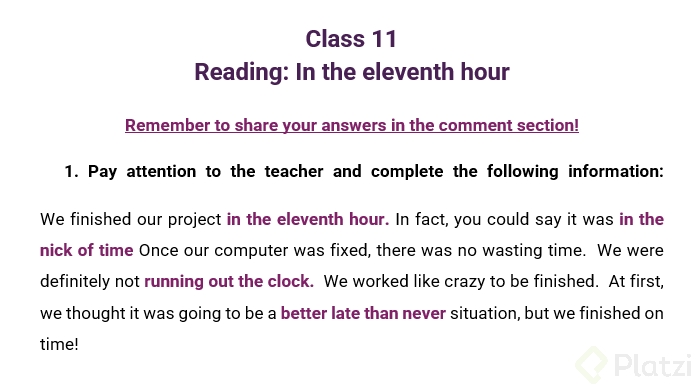
The story tells a brief narrative about a team that finished a project under pressure. Their computer broke down, which caused a delay. Once it was fixed, they worked intensely — they were not running out the clock — and managed to deliver on time. At first, they feared it would be a better late than never situation, but things turned out well.
Notice how these idioms create a natural flow in the narrative. They are not random; they describe a progression from urgency to effort to success.
What makes this practice effective for learning?
Listening and writing at the same time forces your brain to process language actively rather than passively. When you hear the idiom and must recall it to fill in a blank, you strengthen the connection between the expression and its meaning. Reading the answers afterward [1:03] serves as immediate feedback, which research shows accelerates learning.
The story also demonstrates how native speakers combine multiple idioms in a single paragraph without sounding forced. This is how fluent speakers naturally use idiomatic language — layering expressions that relate to the same topic.
If you got most of the blanks right, your understanding of time idioms is solid. If you missed a few, go back and review the meanings before moving on to the next topic: phrasal verbs of time [1:24]. Practice makes all the difference when building idiomatic fluency.