Interview: Plagiarism
Contenido del curso

Learning to write


Formal writing
- 7

Cómo escribir emails profesionales en inglés
07:50 min - 8

Comunicación Efectiva en Slack para Profesionales
08:47 min - 9

Cómo escribir un cover letter en inglés
08:00 min - 10

Inversión en Inglés Avanzado: Usos y Beneficios
05:22 min - 11

Tutorial: Effective professional communication
07:12 min - 12

Práctica de escritura profesional en inglés (emails y comunicación laboral)
00:00 min
Do's and Don'ts of writing


Conclusion

Recursos
Resumen
Understanding plagiarism is one of the most critical skills for any student or professional who writes academic papers. In this interview, John, an English teacher with a bachelor's degree in TEFL and a master's in education, shares his personal experience with plagiarism and offers practical advice on how to avoid it. His story proves that even unintentional mistakes can have serious consequences.
What is plagiarism and why should you care about it?
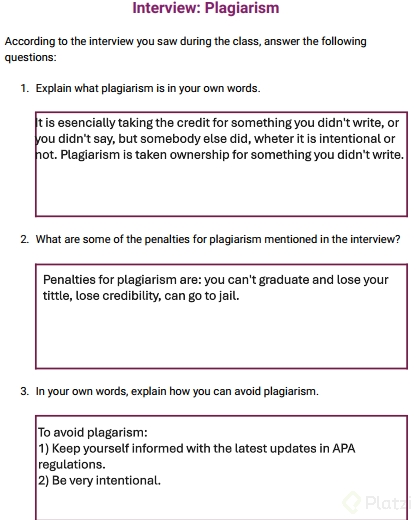
Plagiarism is essentially taking credit for something you didn't write or say [01:52]. Whether it is intentional or not, the consequences in the academic world are the same. John emphasizes that in most cases plagiarism is not intentional, yet it doesn't matter — the offense is treated equally.
The consequences can be devastating:
- You can lose your degree or title [05:32].
- It is considered a crime that can lead to jail time or fines [05:40].
- You lose credibility in your professional field [05:50].
- Any prizes or acknowledgements tied to a plagiarized document can be revoked [06:05].
- Once your reputation is damaged, there is no way back [06:25].
John highlights that in the academic world, your word matters. If you claim you wrote something, you must be absolutely sure that is the truth.
Can you plagiarize your own work?
One of the most surprising lessons from this interview is that self-plagiarism is real [02:55]. John shares a personal story from when he was writing his undergraduate thesis. He found a paragraph he had written for a previous university paper and decided to copy and paste it into his thesis without citing himself.
He assumed that since he was the original author, there was no issue. However, the university ran his document through plagiarism detection software [03:50], which flagged the paragraph as plagiarized. These programs do not distinguish between you and another person — they simply match text across documents and identify duplicates.
John had to talk to his professors, explain the situation, and ultimately paraphrase his own ideas rather than reuse the exact fragment [04:25]. This experience taught him how serious plagiarism detection has become and that even your own previous words require proper citation.
How can you protect yourself from plagiarism?
John offers two key pieces of advice for avoiding plagiarism:
- Stay up to date with citation guidelines [07:30]. Different referencing systems such as APA, MLA, or Chicago have specific rules about text length, source type, and formatting. Knowing the latest updates in these regulations is essential.
- Be very intentional when citing [08:20]. Even if you make small formatting mistakes with periods, commas, parentheses, or quotation marks, actively trying to cite is far better than ignoring the requirement altogether.
What role does paraphrasing play in avoiding plagiarism?
Paraphrasing is a powerful tool that goes beyond simple citation [09:00]. Instead of copying a text word for word, you read and understand the original idea, then rewrite it in your own words while still giving credit to the original author.
John provides a practical example: rather than pasting an entire quote, you can write something like "Just like Ravi (2022) said, it is very important to be aware of plagiarism because..." and then continue developing your own argument [09:25]. This approach lets you transform someone else's ideas into your own language while maintaining academic integrity.
However, there is one rule that must never be forgotten — even when paraphrasing, you must always use the referencing system [10:10]. Paraphrasing without a citation is still plagiarism.
What makes plagiarism avoidable in practice?
John reassures that plagiarism is not something to be afraid of but something to be aware of [06:55]. Writing can be challenging and time-consuming, but with proper citation habits, you can ensure your words stand on solid ground. The key is building awareness, practicing correct referencing, and treating every source with the respect it deserves.
Share your thoughts and any questions about plagiarism in the comments — discussing real experiences is one of the best ways to learn how to avoid common mistakes.