Contenido del curso


Audiencias y targeting


Anuncios que si funcionan


Implementación inteligente


Métricas, optimización y escala


Aprovecha el sistema y vence
- 20

Meta's Four AI Brains That Spend Your Budget
05:27 min - 21

Meta Catalog Ads That Follow Every Shopper
11:52 min - 22

Campañas de mensajes en Facebook Ads para ventas y leads
05:32 min - 23

Reglas automáticas para escalar presupuestos en Facebook Ads
05:57 min - 24

Principios fundamentales del performance marketing exitoso
03:12 min
Choosing the Right Meta Ads Objective
Resumen
Picking the right Meta Ads campaign objective is the single most important decision you make before spending a dollar. The objective tells Meta what you want, optimizes your budget, refines your audience, and decides whether the algorithm finds buyers, leads, or just curious clickers.
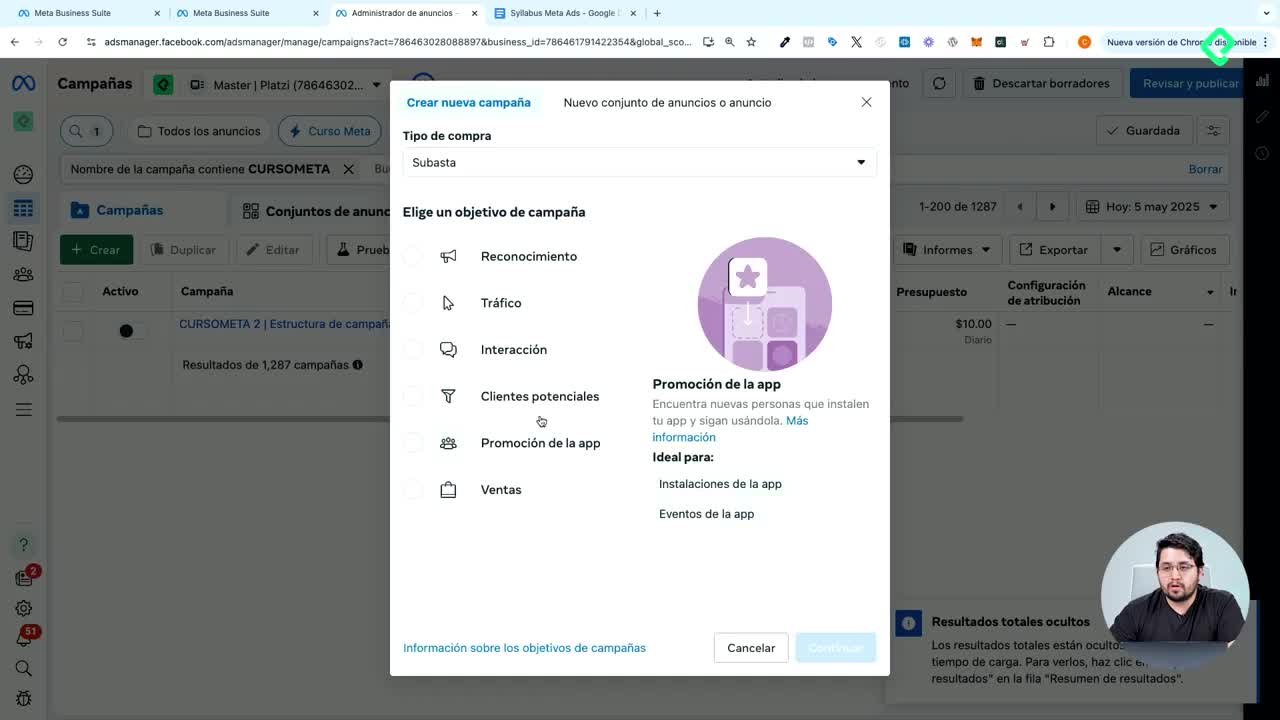
Meta now offers only six objectives, all aligned with the marketing funnel: awareness, traffic, engagement, leads, app promotion, and sales. The trick is matching the objective to your real business goal instead of taking shortcuts that look cheaper but deliver lower quality.
What does each Meta Ads objective actually do?
Each objective unlocks a set of secondary optimizations that change who sees your ad and why.
How does the awareness objective work in Meta Ads?
Awareness is built for big brands that need to spread a message to many people [01:25]. Inside it you can optimize for reach, brand recall, video views, or business location awareness. If you are chasing a direct sale, skip it until your brand has real scale.
What is the awareness objective in Meta? It is an objective designed to maximize how many people see or remember your brand, not to drive sales or leads.
When should I use traffic instead of conversions?
Traffic moves people from a Meta platform to a website, profile, or chat [02:14]. Inside traffic you can pick link clicks, landing page views, profile visits, Messenger, or calls. Avoid link clicks: the algorithm will hunt for people who click and nothing else, so quality drops fast. Landing page views is the safer choice because Meta only counts the visit when the page actually loads.
What is the engagement objective for?
Engagement looks for reactions, comments, video views, and conversations from users who already understand your brand a bit [03:30]. It overlaps with traffic on Messenger, Instagram, and WhatsApp, but here intent is higher and volume is lower. Do not pick conversions or calls inside engagement, those belong in sales or leads.
How do leads, app promotion, and sales objectives compare?
These three are the bottom of the funnel, where every optimization should map directly to revenue.
- Leads: capture qualified prospects through instant forms, qualified chats on Messenger, Instagram or WhatsApp, conversions on an external site, or calls [04:45].
- App promotion: requires the Meta SDK and lets you optimize for installs or in-app events like a purchase inside the app [05:50].
- Sales: optimizes for the most relevant action on your site, usually a purchase, measured by your pixel and conversion API. It also covers catalog sales, chat-based selling, and calls focused on closing [06:30].
Catalog sales deserve special attention. Once your catalog is set up, Meta can show a returning visitor the exact product they viewed, turning a generic ad into a personalized reminder.
Which Meta objective should I choose for online sales? Choose Sales and optimize for the purchase conversion event tracked by your pixel. It tells the algorithm to look for buyers, not browsers.
How does Meta's learning phase and attribution work?
Every campaign goes through a learning phase where Meta figures out who your ideal user is and how to reach them [08:10]. The phase ends when Meta records about 50 attributed conversion events, after which scaling becomes far easier. Without enough events, the algorithm keeps guessing and performance stays unstable.
What is an attribution window in Meta Ads?
The attribution window is the number of days Meta can still claim credit for a conversion after a click or view. The default is 7 days after click and 1 day after view [09:40]. If someone buys on day three after clicking, Meta attributes it. If they buy on day eight, it does not.
You can shorten the click window to 1 day to push the algorithm to optimize faster, but only if you sell impulse or mass-market products. For long sales cycles, stay with the 7-day default or you will starve the algorithm of data.
Why are view-through windows capped at one day?
Because an impression is a low-intent signal. Active views apply only to videos and require at least 10 seconds watched, or 97% of the video if it is shorter [11:05]. A regular view just means the ad was rendered on screen. Letting Meta attribute purchases seven days after a simple view would massively over-credit the platform, so the cap stays strict.
Standard vs incremental attribution: which one should I pick?
- Standard attribution: counts every conversion that falls inside the attribution window.
- Incremental attribution: only counts conversions Meta believes would not have happened without the ad, filtering out users who would have bought through email, WhatsApp, or other channels [12:20].
Start with standard attribution so the algorithm gets the volume of data it needs to learn. Once your account is stable, run incremental as a test to see how much lift Meta is truly adding versus your other channels.
What does attributed conversion mean in Meta? It means Meta has confirmed, through a click or view inside the attribution window, that one of its ads contributed to the sale or lead.
Dialing in the right objective, attribution window, and attribution type is what separates campaigns that learn quickly from campaigns that burn budget. Which objective are you running right now, and is it actually matching your business goal? Drop your setup in the comments and let's review it together.