Arabic Words Hidden in Your English Vocabulary
Contenido del curso



Migración del inglés a otras regiones


Influencia de otros idiomas en el inglés


Haz que el inglés siga evolucionando

Recursos
Resumen
Arabic words in English are everywhere, from your morning coffee to the algebra you studied at school. If you are learning English and want to expand your vocabulary while understanding where common terms come from, tracing the Arabic roots in English will give you both linguistic and cultural insight.
Why did Arabic start influencing English?
The story begins in the 8th century, during the Islamic Golden Age, when Arab scholars led major advances in mathematics, astronomy, and medicine. Their work was translated into Latin and other European languages, and from there, many terms crossed into English.
This intellectual exchange explains why so many scientific and everyday words you use today have an Arabic origin. It is not a coincidence; it is the trace of centuries of knowledge moving across borders.
Why does English have Arabic words? Because Arab scholars contributed heavily to science and trade during the Islamic Golden Age, and their texts were translated into European languages, carrying Arabic vocabulary along.
Which English words come from Arabic?
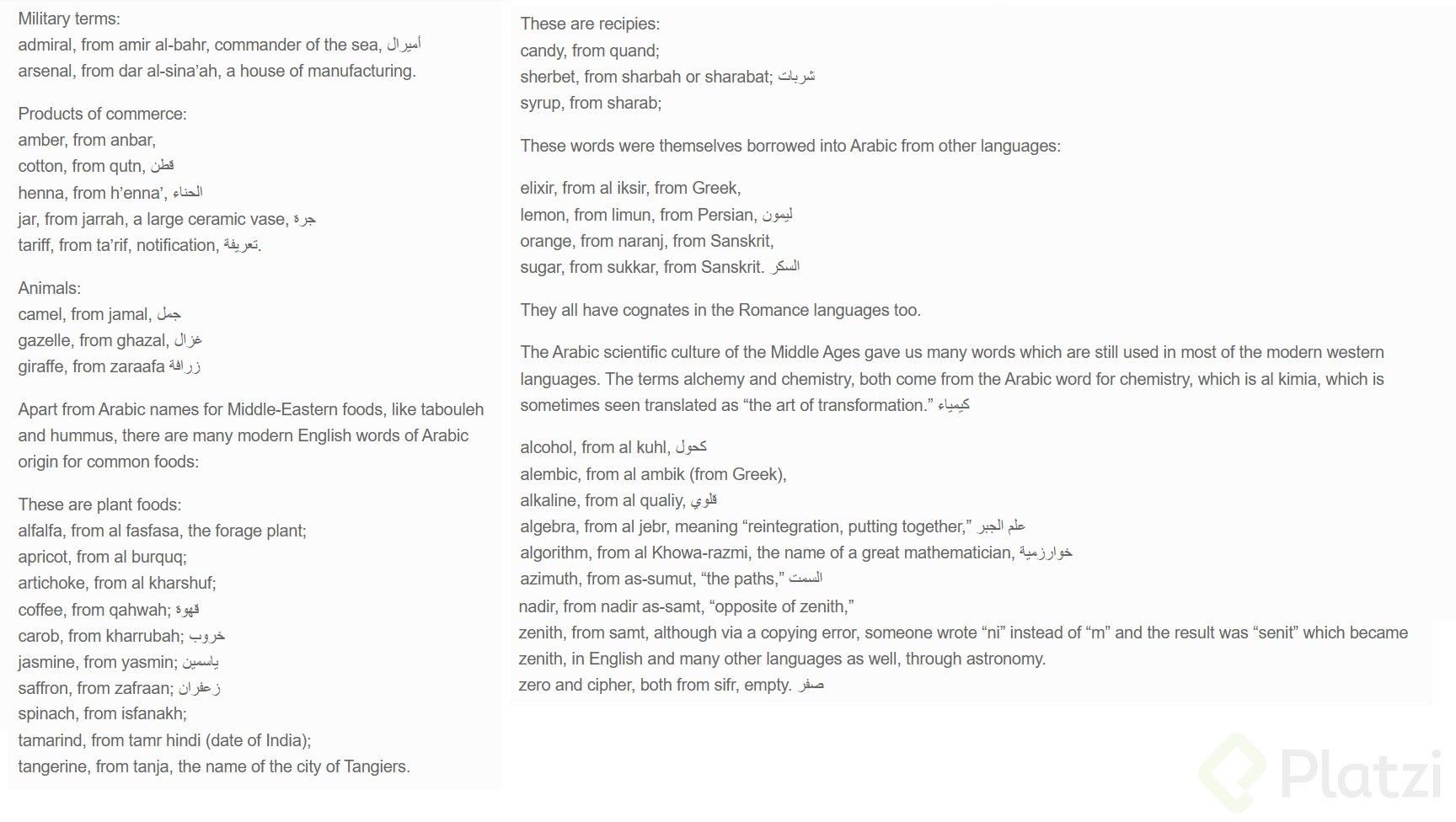
Some of the most common terms you already use have direct Arabic ancestors. Here are clear examples worth memorizing:
- Alchemy: from al-kimiya, the process of transmuting base metals into gold.
- Algebra: from al-jabr, meaning reunion of broken parts.
- Safari: from safar, meaning journey or expedition. It reached English through Swahili.
- Coffee: from qahwa. Coffee was first cultivated in the Arabian Peninsula before its name spread worldwide.
- Alcohol, magazine, and sugar: also borrowed from Arabic and fully integrated into daily English.
Notice a pattern? Many of these words start with al, which is the Arabic definite article, similar to the in English. Spotting that prefix is a quick way to detect Arabic origin.
How did Arabic numerals reach English?
The digits you write every day, from zero to nine, are Arabic numerals. They were introduced to Europe in the 10th century and replaced the much more cumbersome Roman numerals.
This shift was not just cosmetic. It changed how people did math, kept accounts, and developed science. Without it, modern arithmetic as you know it would look very different.
What are Arabic numerals? They are the digits 0 to 9 used in English and most of the world today, originally developed by Arab mathematicians and brought to Europe in the 10th century.
How did Arabic shape English literature and design?
The influence goes well beyond isolated words. The Arabian Nights, a collection of tales from the Islamic Golden Age, was translated into English and left a strong mark on English literature, inspiring storytelling structures and imagery still used today.
Arab scholars also introduced foundational ideas to European thinkers. The concept of zero in mathematics reached Europe through them, transforming science, engineering, and finance.
And there is a visual layer too. Arabic calligraphy influenced the development of English typography and graphic design. Many English-speaking designers drew inspiration from the beauty and complexity of Arabic script, which became popular in art hundreds of years ago.
What does this mean for you as an English learner?
Understanding the Arabic roots of English helps you in three practical ways:
- You memorize vocabulary faster when you connect it to a story or origin.
- You recognize patterns, like the al prefix, that hint at meaning.
- You appreciate English as a living language shaped by many cultures, not a closed system.
Next time you order a coffee, solve an algebra problem, or plan a safari, remember you are using words that traveled through centuries and continents to reach you.
Do you know any other Arabic words currently used in English? Share your examples in the comments.