Evolución Histórica del Idioma Inglés
Clase 3 de 13 • Audio Historia en Inglés: Origen del idioma
Contenido del curso
Clase 3 de 13 • Audio Historia en Inglés: Origen del idioma
Contenido del curso
Julio Cesar Godinez
Julián Cárdenas
Máximo Calderon
Gabriel Obregón
Julián Cárdenas
JULIAN JOSE MONTES HIGUITA
Julián Cárdenas
sebastianrojas77
Maria Camila Rodriguez Moreno
Luis Francisco Montero
Manuel Ernesto Galán Rodas
Gilberto Emmanuel Calderón Ramos
Mayli Quintero
Julián Cárdenas
Sara López
Jairo Armando Torres Rodríguez
Stefany Sarceño
Ronald Victor Blanco Balboa
Julián Cárdenas
Christopher Ortega González
Diego Mauricio Zuluaga Rodríguez
Alejandro Argumedo Moreno
Orlando Galdamez Guevara
Moisés Ezequiel López García
Jaime Josue Perez
juan josevelazquez rincon
Cristela Berenice Escamilla Garcia
Angela María Montañés Silva
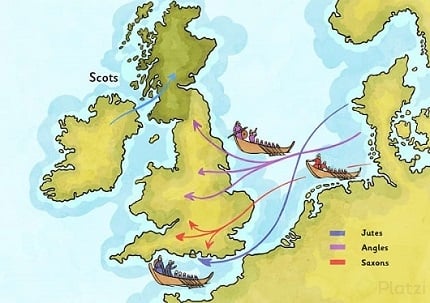
Who were the Angles, Saxons and Jutes and where did they come from?
The Angles, Saxons and Jutes were tribes who came from northern Europe and Scandinavia, from places that we now call northern Germany and Denmark By around AD 410, the last of the Romans had left Britain to defend their home territory as they were under increasing threat from external invaders. This left Britain without Roman protection and forces began to invade. The three biggest invading tribes were the Angles , the Saxons and the Jutes. They became known as the Anglo-Saxons.
Good summary with the picture!
Excellent information Julio, very interesting ... Thanks for share !!!
The three more interesting facts about the Origins of English as a language:
Latin and Greek influenced Old English, which had complex grammar and different letters.
Viking invasions introduced Old Norse, merging with Old English to form Middle English, heavily influenced by French.
French was dominant during the Middle Ages, but English became primary after the Hundred Years' War.
Good summary!
3 interesting facts about the Historical Origens of English as language:
After the Normandy conquest in 1066, such as the language of the British nobility was French. Meanwhile, peasants and the lower classes continued to use Old English or Anglo-Saxon English created with Germanic vocabulary.
Thanks to the invasions of Viking peoples, the Scandinavians gave us 2000 new words. For example: anger, bag, leg sky, window and this fluid pronoun they.
The word shit, which is heard so frequently, is in fact one of the oldest words in English. The word has Germanic and Scandinavian roots and documents have been found certifying its use since 1086. Originally it was used exclusively to designate the liquid stools of cattle.
👏🏻
excellent comment
3 Interesting Facts About the Origins of English as a Language
OLD ENGLISH
MODERN ENGLISH
INFLUENCE OF OTHER LANGUAGES
Thanks, Maria CRM
Palacios, S. J. (2025). The origin of English language. Logos Boletín Científico De La Escuela Preparatoria No. 2, 12(23), 10-11.
Old English: https://www.youtube.com/watch?v=CH-_GwoO4xI
Learning English as a second language helped me to learn German as a third language and French as the fourth one.
facts about the origins of the English language: Old English was influenced by Greek and Latin, which had complex grammar and different letters. The Viking invasions brought Old Norse, which combined with Old English to give rise to Middle English, heavily influenced by French. English became predominant after the Hundred Years War, although during the Middle Ages French was the most important.
Three more interesting facts about the Origins of English as a language:
Info taken from:
Where did English come from? - Claire Bowern https://ed.ted.com/lessons/where-did-english-come-from-claire-bowern#review
👏🏻 NICEE!
These are three factors in el english language formation: 1.The Romans also gave English words that they themselves had borrowed from other languages: anchor, butter, chest, dish, sack, and wine. 2. Old English did not sound like modern English, from which it differs widely in phonology and especially grammar, making Old English unintelligible to modern speakers. 3.With the introduction of Christianity, Latin words and some Greek words were added.
What language were those words part of? Interesting 🤔
Three more interesting facts about the Origins of English as a language
Norman Conquest: In 1066, the Norman Conquest took place when William the Conqueror, Duke of Normandy, invaded England and established Norman rule. This event had a profound impact on the English language. The Normans spoke a variety of Old French known as Anglo-Norman, which became the language of the English elite for several centuries. As a result, thousands of French words entered the English vocabulary, particularly in areas related to law, government, and the arts.
Great Vowel Shift: During the Middle English period (11th to 15th centuries), a significant sound change known as the Great Vowel Shift occurred. This shift affected the pronunciation of long vowels in English, leading to a change in the sound system of the language. As a result, the pronunciation of many words changed, even though their spelling remained the same. The Great Vowel Shift played a crucial role in shaping the modern English pronunciation we use today.
Printing Press and Standardization: The invention of the printing press by Johannes Gutenberg in the 15th century revolutionized the spread of knowledge and had a profound impact on the English language. With the availability of printed materials, including books and pamphlets, English started to be standardized and standardized spelling began to emerge. This standardization helped to establish a more consistent and recognizable form of the English language, making it accessible to a wider audience and aiding its further development.
👏🏻
I'm particularly interested in how the english has been shaped by the speakers, for example in Jamaica I love their accent
Here are three interesting and fun facts about the origin of the English language:
---
1. Viking invaders gave us "they," "them," and "their"
Old English originally used "hi," "hie," and "hiera" for third-person plural pronouns. When Norse Vikings settled in England (around the 9th century), they brought their words "þeir," "þeim," and "þeirra." The English eventually adopted these because they sounded similar enough to Old English words and were easier to distinguish from "he," "him," and "her." So thank a Viking next time you avoid confusion in conversation!
Los invasores vikingos nos dieron "they," "them" y "their"
El inglés antiguo usaba originalmente "hi," "hie" y "hiera" como pronombres plurales de tercera persona. Cuando los vikingos nórdicos se asentaron en Inglaterra (alrededor del siglo IX), trajeron sus palabras "þeir," "þeim" y "þeirra." Los ingleses eventualmente adoptaron estas porque sonaban lo suficientemente similares a las palabras del inglés antiguo y eran más fáciles de distinguir de "he," "him" y "her." Así que agradece a un vikingo la próxima vez que evites confusión en una conversación.
---
2. The word "nice" used to mean "stupid"
In the 1300s, "nice" came from the Latin "nescius" (meaning "ignorant" or "not knowing"). It went through several transformations: foolish → shy → refined → pleasant. So if you called someone "nice" 700 years ago, you were basically calling them an idiot. Language evolution is weirdly insulting!
La palabra "nice" solía significar "estúpido"
En el siglo XIV, "nice" venía del latín "nescius" (que significa "ignorante" o "que no sabe"). Pasó por varias transformaciones: tonto → tímido → refinado → agradable. Así que si llamabas a alguien "nice" hace 700 años, básicamente lo estabas llamando idiota. ¡La evolución del lenguaje es extrañamente insultante!
---
3. Shakespeare invented over 1,700 words—and some by accident
The Bard didn't just write plays; he straight-up made up words when he couldn't find the right one. "Eyeball," "bedroom," "fashionable," "lonely," "swagger," and "uncomfortable" all debuted in his works. Legend says he sometimes just smashed two words together or added prefixes/suffixes until something sounded good. Basically, he was the original content creator winging it!
Shakespeare inventó más de 1,700 palabras—y algunas por accidente
El Bardo no solo escribió obras de teatro; literalmente inventó palabras cuando no encontraba la adecuada. "Eyeball," "bedroom," "fashionable," "lonely," "swagger" y "uncomfortable" todas debutaron en sus obras. La leyenda dice que a veces simplemente juntaba dos palabras o añadía prefijos/sufijos hasta que algo sonaba bien. ¡Básicamente, era el creador de contenido original improvisando!
Excellent information about the evolution of English since the establishment of the Angles, Saxons, and Jutes. Something I find interesting is the fact that the word "English" matches its "Angle + -ish" origin.
what? there is too much to learn, the french, jute and vikings? so many interesting topics to learn from, English has wide history impact over different languages but it all comes down on learning.
Worldwide.
Most of our basic, everyday words (like house, woman, eat, sleep, water) are still Germanic.
About 30% of modern English words come from French (law, art, military, and government terms).
The invention of the printing press helped to standardize the language by promoting a consistent spelling and grammar, largely based on the London dialect.
The British Empire spread English across the globe, leading to the absorption of words from countless other cultures.
American English developed its own variations due to influences from Native American languages and various immigrant groups.