Errores ortográficos comunes y cómo evitarlos
Contenido del curso

Ortografía irregular en inglés



Uso de mayúsculas, acrónimos y ortografía irregular
- 6

Cuándo usar mayúsculas en inglés
04:43 min - 7

Cuándo eliminar letras al conjugar verbos
04:27 min - 8

Formación de Plurales Irregulares en Español
05:40 min - 9

Siglas en inglés que todo profesional usa
03:20 min - 10

Palabras de Shakespeare que usamos hoy
04:42 min - 11

Palabras del latín que usas en inglés
03:57 min - 12

Revisão de erros comuns no inglês escrito
02:58 min
Puntuación en inglés


Conclusión
- 19

Escribe tu perfil personal en inglés
03:01 min - 20

Autoevaluación del curso
- 21

Qué aprendiste sobre escritura en inglés
01:31 min
Recursos
Resumen
Spelling in English can be tricky, especially when vowel and consonant combinations don't follow predictable patterns. Understanding the most common spelling mistakes and learning practical strategies to avoid them will strengthen your written communication and boost your confidence when writing professional or academic texts.
What are the most frequent spelling mistakes in English?
Several words in English have letter combinations that often confuse learners. The exercises covered here highlight patterns you should memorize to prevent errors in your writing.
How do you spell words with silent or unusual letter groups?
The word light is a classic example [01:10]. Many learners mistakenly write "ligh" with a -gth ending, but the correct combination is -ght. This same pattern applies to words like night, right, and eight. In fact, the number eight follows the exact same rule: the correct spelling ends in g-h-t [03:10].
Another tricky group involves the dg combination. The word budget must be spelled with a d before the g [01:30]. Similarly, knowledge uses the same dg pairing [03:30]. Whenever you hear a soft /dʒ/ sound in the middle of a word, remember that dg is likely the correct spelling.
How do you handle the letters "s" and "k" in common words?
The word ask is frequently misspelled as aks [01:50]. The correct order is s before k. The same applies to tasks [04:00] — the s always precedes the k. When the word becomes plural, an additional s appears at the end, so pay attention to avoid writing taks or takss.
What is the "i before e" rule?
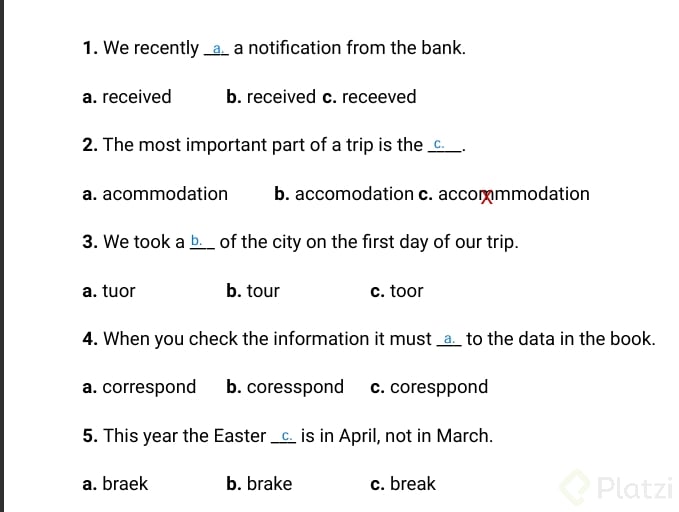
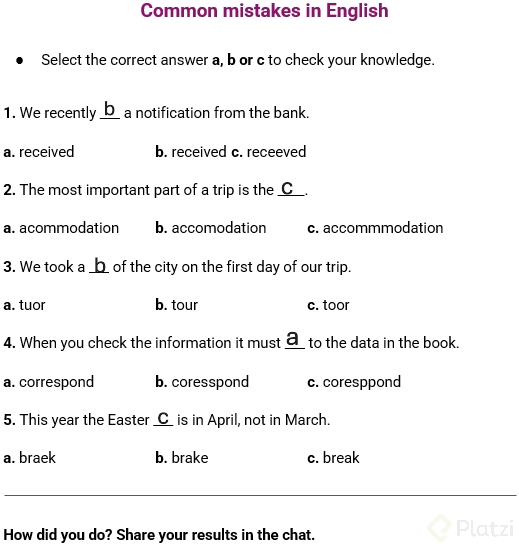
One of the most well-known spelling rules in English states: "i before e, except after c." The word believe follows this pattern perfectly — it is spelled with ie after the l [02:15]. However, the word receive reverses the order because the vowel pair comes right after the letter c, making the correct spelling c-e-i [04:20]. Keeping this rule in mind eliminates a large category of spelling errors.
What tips help you avoid spelling errors in your writing?
Why should you memorize irregular vowel and consonant combinations?
English has many irregular letter combinations that do not sound the way they look [05:00]. Groups like -ght, dg, sk, and the ie/ei pair appear in everyday vocabulary. Reviewing these patterns regularly helps you internalize them so they become automatic when you write.
Why is editing your texts so important?
The second practical tip is to always edit your texts before sending them [05:25]. After finishing a draft:
- Read the entire text at least once.
- Focus specifically on words with tricky spelling patterns.
- Use a dictionary to verify any word you are unsure about.
This habit catches mistakes that even experienced writers make in a first draft. Building an editing routine is one of the most effective ways to improve overall writing quality.
How can you practice these spelling patterns?
To reinforce what you have learned, download the worksheet available in the additional resources [06:00]. It covers the key spelling rules from the entire module and gives you exercises to test your knowledge. Practicing with targeted activities like these turns passive recognition into active recall, which is exactly what you need when writing under pressure.
If you found any of these spelling patterns surprising, share which words give you the most trouble — discussing common mistakes with other learners is one of the fastest ways to remember the correct forms.
Errores ortográficos comunes y cómo evitarlos