Countable vs uncountable nouns and quantifiers
Contenido del curso

Sustantivos y Pronombres en Inglés


Verbos en Inglés
- 7

Verbos en inglés: action vs linking verbs
06:18 min - 8

Auxiliary y stative verbs en inglés
05:31 min - 9

Verbos Regulares e Irregulares: Reglas y Ejemplos Prácticos
08:10 min - 10

Tres formas de pronunciar el pasado en inglés
05:54 min - 11

Tipos de verbos en inglés: enlace, acción y estáticos
00:30 min - 12

Práctica de conversación en inglés (contexto profesional/laboral)
00:00 min
Adjetivos y Adverbios en Inglés


Preposiciones e Interjecciones en Inglés
- 19

Preposiciones de Tiempo y Lugar en Inglés
04:16 min - 20

Preposiciones de movimiento y modo en inglés
04:03 min - 21

Las 7 conjunciones FANBOYS en inglés
03:00 min - 22

Interjecciones en inglés para sonar natural
04:03 min - 23

Repaso de los 4 módulos de gramática
00:21 min - 24
Práctica de conversación en inglés (contexto profesional/laboral)
00:00 min
Oraciones completas en Inglés

Recursos
Resumen
Learning the difference between countable and uncountable nouns in English is easier once you notice a simple trick: some words you can count one by one, and others you simply can't. This guide is for ESL learners who want to use quantifiers like some, any, a lot of, how many, and how much with confidence in everyday and workplace conversations.
Here's the idea that starts it all: time is an uncountable noun. You can't ask "Do you have five times?" but you can ask "Do you have five minutes?" because minutes are time units you can count [00:00].
What are countable nouns and how do I use them?
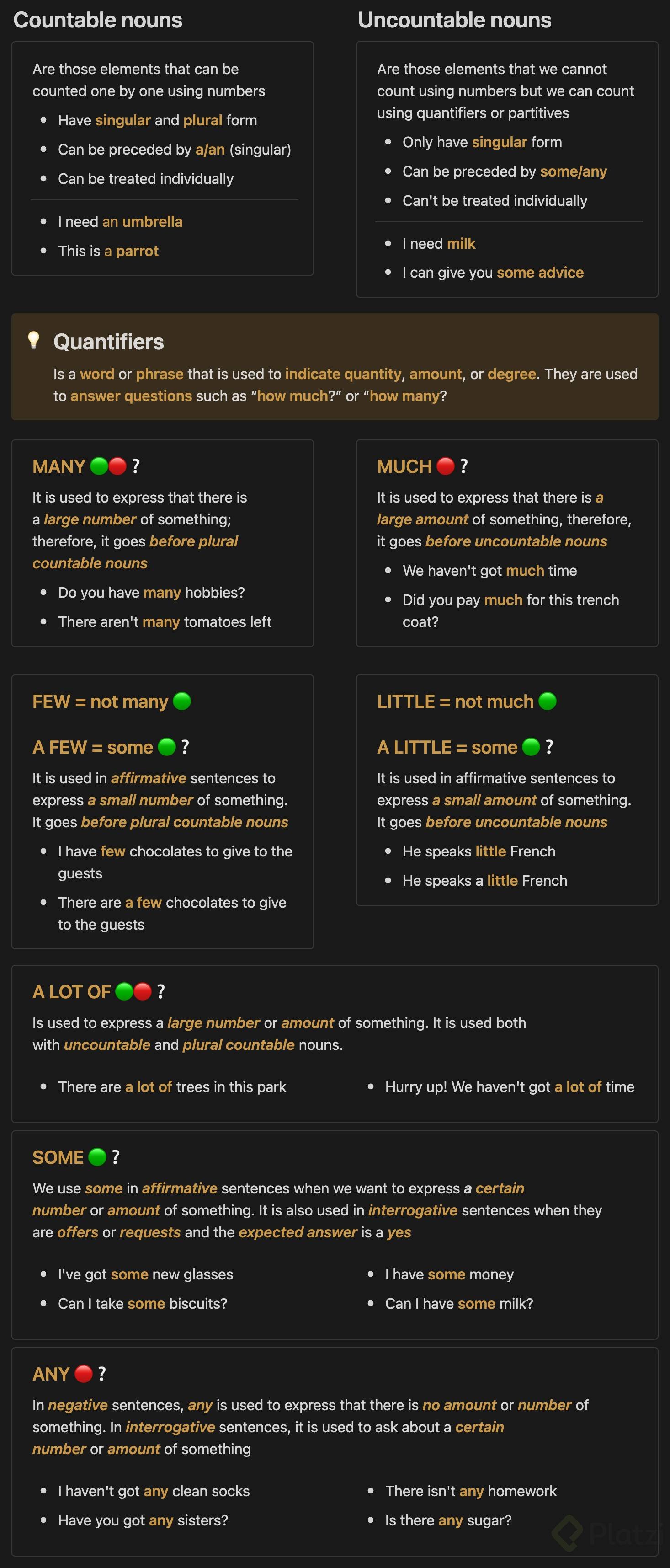
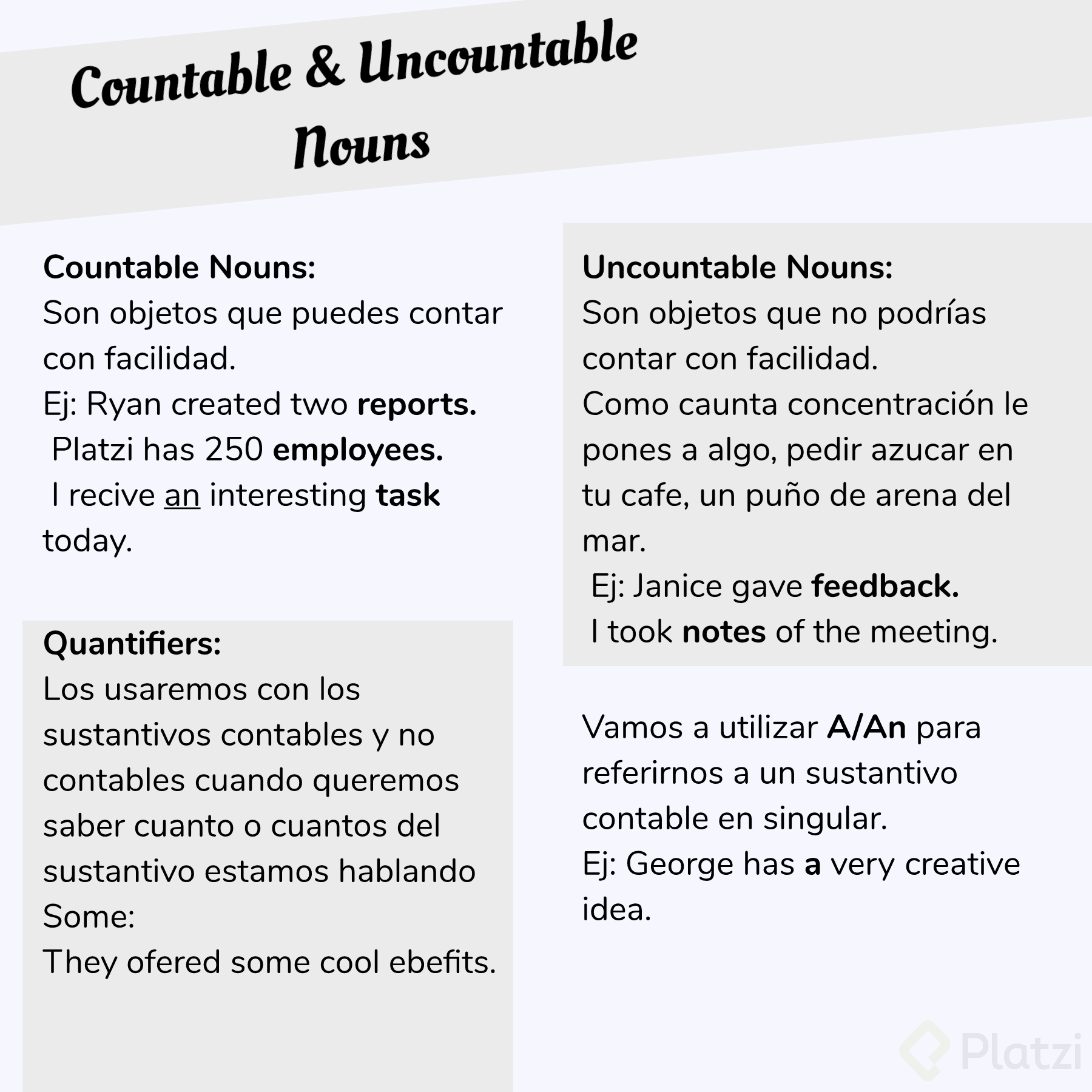
Countable nouns are exactly what they sound like: nouns you can count. One, two, three, and so on [00:22].
Look at how they work in real sentences:
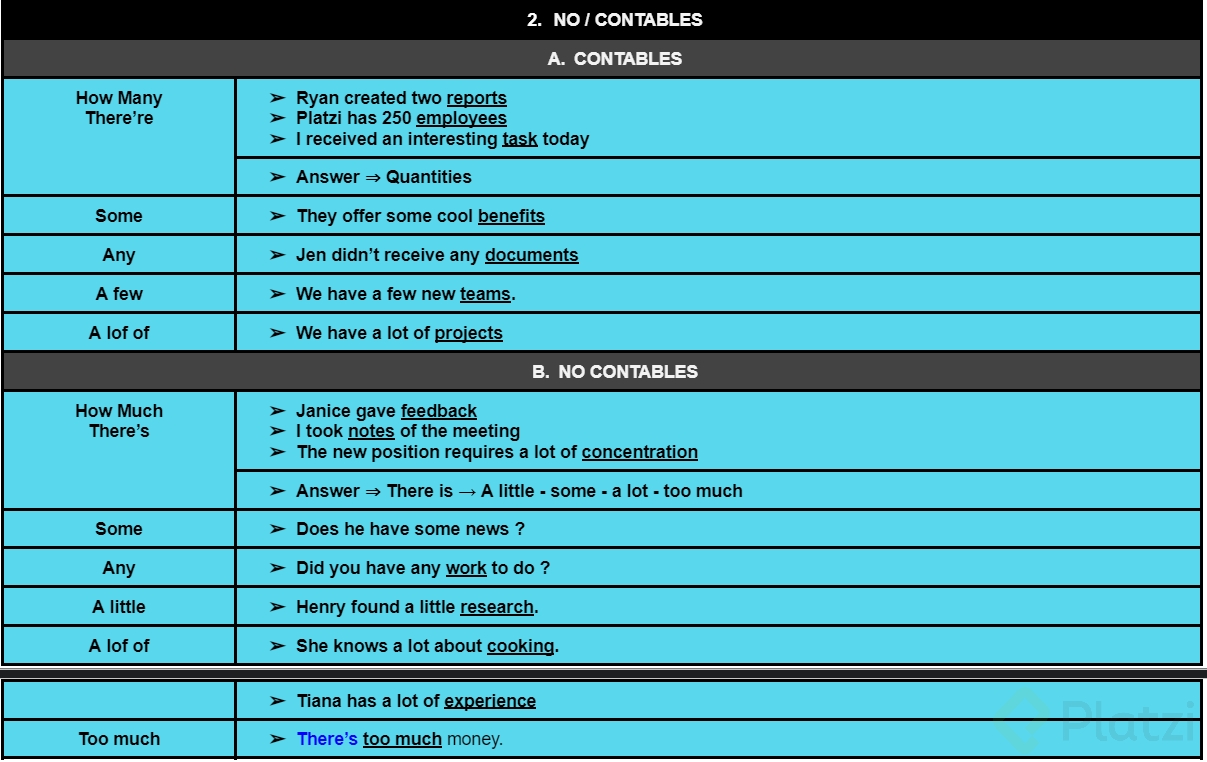
- Ryan created two reports. You can have five reports or fifteen reports.
- Platzi has 250 employees. Employees are easy to count.
- I received an interesting task today. One task, or eight, or fifteen.
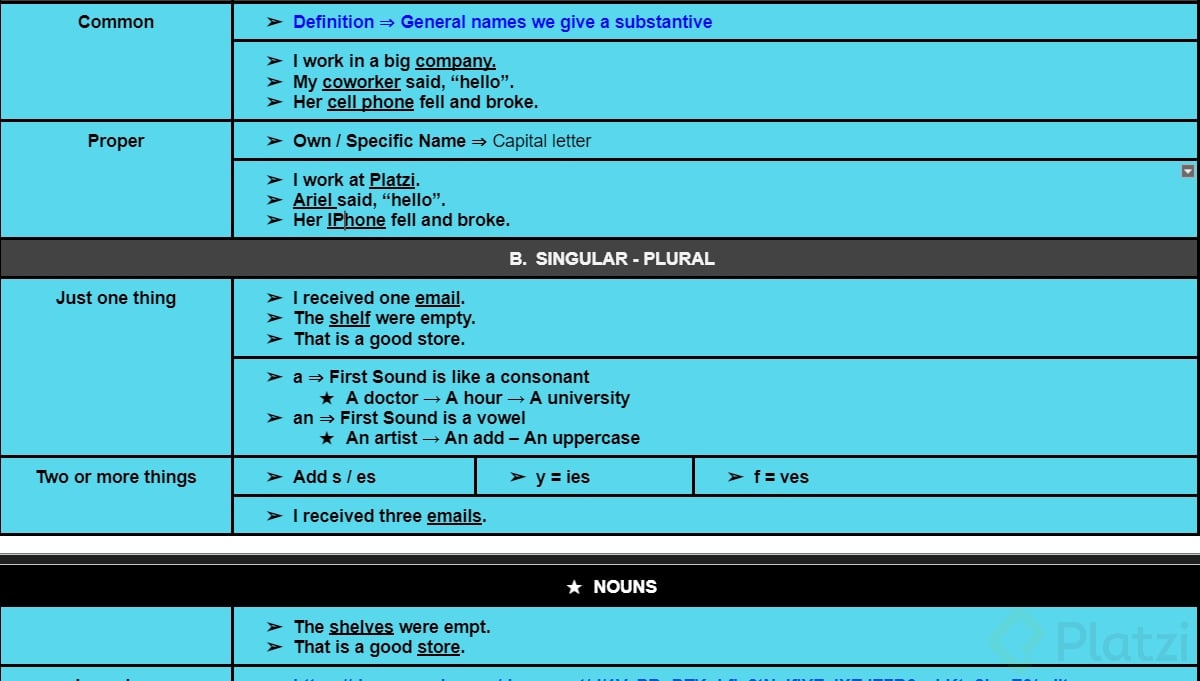
When you talk about a single countable noun, you use a and an [00:52]. For example: George had a very creative idea. Just one idea, but a great one.
What is a countable noun? It's a noun you can count individually, like reports, employees, or tasks. You can make it plural (two reports) and use a or an for a single one (an idea).
What are uncountable nouns and why can't I count them?
Uncountable nouns are nouns you simply can't count, like water or sugar [01:14]. When you order coffee, you don't ask for "three sugars" because nobody hands you three pebbles of sugar. And here's the tricky part: some uncountable nouns end in an s but are still uncountable.
Consider these examples from the lesson:
- Janice gave feedback. You can't count feedback.
- I took notes of the meeting. Even though notes ends in s, it's uncountable, so you don't say "two notes of the meeting" [01:41].
- The new position requires a lot of concentration. You'd never say "three concentrations."
The key takeaway is that spelling doesn't tell you everything. Words like news and notes look plural but behave as uncountable nouns.
When do I use some and any as quantifiers?
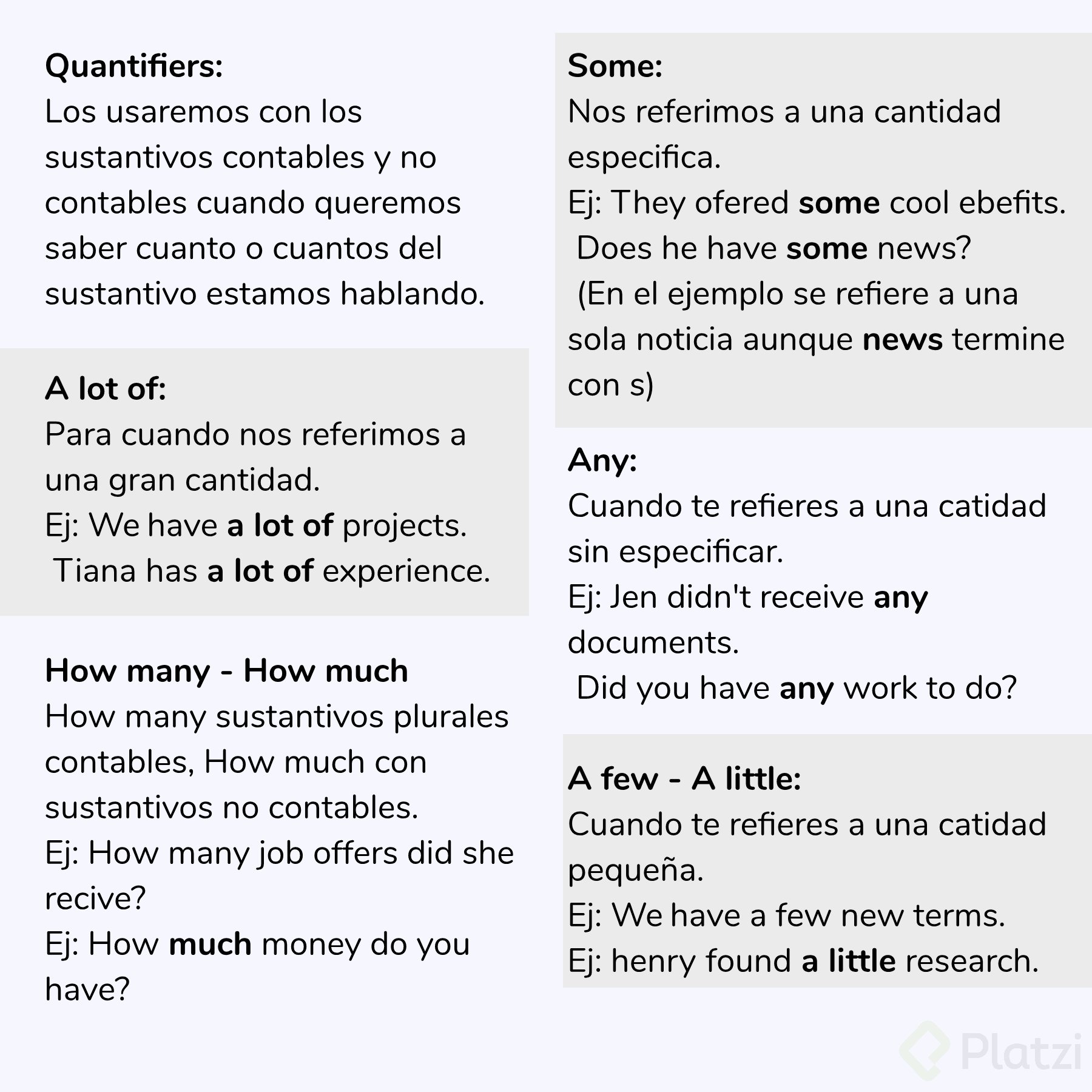
Quantifiers tell you how much or how many of a noun you're talking about, and you use them with both countable and uncountable nouns [02:22]. Let's start with the two most common ones.
You use some for a specified amount, in affirmative sentences and in questions [02:41]:
- They offer some cool benefits. Here benefits is a plural countable noun, so you can't say "some cool benefit."
- Does he have some news? News is uncountable, even with that final s.
You use any for an unspecified amount, in negative sentences and questions [03:20]:
- Dan didn't receive any documents. Notice the plural countable noun.
- Did you have any work to do? Work is uncountable, so you never say "one work, two work."
When do I use some vs any? Use some in affirmative sentences and offers (They offer some benefits). Use any in negatives and questions (Dan didn't receive any documents). Both work with countable and uncountable nouns.
That email closer you've probably written a hundred times, "Do you have any questions?", follows this exact rule: questions is a plural countable noun paired with any [03:40].
How do I choose between a lot of, a few, and a little?
These quantifiers describe size, either big or small, and picking the right one depends on whether your noun is countable [04:16].
Use a lot of for a big quantity with both noun types:
- We have a lot of projects. Projects are countable.
- Tiana has a lot of experience. You can't say "three experiences."
For small quantities, the choice splits in two [04:52]:
- Use a few with plural countable nouns: We have a few new teams.
- Use a little with uncountable nouns: Henry found a little research.
It can sound odd at first, because a little usually makes you think of size, but it always pairs with uncountable nouns like research or information.
How many or how much: which one should I ask?
When you want to ask about quantity, the answer depends entirely on the noun type [05:31].
Use how many with plural countable nouns:
- How many job offers did she receive? You can count job offers.
Use how much with uncountable nouns:
- How much money do you have? You can't count money directly, though you can count dollars and pesos.
Do I say how many or how much? Use how many for things you can count (how many job offers). Use how much for things you can't count (how much money).
A great way to lock this in is to practice with real sentences. There's a worksheet waiting in the resources section, so download it and test your knowledge [06:11]. Which quantifier trips you up the most? Share your example in the comments and let's work through it together.