Partes de la oración en inglés: sustantivos, verbos y más
Contenido del curso

Sustantivos y Pronombres en Inglés


Verbos en Inglés
- 7

Verbos en inglés: action vs linking verbs
06:18 min - 8

Auxiliary y stative verbs en inglés
05:31 min - 9

Verbos Regulares e Irregulares: Reglas y Ejemplos Prácticos
08:10 min - 10

Tres formas de pronunciar el pasado en inglés
05:54 min - 11

Tipos de verbos en inglés: enlace, acción y estáticos
00:30 min - 12

Práctica de conversación en inglés (contexto profesional/laboral)
00:00 min
Adjetivos y Adverbios en Inglés


Preposiciones e Interjecciones en Inglés
- 19

Preposiciones de Tiempo y Lugar en Inglés
04:16 min - 20

Preposiciones de movimiento y modo en inglés
04:03 min - 21

Las 7 conjunciones FANBOYS en inglés
03:00 min - 22

Interjecciones en inglés para sonar natural
04:03 min - 23

Repaso de los 4 módulos de gramática
00:21 min - 24
Práctica de conversación en inglés (contexto profesional/laboral)
00:00 min
Oraciones completas en Inglés

Recursos
Resumen
Understanding how English sentences work starts with one fundamental question: what are the eight parts of speech? Nouns, pronouns, verbs, adjectives, adverbs, prepositions, conjunctions, and interjections form the backbone of every sentence you read, write, or speak. Mastering these categories leads to improved writing, reading, and speaking skills, along with increased confidence when using English in a variety of contexts.
What are the eight parts of speech and why do they matter?
Every word in English belongs to at least one of these eight groups [0:02]:
- Nouns: name people, places, things, or ideas.
- Pronouns: replace nouns to avoid repetition.
- Verbs: express actions or states of being.
- Adjectives: describe or modify nouns.
- Adverbs: modify verbs, adjectives, or other adverbs.
- Prepositions: show relationships between words, often indicating location or time.
- Conjunctions: connect words, phrases, or clauses.
- Interjections: express sudden emotion or reaction.
Knowing how each part of speech functions allows you to construct meaningful sentences with clarity. Instead of guessing where a word fits, you can place it with purpose and precision.
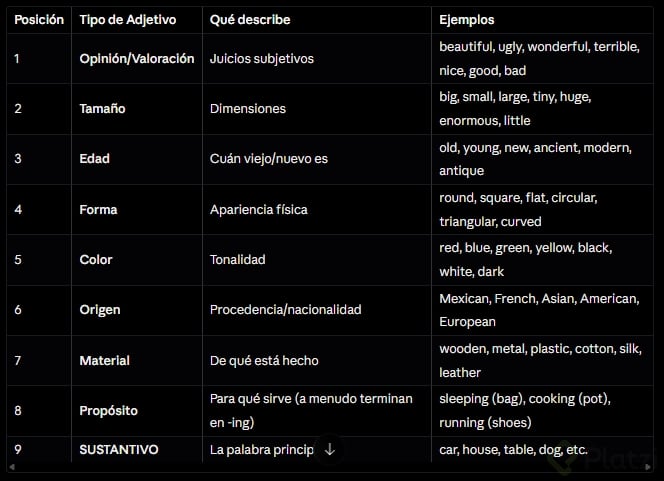
How does the adjective order rule work in English?
One of the most interesting grammar details covered is the specific order adjectives must follow in English [1:12]. Native speakers often apply this rule instinctively, but for learners it can feel surprising.
The standard sequence is:
- Opinion.
- Size.
- Age.
- Shape.
- Color.
- Origin.
- Material.
- Purpose.
Can you see this rule in action?
Consider the example: She has a beautiful, big, old, rectangular, green, French silk scarf [1:26]. Each adjective falls perfectly into the expected slot:
- Beautiful → opinion.
- Big → size.
- Old → age.
- Rectangular → shape.
- Green → color.
- French → origin.
- Silk → material.
- Scarf → the noun being described.
Breaking this order sounds unnatural to fluent speakers, so practicing it early gives you a clear advantage in both writing and conversation.
What skills will you develop by studying parts of speech?
By the end of this course you can expect to [0:30]:
- Identify the most important elements that make up English sentences.
- Understand the various functions of nouns, verbs, adjectives, adverbs, prepositions, conjunctions, and interjections.
- Build sentences that communicate ideas with precision.
- Complete a writing task as a final project that puts all these concepts into practice [1:46].
The course is taught by Vicky, an instructor with over eight years of experience teaching English to students around the world [1:55]. Her approach targets intermediate learners who want to strengthen their grammatical foundation and feel more comfortable producing accurate English.
If you are ready to sharpen your grammar and gain real control over sentence structure, this is the place to start. Share in the comments which part of speech you find most challenging — let's work on it together.