Preposiciones de Tiempo y Lugar en Inglés
Contenido del curso

Sustantivos y Pronombres en Inglés


Verbos en Inglés
- 7

Verbos en inglés: action vs linking verbs
06:18 min - 8

Auxiliary y stative verbs en inglés
05:31 min - 9

Verbos Regulares e Irregulares: Reglas y Ejemplos Prácticos
08:10 min - 10

Tres formas de pronunciar el pasado en inglés
05:54 min - 11

Tipos de verbos en inglés: enlace, acción y estáticos
00:30 min - 12

Práctica de conversación en inglés (contexto profesional/laboral)
00:00 min
Adjetivos y Adverbios en Inglés


Preposiciones e Interjecciones en Inglés
- 19

Preposiciones de Tiempo y Lugar en Inglés
Viendo ahora - 20

Preposiciones de movimiento y modo en inglés
04:03 min - 21

Las 7 conjunciones FANBOYS en inglés
03:00 min - 22

Interjecciones en inglés para sonar natural
04:03 min - 23

Repaso de los 4 módulos de gramática
00:21 min - 24
Práctica de conversación en inglés (contexto profesional/laboral)
00:00 min
Oraciones completas en Inglés

Recursos
Resumen
Choosing the right preposition can feel tricky, but once you understand the patterns behind in, on, and at, your English writing and speaking will become much more precise. These three small words carry enormous weight because they answer two fundamental questions: when did something happen and where is it located.
How do prepositions of time answer "when" questions?
Prepositions of time tell us when something happened or will happen. The key is knowing which one to pick depending on the time reference you need.
When should you use in, on, and at for time?
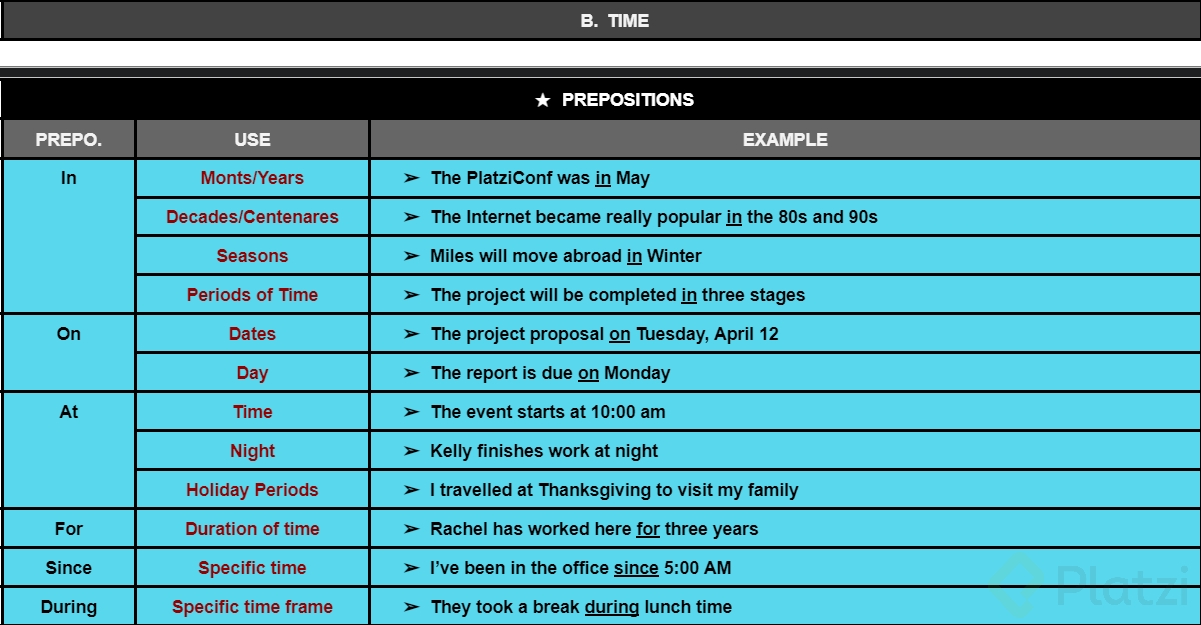
In pairs with broader time references [0:24]:
- Months: "The PlatyConf was in May."
- Years: "Liam and I joined this team in 2021."
- Decades and centuries: "The internet became really popular in the '80s and '90s."
- Seasons: "Miles will move abroad in winter."
- Periods of time: "The project will be completed in three stages."
On works with more specific time units [1:27]:
- Days: "The report is due on Monday."
- Dates: "We need to submit the project proposal on Tuesday, April 12th."
At pinpoints the most precise moments [1:46]:
- Clock time: "The event starts at 10:00 AM."
- Night: "Kelly finished work at night."
- Holiday periods: "I traveled at Thanksgiving to visit my family."
What about for, since, and during?
These three prepositions also express time, but they focus on duration rather than a fixed point [2:09].
- For indicates how long something lasts: "Rachel has worked here for three years."
- Since marks a specific starting point: "I have been in the office since 5:00 AM."
- During frames an action within a defined timeframe: "They took a break during lunchtime."
Notice the difference: for answers "how long," since answers "starting when," and during answers "within what period."
How do prepositions of place answer "where" questions?
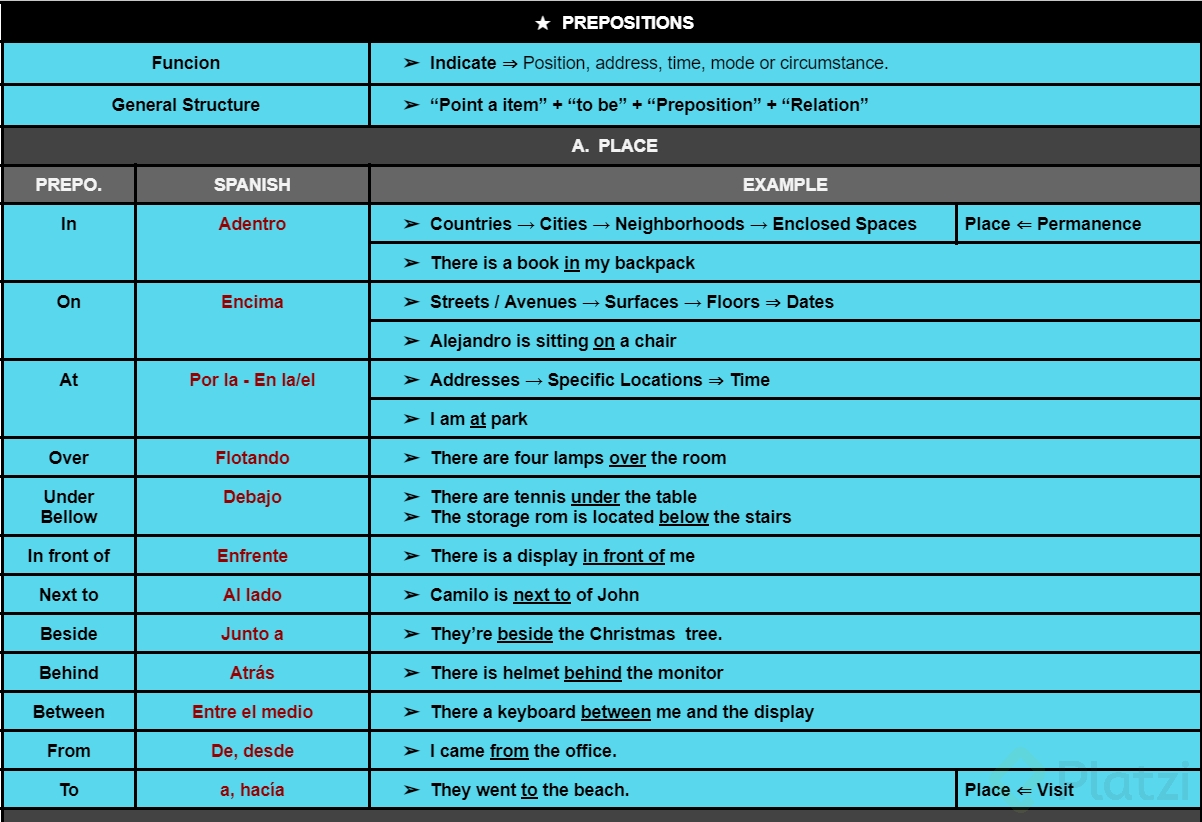
Just as with time, in, on, and at follow a pattern for location — from the largest to the most specific [2:38].
In is used for enclosed or large areas:
- Countries: "The PlatyConf took place in Mexico."
- Cities: "The company's headquarters is in San Francisco, California."
- Enclosed spaces: "I didn't leave my computer in the conference room."
On applies to surfaces and routes [3:07]:
- Streets and avenues: "Jen and Alex work on Park Avenue."
- Surfaces: "The documents are on the desk."
- Means of transportation: "I am on the metro."
At points to exact addresses and specific spots [3:30]:
- Addresses: "I live at 123 Main Street."
- Specific locations: "Let's meet up at the coffee shop."
What other prepositions describe position?
Beyond in, on, and at, several prepositions help describe relative position between objects [3:48]:
- Next to: "The receptionist's desk is next to the entrance."
- Between: "The two offices are located between the meeting room and the bathroom."
- In front of: "His desk is in front of mine."
- Behind: "The printer is behind the office chair."
- Below: "The storage room is located below the stairs."
How can you practice prepositions right now?
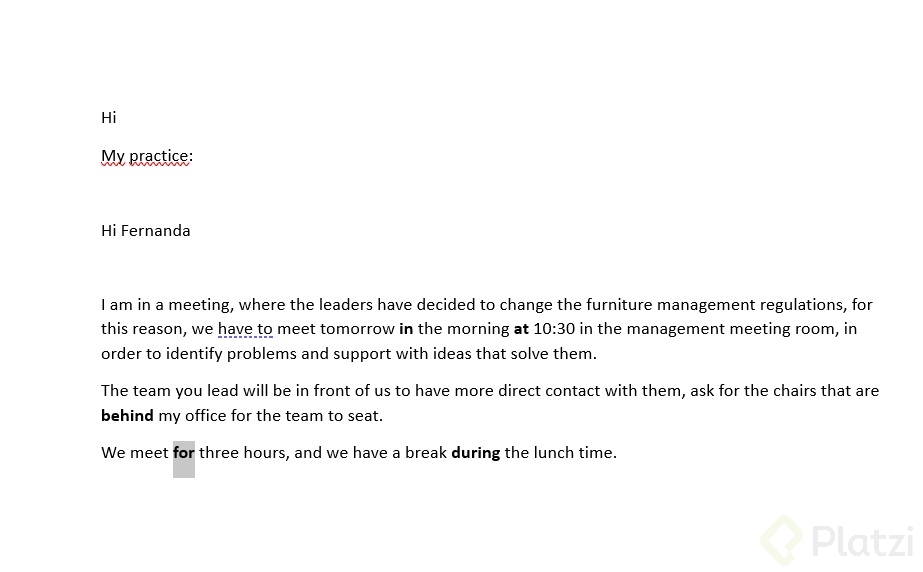
A great way to reinforce these rules is by using them in a real scenario. Try writing a short text message to a colleague informing them about a change in a meeting's location and time [4:15]. Use at least one preposition of time and one of place. Share your message in the comments — reading other people's examples is one of the fastest ways to spot patterns and remember them.