Understanding how to connect ideas about movement and description in English is essential for professional communication. Prepositions of movement and prepositions of manner are two categories that help speakers express how people or things get from one place to another, and how actions are performed. Mastering them makes your speech clearer and more precise in workplace scenarios.
What are prepositions of movement and how do you use them?
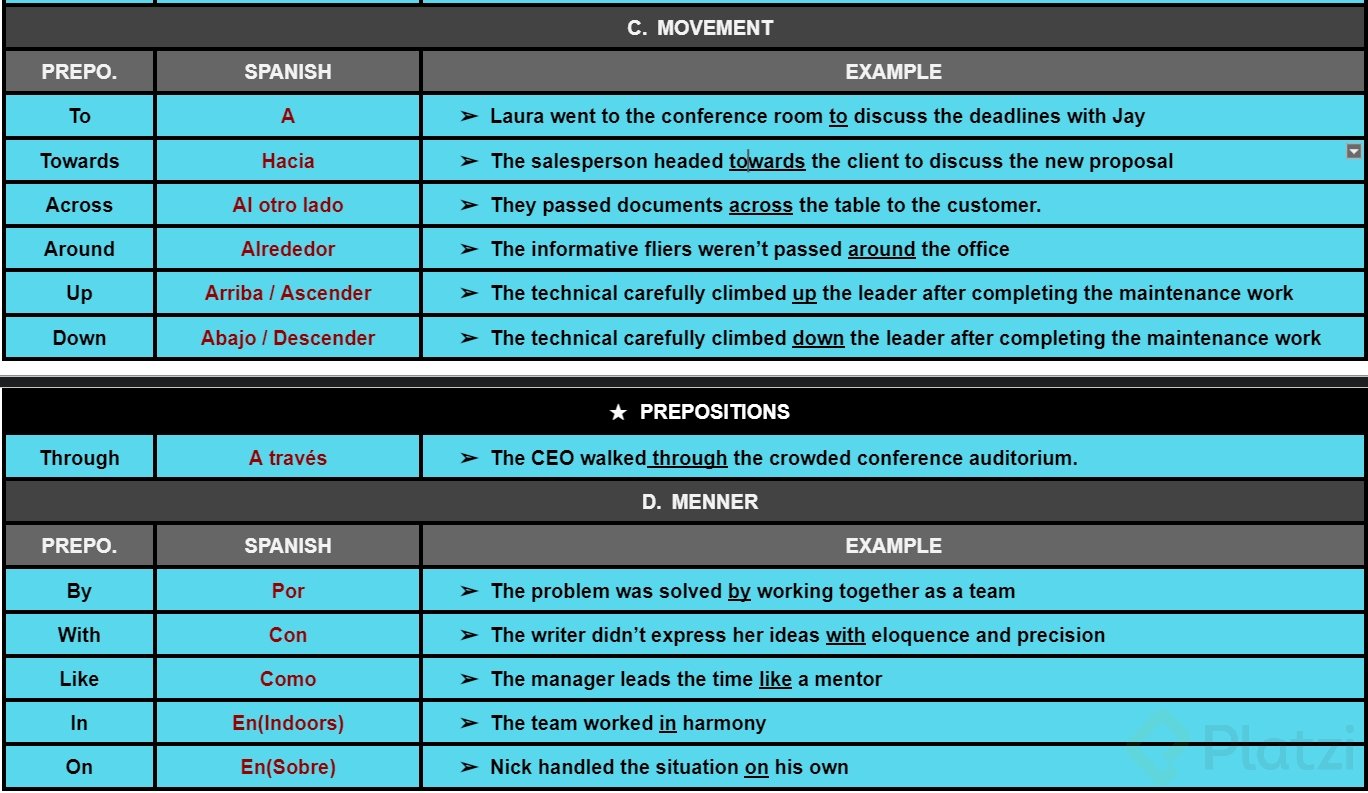
Prepositions of movement are words that express how things or people get from one place to another [0:18]. They answer questions about direction and trajectory. The most common ones include:
- To and towards: indicate a specific destination. Laura went to the conference room to discuss deadlines with Jay [0:30]. Meanwhile, towards points in the direction of something: The salesperson headed towards the client to discuss the new proposal [0:42].
- Across and around: describe movement over a surface or distribution. They passed the documents across the table to the client [0:52]. The informative flyers weren't passed around the office [0:58].
- Up, down, and through: convey vertical or penetrating movement. The technician carefully climbed down the ladder after completing the maintenance work [1:08]. The CEO walked through the crowded conference auditorium to get to the stage [1:17].
Notice how each preposition paints a different picture of the path taken. Choosing the right one depends entirely on the direction or type of movement you want to describe.
How do prepositions of manner differ from adverbs of manner?
Prepositions of manner help us answer how questions — they describe the way something was done [1:28]. A common doubt is whether they work the same as adverbs of manner. They are very similar, but there is a key difference: prepositions always come before a noun or a pronoun, while adverbs modify verbs directly [1:38].
Here are practical examples from professional settings:
- By: The problem was solved by working together as a team [1:48]. How was it solved? By working together.
- With: The writer didn't express her ideas with eloquence and position [1:58]. The preposition connects the manner to a noun.
- Like: The manager leads the team like a mentor [2:06]. This compares the style of leadership.
- In: The team worked in harmony [2:12]. It describes the state or condition of the action.
- On: Nick handled the situation on his own [2:17]. This indicates independence in completing the task.
Can you apply these prepositions correctly?
A quick practice reinforces everything covered [2:24]. Consider these sentences and choose the right preposition:
- William traveled ___ New York on vacation. The answer is to, because we need a preposition of movement toward a destination [2:34].
- The team communicated ___ assertiveness. The answer is with, since we are describing how the communication happened [2:44].
- The team worked ___ the night to meet the project deadline. The answer is through, expressing continuous movement across a period of time [2:56].
Why does choosing the right preposition matter?
Selecting the correct preposition changes the meaning of a sentence entirely. Using to instead of towards implies arrival at a specific point, while through suggests passing from one side to the other — whether referring to physical spaces or time. In professional English, these small words carry significant weight in emails, presentations, and daily conversations.
Practice building your own sentences with each preposition and share your results in the comments to keep improving your accuracy.