Preposiciones de lugar: detrás, delante de y junto a
Clase 9 de 18 • Audio Curso de Inglés para el Uso de Preposiciones
Contenido del curso
Clase 9 de 18 • Audio Curso de Inglés para el Uso de Preposiciones
Contenido del curso

Héctor Alonso Padilla Ramírez

Lisi Leonor Cavagna

Jonathan Bohorquez Figueroa
Lisi Leonor Cavagna

David Hernández

Milagro delcarmen coreas cruz
Milagro delcarmen coreas cruz
Milagro delcarmen coreas cruz
Milagro delcarmen coreas cruz

Ruben Dario Leon Rivera
Oscar Manuel Palacios M

GRICELDA RODRIGUEZ

Daniela Eunice Mejia Martinez

Mario Roberto Aragón

Nidia Emilse Montañez Arevalo
Nidia Emilse Montañez Arevalo
Manuel Avila
Maria Fernanda Terrones Santa Cruz

Saul Alberto Monroy Beltran
Saul Alberto Monroy Beltran
My neighborhood: I´m living in a block, in a small apartment on the third floor. Near home, I have a supermarket, a school, a bus stop, a gas station, and a library. My block is on the mountain side named Ulriken. The block is Between a school and another smaller building. The bus stop is just in front of the library, and the library is next to the supermarket. The gas station is near my house but not at all, I think is nearer than the supermarket.
"In front of me there is a social lounge." "Behind me there is a painting." "Next to me I have two phones."
The desk is next to the table
The gas station is in front the bus station
The river is behind of the Mountain.
My sister is behind of me
Right now:
my bed is in front of the chair
My house is next to the park and in front of the school.
my school is in front of to the hospital
In front of my house is a shop.
Behind my desk is the wall.
The store is behind my house.
The office are right in front of me.
My cat is behind me
In front of my house, there are four threes
Behind my desk, there is a window
The lamp is beside the bed
The chart is on the wall next to the watch
I live in front of the park
My car is next to my house
Behind my house is the Guayacanes Av
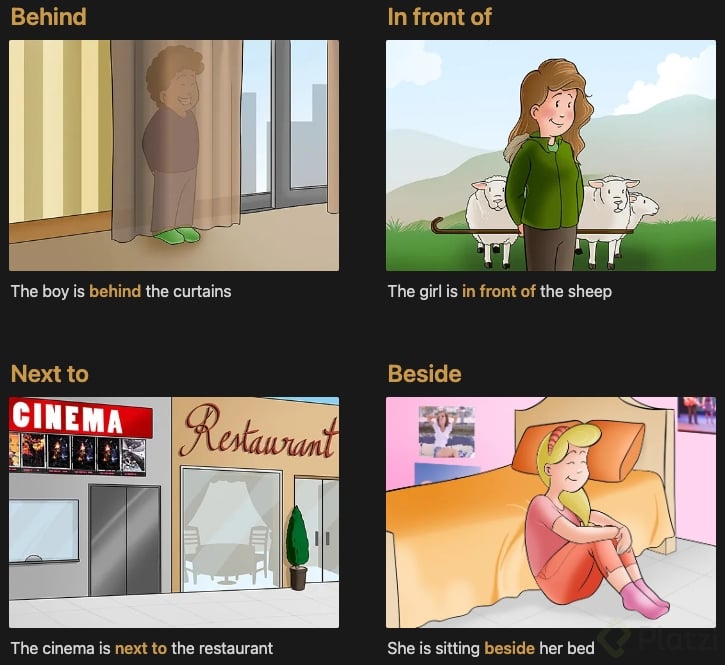
In this class, we focused on three prepositions of place in English: "behind," "in front of," and "next to."
These prepositions help describe the position of objects or people in relation to one another.
Next to me I have a charger
Part 2 - Prepositions of Place - II
Part 2 - Prepositions of Place - I


