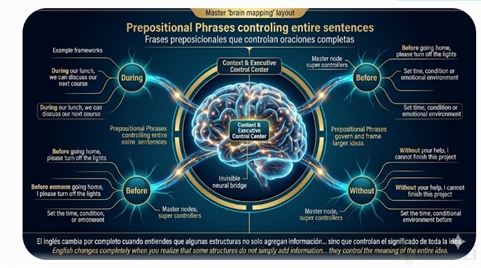
Frases preposicionales que controlan oraciones
Contenido del curso

Preposiciones de tiempo en Inglés


Preposiciones de lugar en Inglés



Preposiciones de movimiento y dirección en Inglés


Frases con preposiciones en Inglés


Practica el uso de preposiciones

Recursos
Resumen
En inglés existen frases preposicionales que no solo acompañan a un sustantivo o verbo, sino que controlan toda la oración que viene después. Entender cómo funcionan te ayuda a dar contexto, precisión y naturalidad cuando hablas o escribes, sobre todo si quieres sonar más claro al dar instrucciones o hacer planes.
¿Qué es una frase preposicional que controla toda la oración?
Es una estructura que empieza con una preposición y un sustantivo o gerundio, y que funciona como un marco de información para lo que sigue. No solo modifica una palabra, sino que gobierna la frase completa que aparece después.
Mira este ejemplo que compartió Ravi en clase: During our lunch, we can discuss our next course. Aquí, during es la preposición y lunch es el sustantivo que controla. Pero juntas, during our lunch, le dan sentido y contexto a todo lo que sigue: we can discuss our next course.
Si quitas esa frase preposicional y dices solo we can discuss our next course, la otra persona se queda con la duda: ¿cuándo?, ¿de qué hablas? Por eso este tipo de frases son tan útiles, porque anclan la información en un momento, lugar o condición específica.
¿Qué hace una frase preposicional al inicio de una oración? Funciona como un marco que da contexto temporal, espacial o condicional al resto de la oración. Sin ella, la frase principal puede sonar incompleta o confusa.
¿Cómo identificar este tipo de frases preposicionales en una conversación?
La pista está en cómo se conectan con el resto. Si quitas la frase preposicional y la oración pierde claridad o deja preguntas en el aire, entonces esa frase está cumpliendo el papel de controlar todo lo que sigue.
Ravi compartió otro ejemplo claro [01:05]: Before going home, please turn off the lights. Si solo dices please turn off the lights, la otra persona puede pensar que estás siendo raro o que no tiene sentido pedirlo en ese momento. Pero al añadir before going home, la instrucción cobra lógica: hay un momento específico en el que debe ocurrir.
Fíjate en el patrón:
- Empieza con una preposición como during, before, after, in, on.
- Le sigue un sustantivo o un verbo en gerundio (lunch, going home).
- Después viene una coma.
- Y luego la oración principal con sujeto y verbo.
¿Cuál es la diferencia entre una preposición común y una frase preposicional que controla la oración? Una preposición común conecta dos palabras dentro de la oración. Una frase preposicional controladora se coloca al inicio y le da contexto a todo lo que sigue después de la coma.
¿Por qué importa dominar estas estructuras al hablar inglés?
Porque te permiten dar instrucciones, hacer planes y compartir ideas con precisión. Sin ellas, tus oraciones pueden sonar incompletas o forzar a tu interlocutor a pedir más información.
Usar bien frases como during our lunch o before going home es lo que diferencia a alguien que traduce palabra por palabra de alguien que comunica ideas completas. Y aquí viene lo interesante: una vez que las identificas, empiezas a notarlas en películas, podcasts y conversaciones reales en inglés.
Para reforzar esta práctica, ve a la parte cuatro de tu workbook y trabaja los ejercicios de repaso. Después nos vemos en la última clase para cerrar el curso con la información final que necesitas. ¿Qué frase preposicional vas a empezar a usar primero en tus conversaciones?