Preposiciones de Lugar: Uso de Sobre, Encima y Dentro
Clase 7 de 18 • Audio Curso de Inglés para el Uso de Preposiciones
Contenido del curso
Clase 7 de 18 • Audio Curso de Inglés para el Uso de Preposiciones
Contenido del curso

Jorge Francesco Ferdinand Meza Mallma

Gabriel Obregón

Kary Alexandra Herrera Romero

Lisi Leonor Cavagna
Alejandro Zuñiga Saavedra

ESTEFANIA VILLANUEVA ROJAS
Milagro delcarmen coreas cruz

Paty Burgos

Ruben Dario Leon Rivera

Ammy Hiraldo Peña

Alfonso Galeano Conde

Claudia Arrieta Palis

Daniela Eunice Mejia Martinez
Alejandro Thome loera

Mario Roberto Aragón

Jose Martínez
Jorge Resendiz

Lina Karina Martínez Romero

Andres Felipe Cogollo Hincapie

Nidia Emilse Montañez Arevalo
When to use "on":
There is a book on the table.
The picture is on the wall.
The cat is sleeping on the sofa.
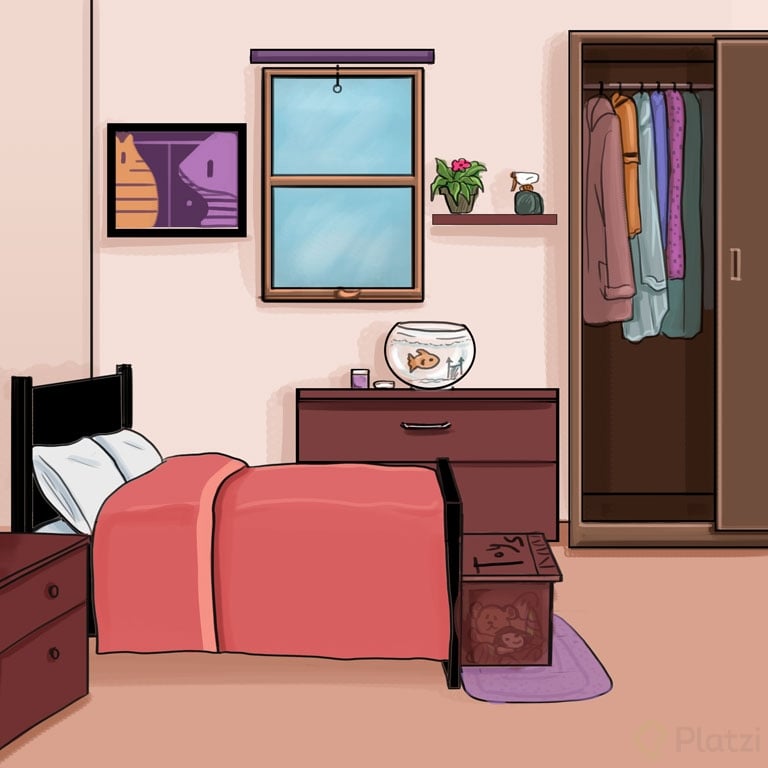
The fan is above the bed.
The clock is above the door.
The keys are in the drawer.
The food is in the refrigerator.
In my room I always can find my best dresses inside the closet, also I can take time to water the plants that are located in the shelves. The things that I use for my skin care are inside the principal drawer.
Cómo usar “on”, “in” y “above”
Practice:
Go around your house and identify some objects with which you can use the prepositions on, above, and in.
- I can see there’s a speaker on my desk.
- I can see there’s a monitor on my desk.
- There’s a mirror above the dresser.
- There’s a wall clock above the dining table.
- I can see a glass in that case.
- I can see nail tools in the plastic bag.
my computer is on the desk,
my sister's picture is above of the desk
my husband's chair is on the left of mine
the tea's bag is in the glass
My books is on the desk.
My tv is above of the fridge.
The chair is on the right.
My celphon is on the table
The smart TV is on the wall
My night suit is in the drawer
My examples:
My laptop is on the left of the monitor
The keyboard in on the desk
My drees is insede the closet
The uncle Luis is in Spain
Here where I am there's a computer on the desk and a cord over the computer, there's a pencil case on the desk and pen, highlighters and pencils inside the pencil case.
In my living room there is a computer on the desk, a picture above the furniture, a plant on the coffee table, and a mirror above the dinner table.
In my room the TV is on the console table. There are also some books in the console table cabinets, and the air conditioner os above the TV.
Right now my computer is on the table
i can see there is computer on my desk , there is a radio above the desk , some markers in the drawer
My phone is on the table.
The shirts are inside the closet.
I'm on the chair in my house, in my room.
My keyboard is on my desk.
My clock is about the desk
Estos ejemplos muestran el uso de las preposiciones "sobre", "encima" y "dentro" en diferentes contextos.
Excdelent class!
I can see the monitor on the desk They cutlery is in the drawer the shelf is above the tablet they pizza is inside the oven
The TV is above the closet
There is a lamp and two books on the table
The colors are in the drawer
There are many books in the library
I have a plant on the desk
There is a mirror over the sink
The painting is on the right of the desk
In my house, there is a watch on the wall


