Understanding when to use "the" can feel tricky, but the rule behind it is simpler than you might expect. This small word is one of the most frequently used in English, and mastering it will make your sentences sound natural and precise.
How do we decide between "a", "an", and "the"?
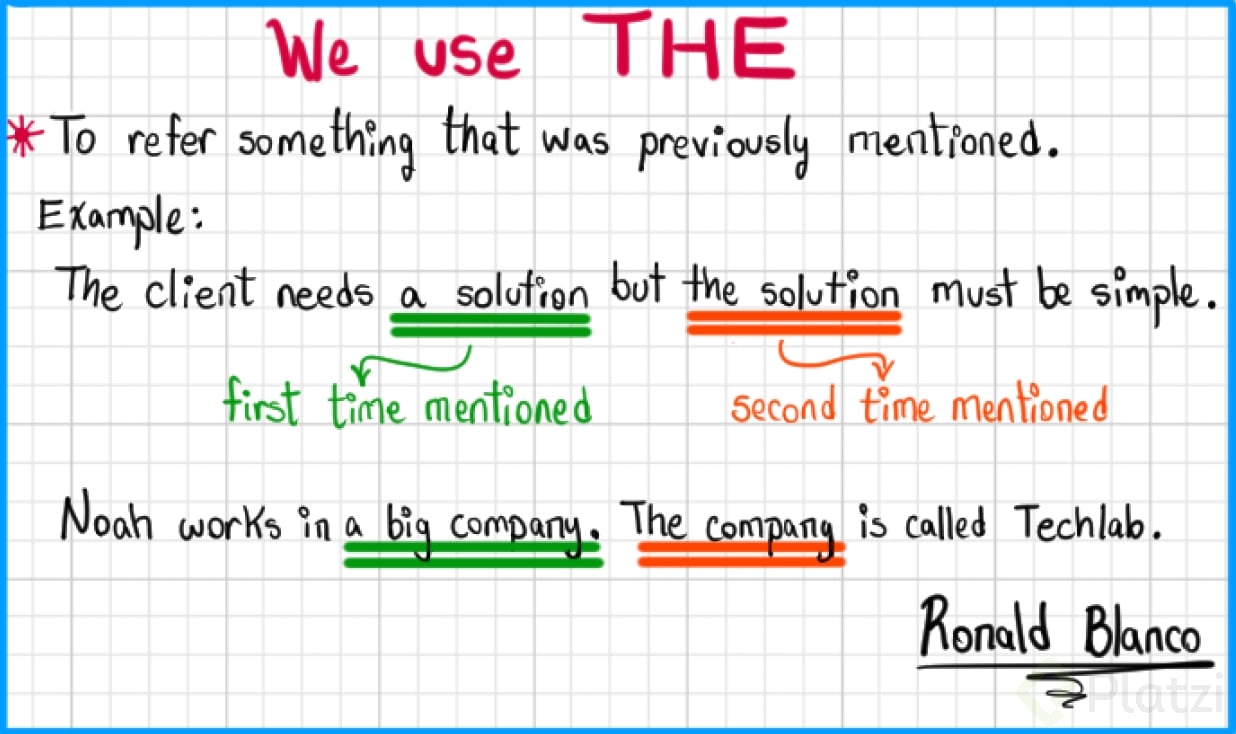
The key idea is straightforward: use "a" or "an" the first time you mention a noun, and use "the" when that noun appears again [0:52]. This is because "the" refers to something previously mentioned, something both the speaker and the listener already know about.
Look at these examples from the lesson:
- "We have a small office in the new building. The office is very modern." [0:38]
- "Paul sent an email late at night. The email had urgent updates on the project." [0:52]
- "Chandler bought a chair. I think the chair is too expensive." [1:10]
In every case, the pattern is the same: the noun is introduced with "a" or "an", and when it comes back, it switches to "the".
What is the difference between "a" and "an"?
Both are indefinite articles, used when a noun is mentioned for the first time. The difference depends on the sound that follows:
- Use "a" before a consonant sound: a file, a chair, a solution.
- Use "an" before a vowel sound: an apple, an email [1:40].
Once that noun reappears in the conversation, you replace "a" or "an" with "the" — the definite article — because now the listener knows exactly which one you mean.
How do you pronounce "the" correctly?
There are two pronunciations of "the," and they depend on the sound of the next word [1:55].
- Before a vowel sound, pronounce it as /ðiː/ (rhymes with "free"): the assistant, the engineer, the email, the interview, the operation.
- Before a consonant sound, pronounce it as /ðə/ (a short, neutral sound): the charger, the salary, the deadline, the training, the supervisor [2:15].
This distinction is subtle but makes a real difference in fluency.
How does this rule work in longer texts?
Let's see a more complete example [2:50]:
- "Noah works in a big company. The company is called Tech Lab, and it's located in Toronto, a city in Canada."
- "Noah has received a lot of feedback. The feedback has helped him improve."
Notice the pattern repeating naturally:
- First mention → "a" or "an."
- Second mention → "the."
This rule applies in both spoken and written English, whether you are drafting an email at work or having a casual conversation.
Quick reference for practice
- A/An = introduces something new.
- The = refers back to something already known.
- Pronunciation of "the" changes based on the next sound: vowel or consonant.
Try writing your own pairs of sentences using this pattern — first introduce a noun with "a" or "an," then refer to it again with "the." Share your examples in the comments and see how natural they sound!