
Can, And, But: Connect English Ideas
Curso de Inglés Básico A2: Adverbios y Expresiones de Tiempo
Contenido del curso

Talking About Places and Things


Talking About Time

Frequency and Habits

Can, And, But: Connect English Ideas
Can, And, But: Connect English Ideas
Curso de Inglés Básico A2: Adverbios y Expresiones de Tiempo
Contenido del curso

Argenis Anibal Chacón Urbina

NICOLLE ANDREA ZULETA IBARRA

JAVIER VILLEGAS FLORES

Leonardo Fabio Valenzuela Muñoz

Jaime Alberto Argueta Maravilla

Diego Andres Benitez

Javier Ramos
Ana Marcela Leon Merino

Yenniana Briceño

Alejandro José Hugo Escalante Santos

Francisco Javier Pineda Giraldo

Rosa Cándida Clímaco

María del Consuelo Irastorza Vázquez

ANDREA ELIZABETH SANTIAGO MEJIA
NATALY MARLENI GOMEZ BAUTISTA
Yaritza Jazmin Sanchez Rosa
Yaritza Jazmin Sanchez Rosa
Yaritza Jazmin Sanchez Rosa
Yaritza Jazmin Sanchez Rosa
Yaritza Jazmin Sanchez Rosa
I'm excited about this new course 😁
I love the new courses
lets do it
Thank you
Excersise,
I can play the guitar but i can't play the drums, sometimes i play the flute too
New english course and I'm so exciting to learn a lot. Here I go.
Yes! another English course with the great Adriana
hola and ,but ,can
Hola
I can`t study English thonigth but i cant study every day
Interesting topic.
Hi Vicky, why use you resumen and not summary, in this lesson?
Hello, I stady english sometimes, I like your way to explain it.
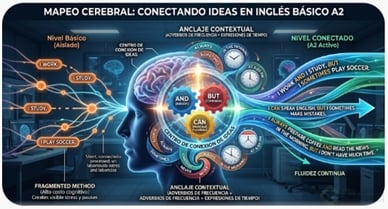
The pedagogical design of this class focuses on eliminating unnecessary pauses and breaking the "robot-like" dynamic when speaking. The goal set by the instruction is not to teach you isolated words, but to transform isolated ideas ("I work. I study.") into a continuous, fluent, and purposeful chain of thought ("I work and I study, but I sometimes play soccer.").
The differential value will lie in how we combine logical connectors (and, but, can) with contextual markers (time expressions and adverbs of frequency). The pedagogical intention is clear: to move from reactive grammar to the intentional design of sentences.
By mastering connectors like and / but along with expressions of frequency and time, you achieve two strategic benefits:
1. Processing time gain: Connecting ideas gives you room to plan the next sentence without stopping your speech rhythm.
2. Transmission of intention: A native listener does not just look for isolated information; they seek to understand the relationship between your ideas (addition, contrast, habit, or exception).
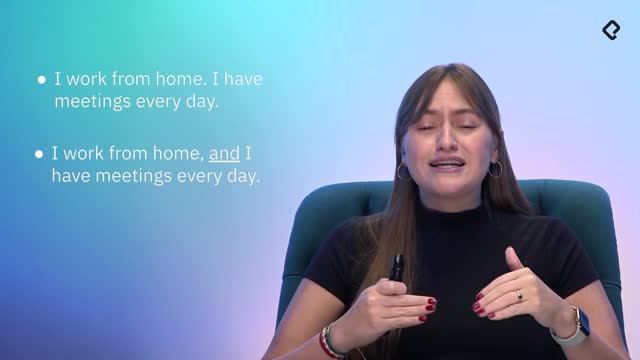
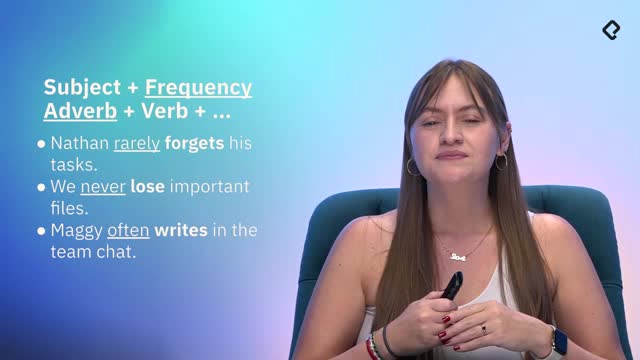
I study English. I practice daily. I study English and I always practice daily. I can speak English. I make mistakes. I can speak English, but I sometimes make mistakes.
What happens if I only use short sentences?
Relying solely on short, isolated sentences can make your communication feel abrupt, basic, and slightly unnatural to native speakers. While it gets the basic point across, it lacks the rhythm and emotional nuance that connected ideas provide. Upgrading to complex sentences instantly elevates your speaking level and helps you express deeper, more complete thoughts.
New english course and I'm so exciting to learn a lot. Here I go.
When should I use but over and?
You should use and to add similar information or build upon a thought, while but is perfect for introducing a contrast or an exception. For example, if you love your job but hate the commute, the word but perfectly highlights that unexpected shift in emotion. It creates a dynamic tension in your sentences that keeps the listener interested.
Why is it better to connect sentences?
Connecting your ideas transforms your speech from sounding like a robotic list into a natural, flowing conversation. By linking thoughts together, you show fluency and make it much easier for native speakers to follow your story without feeling interrupted. It is the fastest way to sound more advanced using the vocabulary you already know.
What happens if I only use short sentences?
Relying solely on short, isolated sentences can make your communication feel abrupt, basic, and slightly unnatural to native speakers. While it gets the basic point across, it lacks the rhythm and emotional nuance that connected ideas provide. Upgrading to complex sentences instantly elevates your speaking level and helps you express deeper, more complete thoughts.
How do time expressions improve my English?
Time expressions act like a GPS for your listener, giving them the exact context of when an action happens. Instead of just stating a bare fact, adding phrases like in the morning paints a vivid picture of your daily routines and habits. This extra layer of detail makes your communication significantly more precise and engaging.
Can I use this for professional emails?
Absolutely, using these linking words is essential for writing clear and professional emails that flow logically. They help you combine project updates or contrast data points smoothly, preventing your message from looking like a choppy list of bullet points. This makes your written communication look much more polished and sophisticated to your colleagues.