
Frequency adverbs in English with percentages
Curso de Inglés Básico A2: Adverbios y Expresiones de Tiempo
Contenido del curso


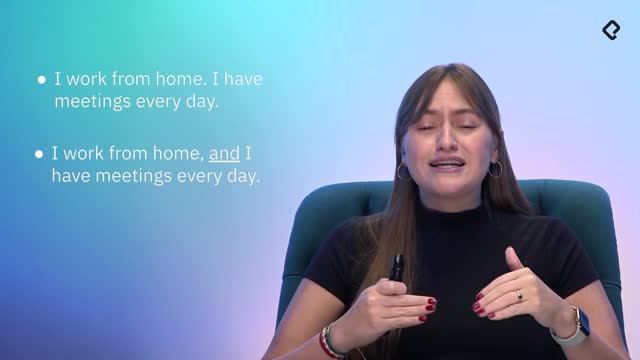
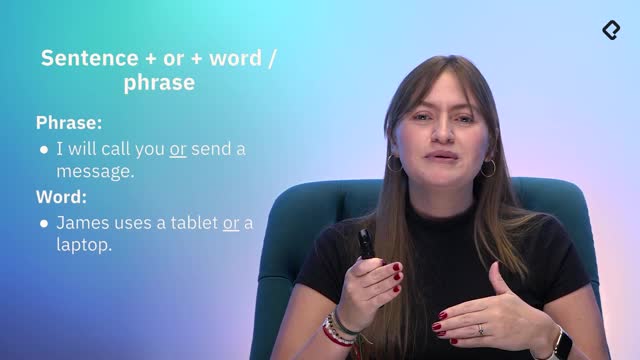
Talking About Places and Things
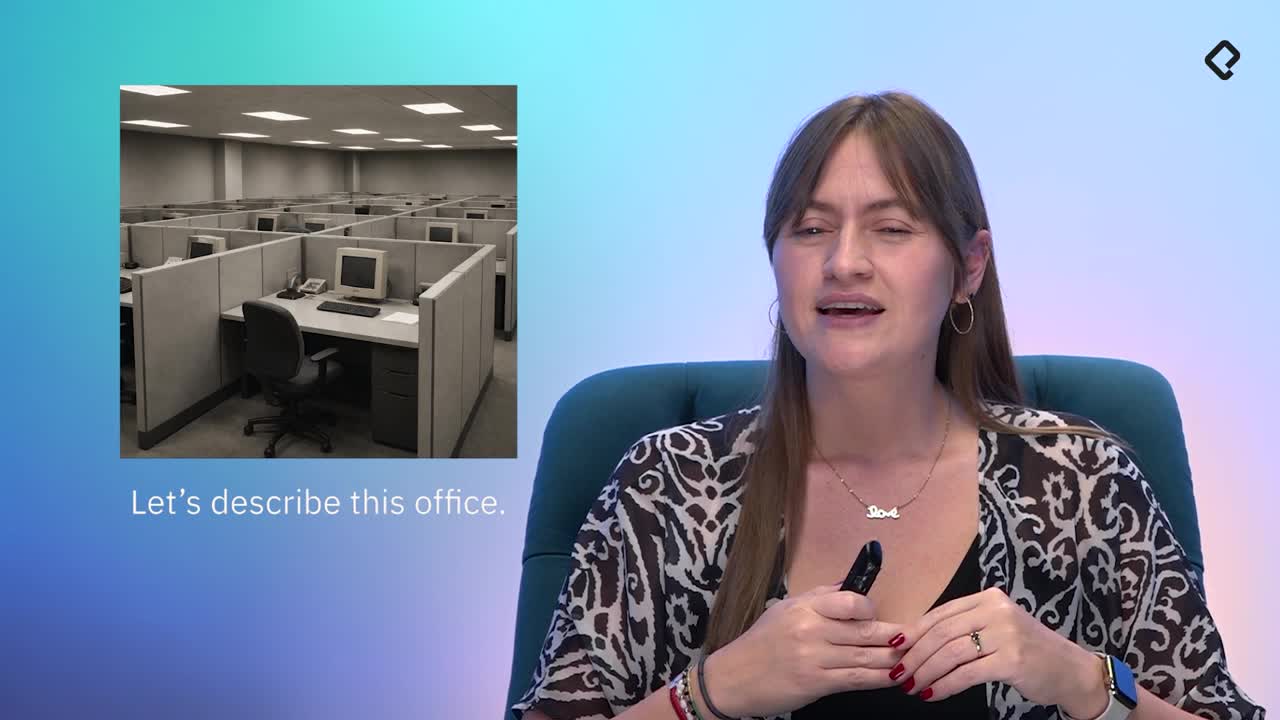



Talking About Time
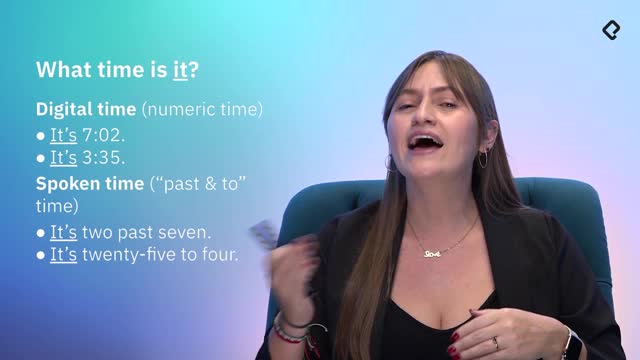
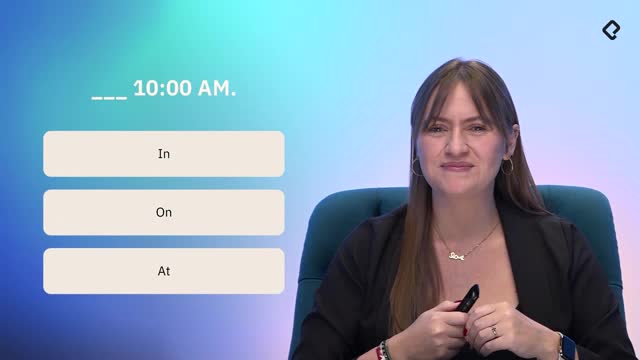
Frequency and Habits
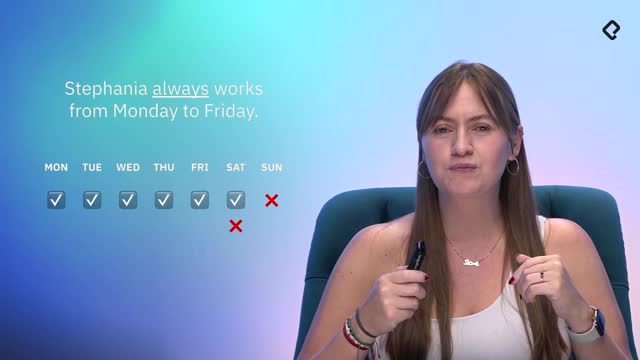



Frequency adverbs in English with percentages
Frequency adverbs in English with percentages
Curso de Inglés Básico A2: Adverbios y Expresiones de Tiempo
Contenido del curso

CESAR IVAN URQUIZA RAMIREZ

Rubén Alejandro García Ibáñez

Johana Marcela Giraldo García

Osvaldo Navegante

LEIDY JHOHANA CORREA MURIEL

RAÚL ERNESTO VELÁSQUEZ VELASCO

Juan Jose Monsalve Marin

María del Consuelo Irastorza Vázquez
Nelson Flores

Gerardo Lopera

Willian Chávez

Maria Paulina Argueta de AYALA

Gabriel Arcila

BRENDA CAROLINA JAIMES GARDUÑO

Mery Katherine Gutierrez Niño

Williams Becker
Yaritza Jazmin Sanchez Rosa
Yaritza Jazmin Sanchez Rosa

Alexander Salvador Hernández Blanco

Kevin Alberto Polanco Cortez
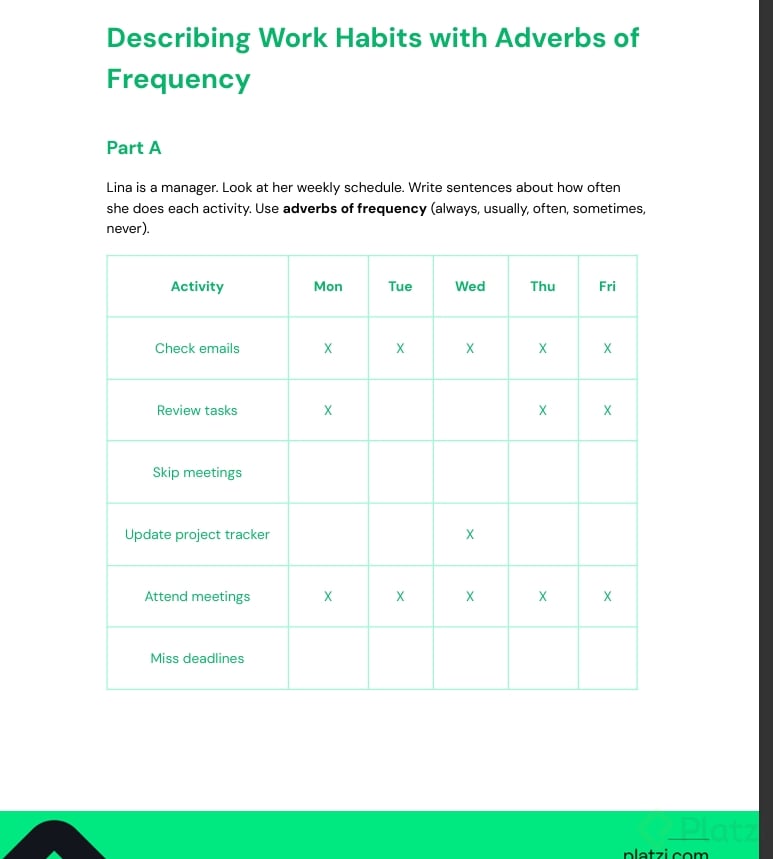
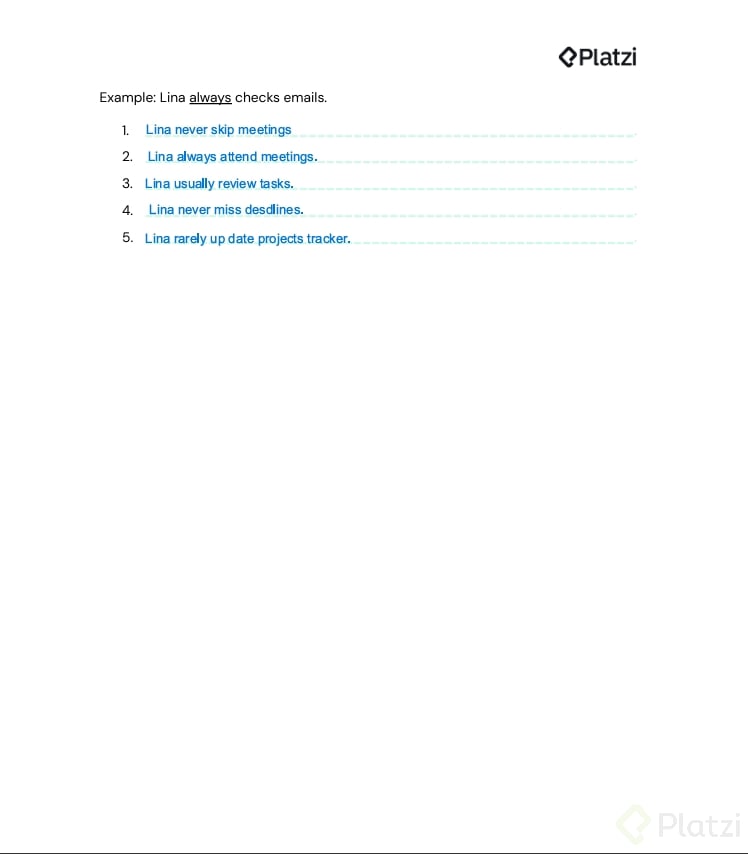
Lina always check emails
Lina sometimes review tasks
Lina never skip meetings
Lina rarely update project tracker
Lina always attend meetings
Lina never miss deadlines
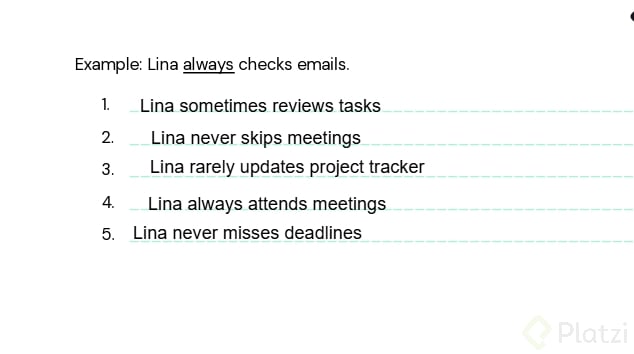
Lina always check emails
Lina sometimes review tasks
Lina never skip meetings
Lina rarely update project tracker
Lina always attend meetings
Lina never miss deadlines
i rarely go out with friends on nigth
i often arrived to my house at eight o´clock PM
I always go to the office on week
I always work every day
I often goto the gym
I rarely sleep afternon
I usually study english
Lina always check emails
She sometimes review tasks
She never skip meetings
She rarely update project tracker
She always attend meetings
She never miss deadlines
I rarely go to the gym because I don't have free time.
I ocasionaly cook for my family but when the food this is beef, I often cook at the brases.
She never responds to calls on the phone because of his work enclosure.
I always work from Monday through Friday.
I usually bring my lunch to the office.
I often go to the gym.
I sometimes practice sports with my sister.
I occasionally practice tennis.
I rarely buy lunch in the office.
I never sleep at the office.
Adverbs of frequency act as temporal precision metrics, quantifying habits and routines through a percentage gradient (from 100% to 0%) that standardizes operational communication.
3 Key Concepts
· Percentage Gradient: Establishes a numerical probability scale (Always 100%, Usually 90%, Often 70%, Sometimes 50%, Occasionally 30%, Rarely 15%, Never 0%) to eliminate ambiguity when describing behaviors.
· Structural Positioning: Their placement follows a fixed syntactic rule within the affirmative sentence: they are placed strictly between the subject and the main verb in its base form.
· Operational Precision: They allow for documenting the predictability of daily processes and corporate workflows without needing to resort to complex temporal structures.
Quantifying frequency with millimeter precision transforms planning and work reports into an exercise in high efficiency.
· In assigning responsibilities: Define clear expectations with your team using implicit percentages, for example: "The QA team usually runs tests on Mondays" (90%).
· In optimizing personal routines: Measure your own productivity and professional habits with the appropriate gradient, such as "I occasionally join calls from my phone" (30%).
· In risk mitigation: Communicate quality commitments with absolute forcefulness through the use of 0%, such as "We never miss a deadline."

give me phrasel verbs for doing sentces with adverbs of frecuency
We don't need fancy phrasal verbs here—everyday action verbs like log in, print out, or wrap up fit right into our frequency formula: subject, frequency adverb, verb, complement.
How often do you log in early? Try writing one sentence about your marketing office routine using usually.
my mother alway cooks dinner.
I never go to bedddd late,
I usually study inglesh at night.
I always go to the gym I never bought a house
I rarely run in the park
Pablo always check emails
He usually review tasks
He often skip meetings
he somethimes update project tracker
He occasionally attend meetings
He rarely miss deadlines
Can I use this for past habits?
Yes, you absolutely can use these adverbs with past tenses to describe routines you used to have. The structure remains exactly the same; you simply change the main verb to its past form, like saying 'I always drank coffee in college' instead of 'I always drink coffee.' Whether you often visited family or rarely studied, these words are perfect for painting a clear picture of your historical habits.
When should I use "hardly ever"?
You should use hardly ever exactly the same way you use rarely, as they are perfect synonyms representing that 15% frequency zone where an action is extremely uncommon. The choice between them comes down to rhythm; hardly ever sounds a bit more conversational and dramatic, making it great for emphasizing how unusual something is. Feel free to mix them up to make your spoken English sound more natural and dynamic!
No resulta que ya lo hice y tengo 13 de las 14 preguntas resueltas pero en la última pregunta no me da la opción de avanzar
Parece que el sistema se quedó esperando algo. A veces, si no marcaste una opción o falta un espacio, el botón de "enviar" o "avanzar" no se activa.
¿Revisaste si la última pregunta requiere que escribas una respuesta completa o si simplemente olvidaste seleccionar un círculo?
I always wake up earling.
I usualy take a break in my job.
Some times I study english
I Ocasionally sleep more than 8 haours