Understand how to use time expressions with confidence: learn when “this” points to the near past, the present, or the near future, and where to place it in real sentences like “This week, we launched the new app.” Speak naturally at work when discussing plans, updates, and meetings.
Why does “this” change meaning in time expressions?
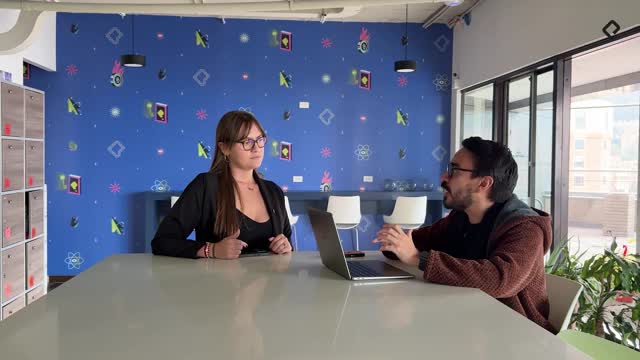
Using “this” signals closeness in time. The context tells if it is the near past, the present, or the near future. In the dialogue, key expressions appear naturally in a work setting: this morning, this week, and on Tuesday. These phrases help organize tasks and communicate status clearly.
- “This” can point backward to recent events. Examples: “I ran 10 kilometers this week.” “I walked my dog after work this evening.”
- “This” can describe what is happening now. Examples: “This week, I’m working on a new project.” “She is sick this week.”
- “This” can point forward to near-future plans. Examples: “This month, I plan to close a deal.” “I want to buy a new computer this evening.”
- Use with parts of the day: this morning, this afternoon, this evening. Not “this night”: say tonight.
- Use with short periods: this week, this weekend, this month.
- Use with days: this Wednesday, this Saturday, this Friday morning.
Which examples show each time reference?
Identify the timeline from the sentences in context.
- “We want to celebrate the victory this week.” Near future. It has not happened yet.
- “This morning, I went to the gym.” Near past. The action is finished.
- “Robert was in Brazil this Monday.” Near past. It refers to a recent day, not today.
- “I’m in the office this week.” Present. It describes the current period.
How to use “this” for past, present, and future?
A single word adapts to time through meaning. The skill is to map the action and its completion to the time phrase.
What indicates the near past with “this”?
- Completed actions in a recent period. Examples: “I ran 10 kilometers this week.” “I walked my dog after work this evening.”
- Clear end point signals the past: “I went to the gym.”
What indicates the present with “this”?
- Ongoing situations during a current period. Examples: “This week, I’m working on a new project.” “She is sick this week.”
- Progressive or simple present frames the “now”.
What indicates the near future with “this”?
- Plans or intentions close to now. Examples: “This month, I plan to close a deal.” “I want to buy a new computer this evening.”
- Verbs of intention or planning mark future meaning: want, plan.
Where should “this” go in a sentence?
Placement is flexible: start or end of the sentence. When it appears first, add a comma.
- Beginning position with comma. Example: “This week, we launched the new app.”
- End position without extra punctuation. Example: “I sent you the proposal this morning.”
Which time phrases are correct with “this”?
- Parts of the day: this morning, this afternoon, this evening. Use tonight instead of “this night”.
- Short periods: this week, this weekend, this month.
- Days and combinations: this Wednesday, this Saturday, this Friday morning.
What work vocabulary appears in the dialogue?
Boost communication at work with these keywords from the conversation and tasks described.
- outline (of the project): a general plan.
- feedback: comments from clients.
- final presentation: the last version to present.
- coordinate (details) with the developers: organize tasks with the team.
- test the final version: check the product before presenting.
- prepare the files: get documents ready.
- agenda (of the meeting): plan the order of topics.
- prototype: the model to show first.
- client and meeting: core business context words.
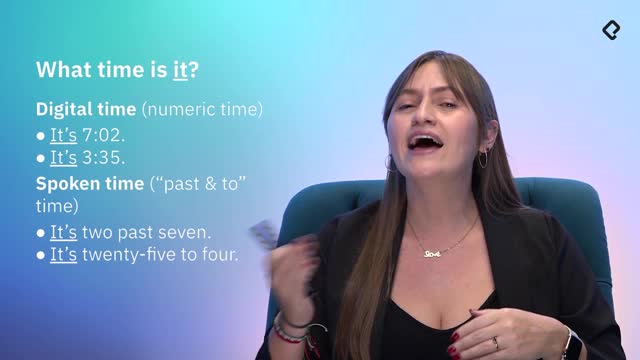
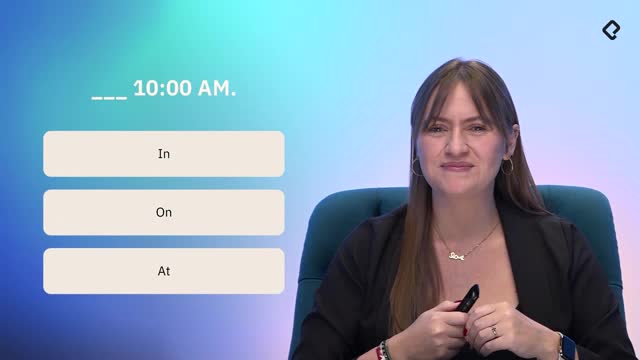
Key grammar covered in the module: telling time in spoken form, using prepositions in, on, at for dates and time, and mastering tasks with this in time expressions.
Want more examples with your own schedule or team updates? Share a few sentences and ask for quick feedback.